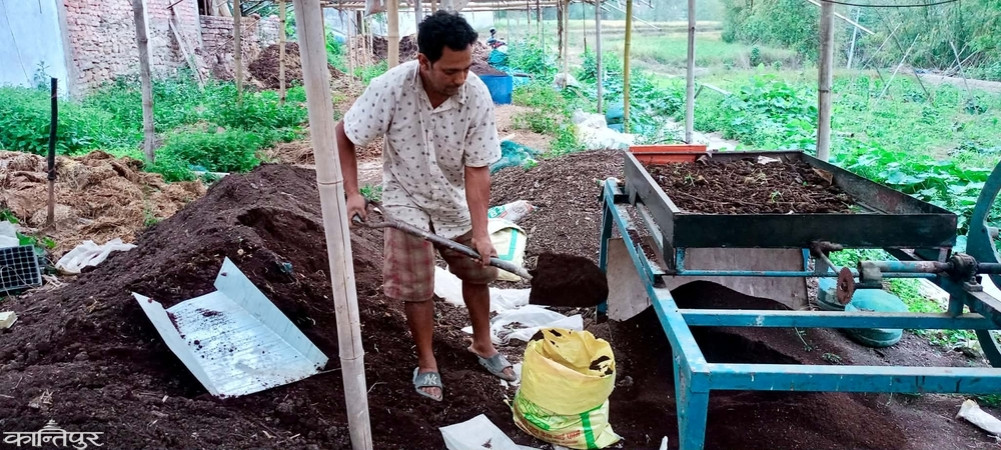
The use of termite manure has reduced farmers' dependence on chemical fertilizers, which has also helped increase production and income.
We use Google Cloud Translation Services. Google requires we provide the following disclaimer relating to use of this service:
This service may contain translations powered by Google. Google disclaims all warranties related to the translations, expressed or implied, including any warranties of accuracy, reliability, and any implied warranties of merchantability, fitness for a particular purpose, and noninfringement.
Madhu KC, a young farmer from Sandhikharka Municipality-7, Khanchikot, has been doing commercial farming for more than a decade and a half. He used to produce grains and vegetables by applying cow dung and urea to his fields.
Lately, he does not use chemical fertilizers. He uses wormwood fertilizer in vegetable farming and grain crops. ‘After using wormwood fertilizer in vegetable farming, the production has almost doubled,’ KC said, ‘Germwood fertilizer gives better yield than cow dung. We have also used this fertilizer in grain crops and fruit plants.’
Vegetables are grown in more than 15 ropanis of land. Vegetables are produced in plastic tunnels all year round. ‘Gargoomba, which used to yield four/five kilos with cow dung fertilizer, yielded seven kilos with wormwood fertilizer. The plants will be healthy, bear good fruit, and be healthy.’
There are seven dairy cows in his barn. More than 50 liters of milk are sold daily. He makes cow dung manure into worm castings. Vegetables are grown in the fields both inside and outside the tunnels for twelve months. ‘Income has also increased after worm castings gave higher yields,’ he said. ‘The turnover from the sale of vegetables, grains, milk and other items has increased by more than Rs 1.5 million per year.’ KC also sells worm castings. Last year, 60 quintals of manure were sold. It is sold for Rs 30 per kilogram. He said that farmers who cultivate rooftops in the market and also buy it for planting vegetables, fruits, and grains come to their homes. He said that there is a high demand for worm castings. In the past years, Sandhikharka Municipality had been buying the cow dung he produced and distributing it free to farmers.
Baburam Pandey of Argha has also been using cow dung in vegetable farming for two years. He has been cultivating vegetables for 16 years and said that the production of vegetables has doubled when he uses cow dung directly compared to cow dung.
He has been cultivating vegetables in a 60-ropani farm and said that his economic turnover has also increased after the production increased. His wife Rina said that cow dung is a good alternative to cow dung and chemical fertilizers. Cucumbers, cabbage, broccoli, gourds, and ghirau are now grown in his farm.
The National Agricultural Modernization Program is providing technical support to KC and Pandey to make cow dung. The program has now provided a machine to make cow dung. Senior Agriculture Officer of the program, Bishnu Bahadur Magrati, said that this fertilizer would be good for getting more production from less land.
Bhesh Bahadur Nepali of Dharapani village also cultivates vegetables using worm castings. Since worm castings keep the soil healthy, the crops are also healthy, said Buddhiraj Ghimire, head of the Agricultural Knowledge Center. 'This is a natural fertilizer,' he said, 'worm castings do not allow acidity in the soil. The soil remains healthy in the long run.'
He said that after the worm castings were good, a proposal was submitted to the Ministry of Agriculture and Land Management of the Lumbini Province Government for the upcoming budget to build 12 plants in 6 local levels of the district. He said that a program was proposed to prepare two models in one municipality. He said that fertilizer can be prepared by keeping worm castings in household kitchen waste and cow dung. He said that vermicompost should be used as an alternative to chemical fertilizers for organic production of crops and vegetables.