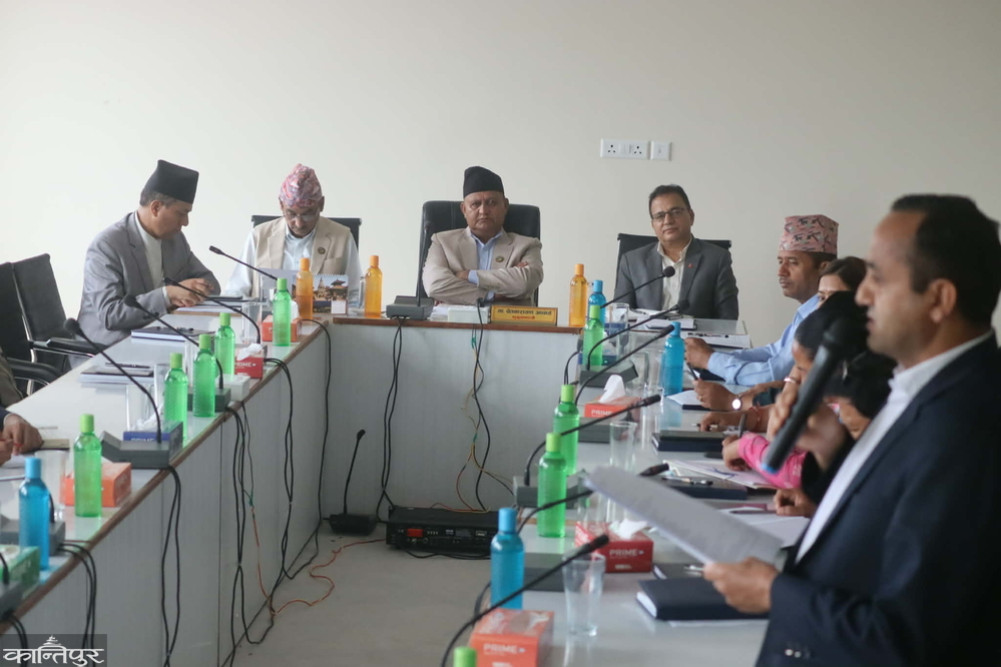
The lack of coordination between the provincial and local levels was evident as the council meeting was not convened after Magh 4, 2080.
We use Google Cloud Translation Services. Google requires we provide the following disclaimer relating to use of this service:
This service may contain translations powered by Google. Google disclaims all warranties related to the translations, expressed or implied, including any warranties of accuracy, reliability, and any implied warranties of merchantability, fitness for a particular purpose, and noninfringement.
The eighth meeting of the Lumbini Province Coordination Council, which plays the role of development, plan selection and advisory to the province, was held in Deukhuri, Dang after 28 months on Thursday. The seventh meeting of the council was held on Magh 4, 2080.
The council was formed with the aim of coordinating between the provincial government, local levels and concerned bodies. The council's working procedures state that a meeting will be held at least once a year. In addition, it is mentioned that the chairperson of the council and the chief minister of the province can call a meeting as needed. However, the meeting could not be held for 28 months due to the constant change of government in Lumbini Province and the need for the council could not be confirmed. The council has a provision that the chief minister chairperson, ministers of the provincial government, chief secretaries of the provincial government, heads/deputy heads of local levels of the province, and representatives of the district coordination committee will be members. The secretary of the office of the chief minister and the council of ministers will be members-secretaries of the council.
The council will coordinate development plans and programs between the province and local levels, facilitate cooperation between various ministries, government agencies and local governments in policy implementation, discuss and facilitate solutions to problems seen in the implementation of development projects, provide suggestions for the effective implementation of provincial-level priorities, budgets and plans, strengthen the interconnection and cooperation between the union, province and local levels, monitor and coordinate public service delivery, infrastructure development, social and economic programs, according to the working procedures.
Council Chairman and Lumbini Chief Minister Chet Narayan Acharya said that the meeting could not be held for a long time due to the impact of government changes, staff shortage and lack of coordination. 'We have been trying to call a meeting repeatedly since we came here, and an attempt was made even before last year's budget.' "What's not agreed upon?" he said. "That's why we have called a council meeting before the policy program and budget." He said that the suggestions given by the meeting will be implemented in the policy, program and budget, and that coordination and cooperation will continue in the coming days.
In Thursday's meeting, the policy program, budget formulation, coordination between the province and local levels, revenue management and employee management, among other issues, were discussed. The province has been facing a continuous shortage of employees. The meeting has decided to coordinate with the federal government for employee management. Local level people's representatives also raised issues of problems seen in the areas of plan selection, staff shortage, common rights, monitoring and budget distribution in the meeting. Similarly, in the meeting, council members and local government heads also suggested that the provincial government should select plans only from the project bank, discourage fragmented plans, and ensure effective coordination between the three levels of government.
Council member and District Coordination Committee Federation Lumbini President Dron Khatri suggested that increasing the institutional capacity of the province and building access roads to the municipality should be prioritized. Lumbini Province Municipality Association President Khildhwaj Panthi said that it is necessary to expand the scope of work on the issue of common rights. He drew the attention of the council, saying that there is a problem in moving forward many works due to the lack of effective coordination between the three levels of government. Similarly, National Federation of Rural Municipalities President Bishnukumar Giri said that programs should be focused in such a way that the presence of the provincial government is felt at the local level.
In response, Council President and Chief Minister Acharya said that the Lumbini Provincial Government has now put forward a clear policy to include only the projects included in the project bank in the budget and programs, clarifying that the provincial government will become 'ruthless' in plan selection and budget preparation. 'We have put forward the concept of the project bank through the work procedure,' he said, 'Therefore, it is no longer possible to go beyond the project and select plans.' The plans will be selected only on the basis of the method. He claimed that the provincial government will not accept plans costing less than Rs 3 million in infrastructure and plans costing less than Rs 1 million in other areas will not be kept at the provincial level. Chief Minister Acharya said that if there is a situation where plans up to Rs 5 million need to be taken forward, they will be sent to the local level through conditional grants. In the meeting, Minister for Economic Affairs and Planning Dhanendra Karki said that the budget will be prepared by prioritizing incomplete plans, multi-year plans and drinking water projects. He said that it would not be possible to go for new plans in the context of the shrinking budget. Provincial Chief Secretary Krishna Prasad Kapri and Vice President of the Provincial Planning Commission Dr. Dilliraj Aryal had said that the right selection of plans from the grassroots level is necessary to accelerate development activities and make service delivery effective. In the meeting, members of the council and heads of various municipalities also made various suggestions on the development problems seen at the local level, the impact of staff shortage and the work to be done by the provincial government.