The change in the income of the 21,971 households participating in the Family Income and Professionalism Enhancement Program is impressive. Comparing before and after the start of the Agriculture and Livestock Development Program, it is seen that the annual income of farmers has increased.
We use Google Cloud Translation Services. Google requires we provide the following disclaimer relating to use of this service:
This service may contain translations powered by Google. Google disclaims all warranties related to the translations, expressed or implied, including any warranties of accuracy, reliability, and any implied warranties of merchantability, fitness for a particular purpose, and noninfringement.
The work done by some local governments to commercialize the agriculture and animal husbandry sector is playing an important role in changing the lives of farmers.
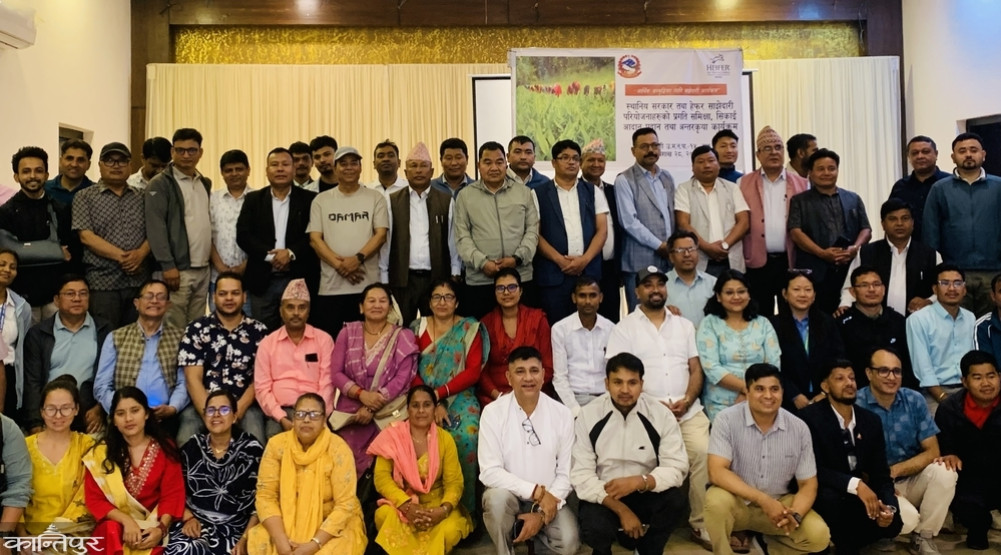
10 local levels of Dang, Rolpa and Pyuthan have gathered in Ghorahi to exchange learnings on this. A review has been conducted on the significant increase in investment by municipalities in the agriculture and animal husbandry sector. Local level data shows that the budget allocation for the agriculture and animal husbandry sector has increased by 59.7 percent compared to the fiscal year 2078/79.
In partnership with Heifer International Nepal, municipalities have been running agriculture and animal husbandry development programs since the fiscal year 2078/79. Every year, municipalities are increasing their budget in this sector and supporting farmers in commercial agriculture and animal husbandry. This program has been running in Garhwa, Rajpur, Dangisharan and Shantinagar of Dang. Similarly, the program has been implemented in Sunchhahari, Madi and Lungri rural municipalities of Rolpa and Airavati and Sarumarani rural municipalities of Pyuthan as well as Swargadwari Municipality.
The change in the income of 21,971 households participating in the family income and professionalization enhancement program is impressive. Comparing before and after the start of the agriculture and livestock development program, it is seen that the annual income of farmers has increased. The records of the municipalities show that goat farming has increased by 80.4 percent, vegetable farming by 198.8 percent, dairy production by 51 percent and sour fruits by 87.8 percent.
The annual income of 10 local levels has increased from 317.8 million to 596.7 million from the three-year program. ‘The program has not only increased economic income, but has also built strong social capital in the rural areas,’ said Yam Narayan Sharma Pokharel, chairman of Gadhwa rural municipality in Dang, ‘Farmers have succeeded in making agriculture and livestock farming income-generating.’ They have also been able to learn and teach about this.'
925 women's groups have been formed at 10 local levels, while 12 cooperatives have been registered and are working on agricultural and livestock development as well as making women entrepreneurs. 21 collection centers and 44 rural collection points have been established at the municipal level to facilitate marketing.
In the last fiscal year alone, a turnover of Rs 242.8 million was generated through collective marketing of goats, vegetables and milk through groups and cooperatives. The women in the groups encourage each other to engage in commercial animal husbandry by gifting goats and pigs. Currently, the group has 2,900 seed goats, goats and pigs as a gift fund. The market value of which is Rs 28 million. Considering the investment and return ratio, the additional income has reached Rs 27,128 with an investment of Rs 17,546 per household.
This data confirms that the agriculture-based partnership program is becoming a strong foundation for rural poverty alleviation and economic prosperity, said Dr. Tirtharaj Regmi, Director of Heifer International Nepal. ‘The foundation of Nepal’s rural economy is agriculture and animal husbandry, but due to the lack of traditional farming and market assurance, farmers had problems becoming professional,’ he said, ‘The partnership program for economic prosperity has played a role in bringing about changes in the living standards of rural farmers.’
In the past, it was alleged that most of the local budgets were focused only on physical infrastructure, but since the start of the agriculture and animal development partnership program, the priorities of the annual budgets of 10 municipalities have changed. According to the data of the municipalities, the budget allocation in the agriculture and animal development sector has increased by 59.7 percent compared to the fiscal year 2078/79.
In particular, Dangisharan Rural Municipality of Dang has allocated 7.2 percent of its total budget, Rajpur 6.1 percent, and Shantinagar 4.6 percent of its budget only on agriculture and animal husbandry. Municipalities are mobilizing a budget of around Rs 490 million to Rs 560 million annually, with agriculture as a top priority.
Bharat Kumar Thapa, chairman of Lungri Rural Municipality in Rolpa, said that this change has confirmed that local governments are not just committed to improving the income level of farmers in slogans but in practice. He said that the program has encouraged farmers to work in groups and based on commercial value chains, not in isolation.
Out of the total 19,835 households involved in the program, the highest percentage, 69.6 percent, is involved in goat farming. Similarly, 15.2 percent are involved in vegetable farming, 12.7 percent in dairy production, and 2.6 percent in sour fruit farming.
Out of the 59,525 households covered by the program, 88.7 percent are involved in agriculture, which is higher than the national average of 60.4 percent. This has helped establish agriculture as the main occupation in rural areas, said Basanta Khadka, vice-chairperson of Sarumarani Rural Municipality in Pyuthan. ‘The strongest aspect of the partnership program is the income that reaches the pockets of farmers,’ she said. ‘Now farmers have started saving in cooperatives by earning cash income from livestock and agriculture.’
Income from goat farming has increased from Rs 251.2 million annually three years ago to Rs 453.3 million now. Income from vegetable farming has increased by 198.8 percent to Rs 75.8 million. Income from milk sales has increased by 51 percent from Rs 32.4 million to Rs 49 million.
Tika Bishwakarma, a farmer from the Belghari Women’s Group in Rajpur Dang, said that farmers no longer have to rely on middlemen to sell their products. ‘The cooperative we have formed buys agricultural and livestock products,’ she said, ‘We get the right price, and we get cash as soon as we sell.’
Another farmer, Anju Sunar, said that this has made the concept of ‘small farmers, big market’ meaningful. ‘Small farmers set up big markets at the village markets and vegetable collection centers,’ she said, ‘The village’s produce is sold in the village itself.’ Shambhu Giri, chairman of Dangisharan Rural Municipality in Dang, said that he is working with the goal of increasing the investment and return ratio in the agricultural and livestock sectors from 1.5 to 2.7.