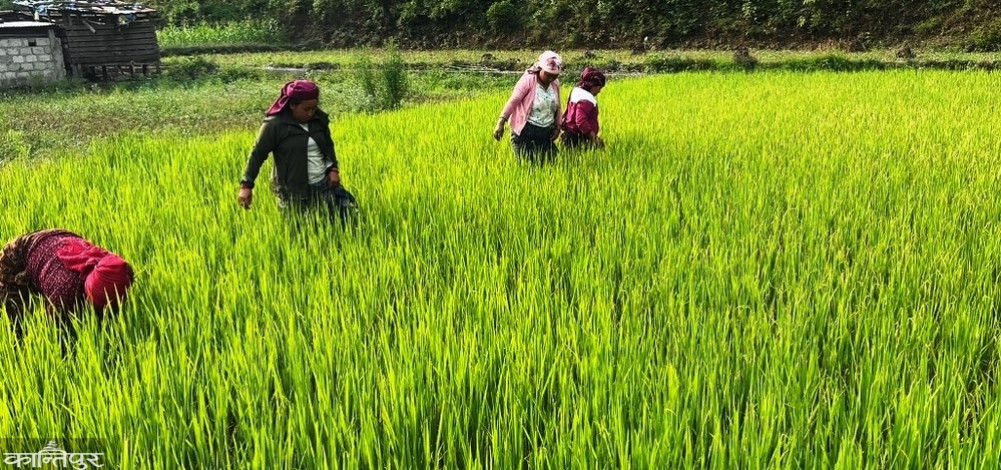
Farmers are worried about a decline in production after brown streaks and drying problems were observed on Chaite rice leaves in various rural municipalities of Palpa.
We use Google Cloud Translation Services. Google requires we provide the following disclaimer relating to use of this service:
This service may contain translations powered by Google. Google disclaims all warranties related to the translations, expressed or implied, including any warranties of accuracy, reliability, and any implied warranties of merchantability, fitness for a particular purpose, and noninfringement.
Farmers in Palpa are worried about the problem of long brown stripes appearing on the edges of the leaves and the tops drying out when sowing Chaite rice.
Farmers are worried about the decline in production after the disease spread to Chaite rice planted in Purbakhola, Rambha, Nisdi rural municipalities and Rampur municipality. Farmers have complained that the disease has been seen in rice crops planted in more than five hundred ropanis in Purbakhola Rural Municipality-3 Ringnerah.
Farmer Thamisara Pun of Purbakhola Rural Municipality-3 Ringnerah said that long brown stripes appear on the edges of the leaves and the tops dry up and turn red when sowing Chaite rice in the fields along the Purbakhola. She said, ‘Although this is seen in rice planted in Ashar, which ripens in Mangsir, this time it is worrying to see this phenomenon in Chaite rice.’
The disease has started spreading in the rice fields around Purvakhola since July. The disease, which was seen sporadically, has now spread everywhere. At first, it was slightly red and then gradually spread throughout the plant, said Sukmaya Baral of Purvakhola-3 Ringner. ‘The disease has spread to all the rice plants in recent days,’ she said, ‘Even the technician has not informed about this.’
The locals had previously used home remedies to treat the rice that ripens in November. Farmer Baral said that they used to make a solution of the grass of the forest and keep it. She said that the technician who came to check the rice in the field said that the bacteria was present.
The agriculture branch of Purvakhola rural municipality has advised people to visit the affected areas, collect samples and carry out home treatment. According to Chandani Chaudhary, head of the agriculture branch, it has been advised to keep cow dung in one/four parts. Agricultural technician Shir Bahadur Budha visited the farmers' fields and studied the disease. He said that he recommended it to the farmers because the municipality did not have medicine.
Farmers complain that the number of people planting Chaite rice is decreasing every year due to lack of medical treatment in case of disease, lack of irrigation canals, drying up of water sources in recent times, lack of workers, migration of young manpower, lack of encouragement from the local level and Agricultural Knowledge Center to farmers to plant Chaite rice. Until 10 years ago, Chaite rice was planted on 1,500 hectares. Local varieties of rice such as Chaite 2 and Chaite 3 are planted.
Chaite rice is planted in Purbakhola area, Boshi area of Kaligandaki, Nisdi, Arunkhola and other places. Rice planted in Chaite produces more than rice planted in Asar and is sweeter.