The conference concluded that with the development of information technology, its challenges are also increasing, and the entire media sector and society are being affected by false and misleading information coming through various social media platforms.
We use Google Cloud Translation Services. Google requires we provide the following disclaimer relating to use of this service:
This service may contain translations powered by Google. Google disclaims all warranties related to the translations, expressed or implied, including any warranties of accuracy, reliability, and any implied warranties of merchantability, fitness for a particular purpose, and noninfringement.
The three-day media churning and national media conference in Butwal ended on Monday with the issuance of the 15-point Butwal Declaration. The conference, organized by the Rupandehi branch of the Federation of Nepali Journalists, discussed the crisis facing the media and issues of national and local concern.
The declaration states that the Federation of Nepali Journalists is committed to protecting, promoting and upholding the constitutionally guaranteed rights to freedom of expression and full press freedom. Similarly, the declaration states that the federation, which is active with the interests of working journalists as its main goal, is firmly in favor of democracy, an independent judiciary and an accountable governance system and press freedom. The conference also urged the full implementation of the minimum wage, stating that ‘all parties should be committed to protecting press freedom, implementing the Working Journalists Act and the Right to Information.’
As the provincial and local levels have not shown interest in making laws related to communication for a decade after the country entered federalism, the conference has demanded that the provincial and local governments make such necessary laws as much as possible. The conference has also demanded that sufficient discussions and consultations be held with stakeholders while making such laws.
‘The act of limiting government advertisements to government media, which is against the constitution, law, international values, open market economic policy and the essence of federalism, is unacceptable. Therefore, we demand that the government immediately reverse its recent decision to publish and broadcast advertisements only in government media,’ the declaration states. The National Media Conference believes that this kind of government policy is an attempt by the government to indirectly control press freedom, said Dinesh Pandey, President of the Federation of Nepali Journalists.
‘This will weaken the private and community media outlets operating at the local level financially,’ he said, ‘and as a result, the employment of hundreds of local journalists, media workers, laborers and employees is in danger.’ He said that the conference has demanded that the government immediately revoke the decision and put an end to the current situation in government advertising, making the distribution of advertisements transparent, proportional and inclusive, and implementing a proportional advertising system for a long-term policy arrangement to protect and promote the crisis-hit media sector.
The conference concluded that with the development of information technology, its challenges are also increasing, and the entire media sector and society are affected by false and misleading information coming through various social media platforms. The conference has urged that such platforms be discouraged and professional media be encouraged. 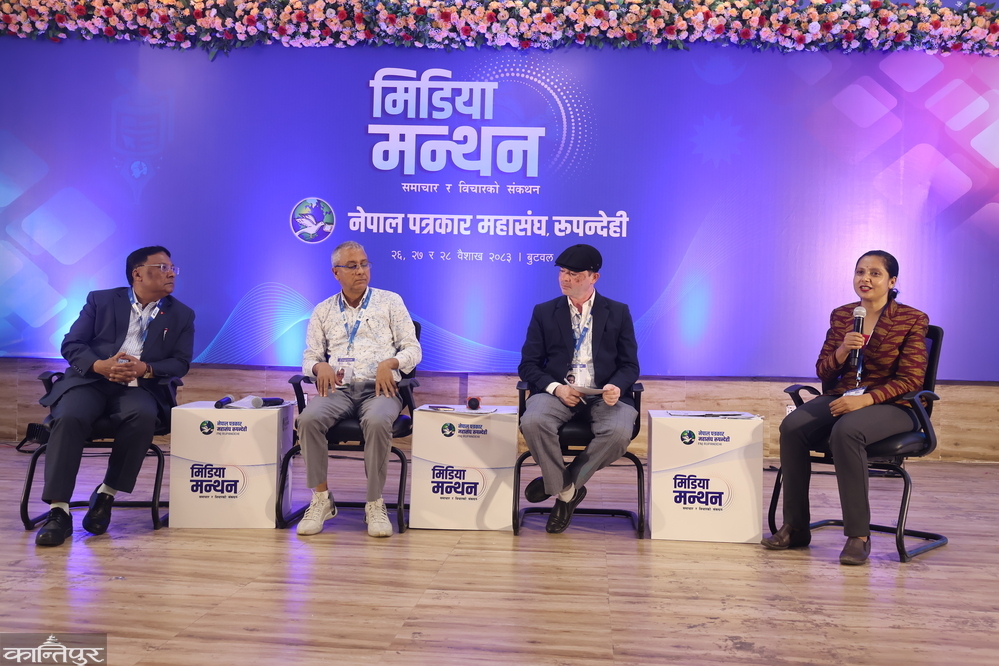
The necessary legal provisions to make the Communication Coordination Council formed by the Lumbini Provincial Government fully functional and effective, and the implementation of the communication-related programs, plans and budgets approved by the Provincial Government have also been demanded immediately. As the government has recently been forcibly evicting landless and squatters from structures in the name of public land management by using bulldozers, it has been demanded to stop this work and make alternative arrangements for the displaced.
The conference has demanded that the governments at all three levels and all the concerned bodies make special plans and effectively implement them for the development and promotion of Lumbini, the birthplace of Buddha, the land of world peace, and the protection and promotion of the historical, religious and cultural, and tourist areas of Rupandehi including the historical Jitgadhi Fort, Manimukunda Sen Garden, Siddha Baba Temple.
Discussions were held in 9 different sessions at the conference. Journalists Shiva Gaunle, Kishore Shrestha, Keshav Sharan Lamichhane spoke on the topic ‘Media in the midst of questions, how to win the hearts of readers, viewers and listeners’, journalists Bhuwan KC, Madhusudan Panthi, Poonam Poudel, Dipesh Tripathi spoke on the topic ‘The challenge of digital platforms over traditional media’, and Kantipur Media Group CEO Mahesh Swar, Butwal Today’s Managing Director Nawaraj Kunwar, News Agency Nepal’s Krishna Poudel, and Nepalgunj Daily’s Jhalak Gaire spoke on the topic ‘Media in an economic crisis, the way forward’.
Kantipur Media Group CEO Mahesh Swar said that the media was operated best in the years before COVID. ‘However, after the impact of COVID, it does not seem like any government has done much to uplift the media. However, we also have to move forward with the times. We have to go according to the demands of the next generation. We have to start talking about what journalism is. Journalists are not YouTubers,' he said, 'It is time for stronger journalism. Journalism will be there yesterday, today and tomorrow.'
'Local government, what is it doing, what should it be done' by Savitradevi Aryal, Ramkrishna Khand, Istihaq Ahmed Khan, Dhruv Kharel, 'How to save local media' by Balkrishna Chapagain, Ejaz Alam, Gautam Bhusal, Kalpana Tiwari, Kamal Rayamajhi, 'Media workers: Watchdog or political player' by Shiva Lamsal, Ganesh Pandey, Kamal Giri, Shyamlal Pokharel, Sher Bahadur BK, Ramchandra Shrestha, 'How does industry and business survive' by Hariprasad Aryal, Krishna Parajuli, Prakash Dhakal, Netra Acharya, Loknath Panthi, 'Lumbini's tourism: How to attract tourists and money' by Prachanda Bikram Neupane, Dr. Haridhwaj Rai, Kalpana Harijan, Sagar Adhikari and Dr. Suresh Acharya, Neetu Pandit, Uday Bahadur Rana and Binod Pahadi brainstormed ideas on the topic of 'What should be the media policy?'

