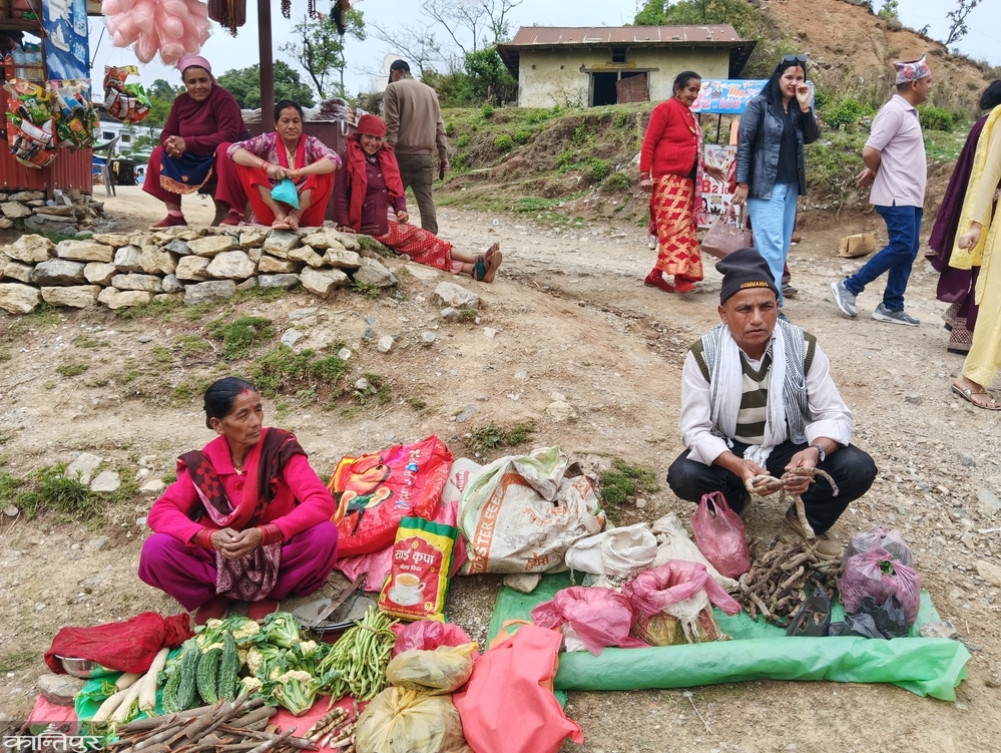
As tourists started going door to door looking for vegetables, food items, and herbs, locals started bringing them to the market and selling them.
We use Google Cloud Translation Services. Google requires we provide the following disclaimer relating to use of this service:
This service may contain translations powered by Google. Google disclaims all warranties related to the translations, expressed or implied, including any warranties of accuracy, reliability, and any implied warranties of merchantability, fitness for a particular purpose, and noninfringement.
Local Man Bahadur Rayamajhi has spread sacks and plastic bags near the Narpani picnic spot on the Sandhikharka-Gorusinghe road section and has kept local household herbs and vegetables for sale. His customers are tourists who have visited Narpani. He sells
sisno, sisno dust, Pakhanved, Timur and vegetables daily. 'I grow vegetables in my own garden,' he said, 'I have to search for herbs in the forest.' It has sold well.' After worshipping at the Supa Deurali temple, he comes to the Narpani picnic spot to receive prasad. He said that some people who visit and receive prasad buy vegetables and herbs and take them with them. He said that Pakhanved helps to heal when the body and limbs ache.
Timur, which is found in the forest, is delicious when mixed with dishes such as lentils, vegetables, meat, pickles, etc. . Many people buy Timur . ‘We have preserved the sisno on the banks of the fields and rivers,’ he said, ‘We collect the sisno, dry it, and make it into powder, and we also sell raw sisno . Before the influx of tourists in Narpani, the buffaloes used to eat the food such as iskus, farsi, sisno and so on and it would go to waste, now we sell it to tourists .’
He said that tourists from the Terai also buy the green vegetables produced in the cold place Narpani . He said that the money earned from the sale of vegetables and herbs is enough for the house to buy salt oil, the school expenses of his children, and his own pocket expenses . According to him, he earns 10 to 20 thousand rupees a month .
After finishing her morning chores and eating, Binkala Rayamajhi of Narpani packs cinnamon bark, bojo and vegetables in sacks and brings them to the road. She sells seasonal vegetables, fruits and herbs daily. ‘A handful of greens, coriander, ripe pumpkin and other food items are all sold,’ she said. ‘Nowadays, bringing things that go to waste and are eaten by buffaloes to Narpani and selling them has brought money in her hands. You have to be able to find them in the forest and grow them in the garden, anything is sold.’
Sometimes, she said, tourists go door to door in their vehicles and buy soybeans, corn, wheat, potatoes, ghee, milk and curd. They buy local chickens and goats before they can grow up at home and take them away. ‘Tourists buy dried fruits, gundruk, and masyaura,’ she said, ‘now they produce and take them to Narpani. Everything is sold.’
She said that she used to sell vegetables, fruits, and herbs to meet her household expenses. She does not spend two to four thousand rupees in her pocket. She said that she is also selling vegetables including bitter gourd, radish, and cabbage.
Hotels and resorts in the Narpani area also buy fresh vegetables from the village. Kaphal and ainsulu are also available. When tourists started going from house to house and looking for vegetables, food items, and herbs, the locals started bringing them to the market and selling them.
Young Pritam KC has produced a variety of vegetables in his home garden. In his vegetable garden, he has cultivated tomatoes, gourds, cauliflower, onions, and garlic. His products are sold at the local Narpani market. Tourists easily buy vegetables, goats, chickens and other products produced in cold places. ‘Tourists buy local products considering the food tasty and sweet,’ he said, ‘Farmers of Narpani and Khanchikot are becoming self-employed as they are earning good income from agricultural enterprises.’
The number of tourists visiting the Supa Deurali temple, located two kilometers from Narpani, and Narpani is increasing every year. He said that the demand for every item produced in Narpani is also increasing due to the increasing number of tourists.
Narpani tourism entrepreneur Padam KC said that the tourism sector is the only one that is developing the agricultural enterprises in this area. ‘The locals are excited when they go door to door and buy agricultural products,’ he said, ‘Locals are becoming self-employed through agriculture.’ If the three-tier government builds structures including tourism infrastructure to attract tourists to Narpani, the tourism business in this area will also grow.’