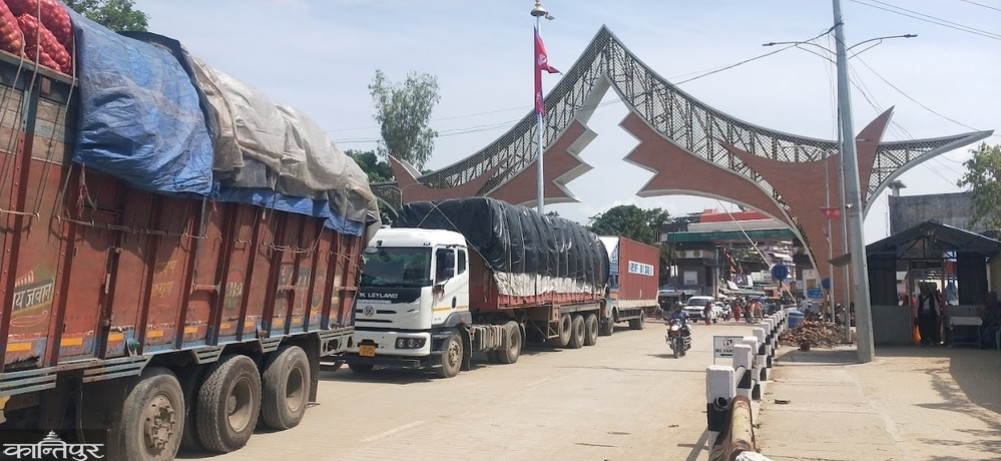
The Customs Department has facilitated that importers can import the imported goods immediately by making a written self-declaration with a commitment to affix labels with details including MRP, brand, and expiration date before selling and distributing them in the market.
We use Google Cloud Translation Services. Google requires we provide the following disclaimer relating to use of this service:
This service may contain translations powered by Google. Google disclaims all warranties related to the translations, expressed or implied, including any warranties of accuracy, reliability, and any implied warranties of merchantability, fitness for a particular purpose, and noninfringement.
The import process, which was made difficult by the rule requiring mandatory maximum retail price (MRP) to be mentioned at the customs point, has started from the Bhairahawa border post after the facilitation of the Customs Department.
The Customs Department has facilitated that importers can import immediately by making a written self-declaration with a commitment to affix labels with details such as MRP, brand and expiry date before selling and distributing the imported goods in the market.
Harihar Poudel, Chief of the Bhairahawa Customs Office, said that imports have started from Thursday after the Customs Department informed them verbally about the facilitation. “Businesses who have imported such goods have made a written self-declaration with a commitment at the customs,” Poudel said.
There is a demand that businesses should be allowed to affix labels with details such as MRP on imported goods in the warehouse.
In accordance with the letter of the Ministry of Industry, Commerce and Supplies dated Chaitra 30, the Department of Commerce issued a 15-day notice for the implementation of the rule, and since last Baisakh 14, the import process had become inconvenient after the import of goods without MRP was stopped at the customs.
The importers did not clear the imported goods at customs, citing the fact that this rule was implemented in a very short time, that goods had been ordered abroad for import before the rule was implemented, and that MRP could not be affixed for some goods.
When the importers did not clear the customs, such goods were stopped at customs and on the way for many days. According to the Nepal Customs Agents Association, Siddharthanagar, this rule stopped more than 400 goods loaded in vehicles at the Bhairahawa border without customs clearance.
The Department of Commerce had issued a 15-day notice on Chaitra 30 stating that it would ensure that labels with details such as the brand, MRP and expiry date of the product and other prepared goods imported from abroad for commercial purposes are displayed on the labels.
Strict enforcement was implemented at the customs point to implement the rule. According to the Bhairahawa Customs Office, imports from the Bhairahawa customs point had been decreasing since Baisakh 14 after the rule was implemented. After customs facilitation, more than 90 trucks of goods that were stopped have been released from customs by Thursday. On Thursday alone, the Bhairahawa Customs Office has recovered Rs 540 million in customs revenue. This recovery is the first since Baisakh 14, said Customs Chief Poudel.
Madhu Prasad Panthi, President of the Nepal Customs Agents Association, Siddharthanagar, said that the implementation of MRP has been complicated as goods imported from India and third countries have already been loaded and left for Nepal before the government issued the notification.
‘It takes months for goods imported from countries such as Japan and China to reach the customs checkpoint. However, the MRP was implemented on a short notice basis,’ Panthi said, ‘which has made it complicated to implement it for goods imported from far away.’