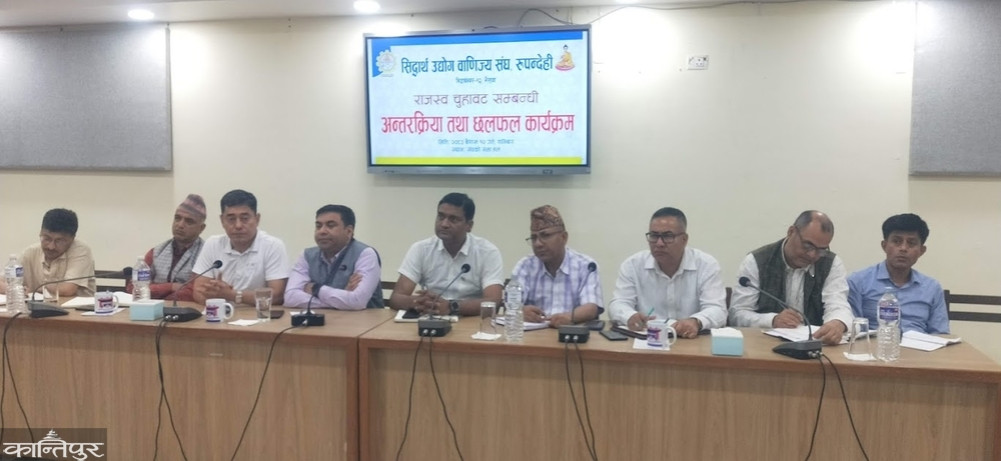
Businessmen participating in an interaction on revenue leakage organized at the Siddhartha Chamber of Commerce and Industry claimed that organized smuggling would not be possible without the cooperation of security and administrative bodies.
We use Google Cloud Translation Services. Google requires we provide the following disclaimer relating to use of this service:
This service may contain translations powered by Google. Google disclaims all warranties related to the translations, expressed or implied, including any warranties of accuracy, reliability, and any implied warranties of merchantability, fitness for a particular purpose, and noninfringement.
Businessmen in the Bhairahawa region have suggested that the tax rate should be reduced to control revenue leakage due to customs evasion due to open borders.
Due to the inability to control the open border with India, goods are being smuggled from India for commercial purposes without paying customs duties. Businessmen have also claimed that organized smuggling is not possible without the connivance of security and administrative bodies.
Businessmen participating in an interaction on revenue leakage organized at the Siddhartha Chamber of Commerce and Industry said that since the tax imposed on goods imported from India is high, the price of such goods in Nepal is very expensive, resulting in revenue leakage through smuggling. Businessmen say that since the tax on goods imported from India is high, illegal transactions are encouraged and this leads to large-scale revenue leakage.
Lumbini Province President of the Federation of Nepalese Chambers of Commerce and Industry Thakur Kumar Shrestha said that customs and other tax rates should be reduced to control revenue leakage. ‘Due to various taxes imposed during export, the price of the item should be determined in such a way that there is not much difference in the Nepali and Indian markets,’ Shrestha said. ‘To reduce revenue leakage and collect more revenue, the tax rate should be reduced and the scope should be increased.’ He said that the private sector is ready to cooperate with the government to increase the scope of the tax.
He claimed that not even a single chocolate can enter the country without customs clearance without the consent of the security agencies.
Chandraman Shrestha, the operator of Siddhartha Rice Industry, Bhalbari, said that it is necessary to adjust the customs rate. ‘If we have to discourage the import of any goods into Nepal, we will have to impose high taxes on the import of that goods,’ he said. ‘Otherwise, there will be stricter measures at the main customs checkpoints, but how is it possible to completely control such a long open border?’ He said that although there are many offices in Nepal that collect revenue, such as surveying, transportation, traffic, and land revenue, the service flow and good governance are weak.’
Former president of the Siddhartha Chamber of Commerce and Industry Bishnu Sharma said that when it comes to paying customs duties and conducting legal transactions, it is a hassle to coordinate with dozens of agencies, but smugglers directly import goods without paying customs duties. ‘The customs data does not show that ready-made garments have been imported, but there are foreign fabrics all over the market,’ Sharma said.
Senior vice-president of the association Dilip Kandu said that no one can deny the fact that smuggling is taking place with the connivance of the security agencies. A team including representatives from the Revenue Investigation Department, Internal Revenue Department, Nepal Police, and Armed Police Force, coordinated by Deputy Director General of the Customs Department, Bharatmani Pandey, has collected suggestions from local businessmen regarding the budget to be prepared for the fiscal year 2083/084. Cement and food businessman Hrishikesh Agrawal said that the items that are causing the most revenue leakage should be identified and a policy should be formulated accordingly.