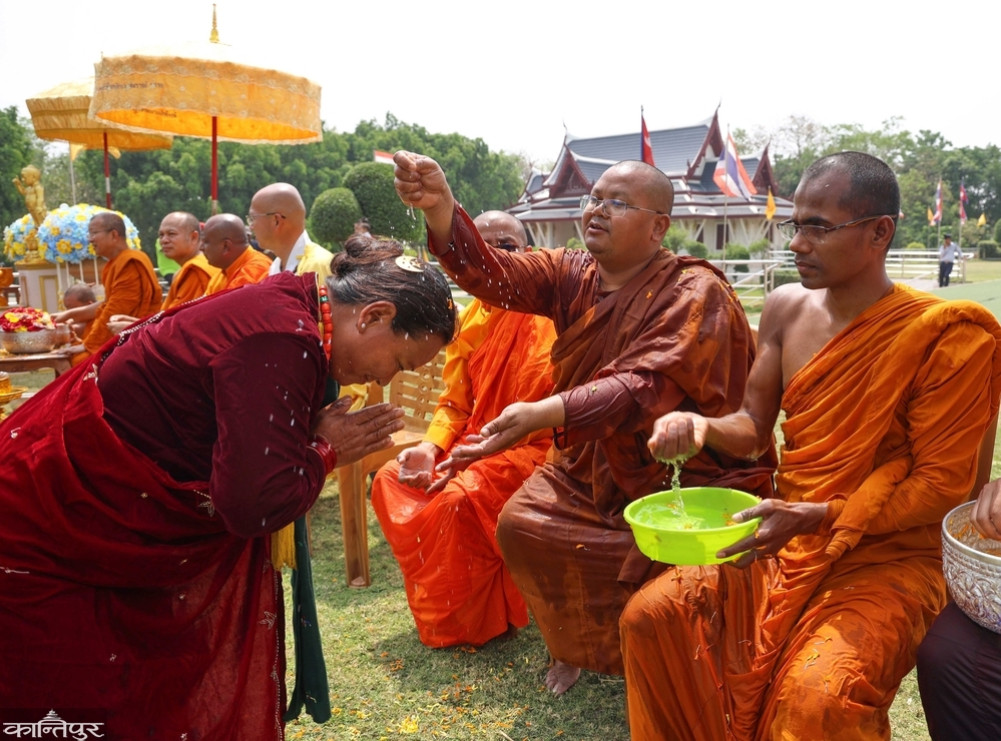
Siri Bazir, associate professor at Lumbini Buddhist University, said that the New Year was celebrated at the Royal Thai Monastery, taking blessings from the elders and treating the younger ones with compassion, friendship, and love.
We use Google Cloud Translation Services. Google requires we provide the following disclaimer relating to use of this service:
This service may contain translations powered by Google. Google disclaims all warranties related to the translations, expressed or implied, including any warranties of accuracy, reliability, and any implied warranties of merchantability, fitness for a particular purpose, and noninfringement.
While Nepalis are welcoming the New Year 2083, Thai citizens have also celebrated their New Year Songkran in Lumbini, the birthplace of Buddha, according to Thai tradition. In Thailand, the Songkran festival is celebrated as a festival to forget the sorrows and pains of the past year, to exchange joys with enthusiasm and enthusiasm, and to respect the elderly and family.
The New Year was celebrated at the Royal Thai Monastery by taking blessings from the elders and treating the younger ones with compassion, friendship, and love, said Siri Bazir, associate professor at Lumbini Buddhist University. On this occasion, monks, nuns, gurus, and nuns celebrated the Songkran festival by splashing holy water.
Worship was performed at the Baby Buddha near the Peace Lamp in Lumbini. On this occasion, the Baby Buddha was bathed and made holy by performing religious rituals. The monks, nuns, and male and female worshippers washed the feet of the baby Buddha and made them holy by pouring water from a one-and-a-half-meter-long brass pipe. Then the monks and nuns showered flowers.
The Paritran was recited for the happiness, peace, and well-being of all human life and beings. The new year was celebrated with the hope that the Thai New Year would bring new hope, success, and happiness to everyone, said Bhikkhu Binanda Thero, Lumbini branch chief of the Mahabodhi Society, Calcutta, Lumbini.
At the Royal Thai Monastery, people exchanged harmony, compassion, and friendship by sprinkling holy water mixed with fragrance and flowers. In Thailand, there is a tradition of celebrating the New Year for 3 to 7 days by organizing various programs nationwide. The monks and nuns, followers of peace, celebrated the New Year by organizing programs here.
The most famous aspect of the Songkran festival is the splashing of water to remove dirt and grime from the body and mind, and the exchange of mutual goodwill and friendship, said Phra Rajbodhi Bidesh Vajirasuddhi, head of the Royal Thai Monastery in Lumbini. The festival is celebrated by splashing water with fragrance and flowers, and enjoying the festival. 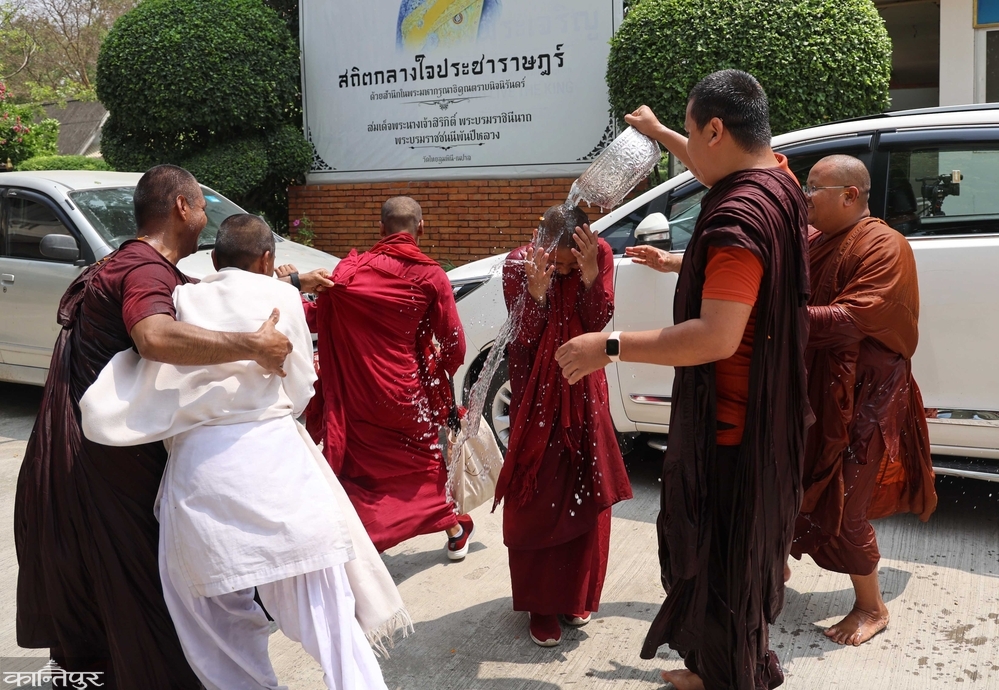
The monks and nuns said that Nepal and Thailand celebrating the New Year together as a festival has brought the two countries closer culturally. Phra Thamma Bodhiong, the Thai government's envoy to India and Nepal, said that this should be used as an opportunity to strengthen mutual friendship, unity and goodwill and work together for peace. The festival was attended by monks and nuns from countries including China, Myanmar, Sri Lanka, Cambodia, India, Germany and Vietnam in Lumbini.
Songkran, which was previously considered a Hindu festival, has transformed into a Buddhist festival with the change of time. Songkran has now become a major attraction for foreign tourists in Thailand. Songkran has also been recognized as a leading global festival by UNESCO. Furthermore, as a UNESCO-listed cultural heritage, the 2026 festival has been branded as a global Maha Songkran event.