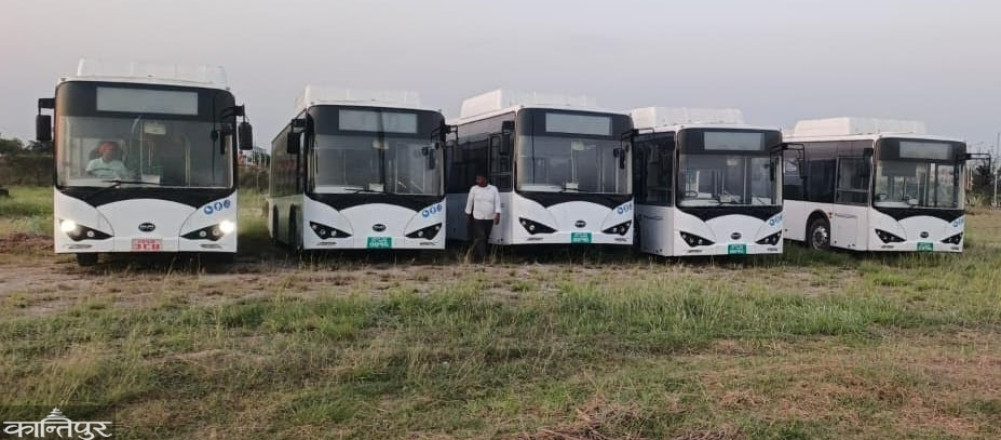
To connect the world with Lumbini, buses and vans have been provided to transport tourists and pilgrims from Gautam Buddha International Airport in Bhairahawa to Lumbini. Currently, the same five buses are parked at Gautam Buddha Airport.
We use Google Cloud Translation Services. Google requires we provide the following disclaimer relating to use of this service:
This service may contain translations powered by Google. Google disclaims all warranties related to the translations, expressed or implied, including any warranties of accuracy, reliability, and any implied warranties of merchantability, fitness for a particular purpose, and noninfringement.
The decision to operate the electric buses that were brought in for the Lumbini Development Fund five years ago has not been taken. The buses, which were brought into operation for two days after the instructions of the Office of the Prime Minister and Council of Ministers, have now been brought to the Civil Aviation Authority office in Bhairahawa and stored. The buses were stored at Gautam Buddha International Airport less than 48 hours after the fund put them into operation.
Locals protested when preparations were made to take the 5 buses that were left in the sun and rain to Kathmandu a week ago. Then, following the instructions of the Office of the Prime Minister and Council of Ministers, they were operated for two days. Two buses were operated on Chaitra 18 and 19. The buses operated on the Belahiya-Lumbini and Lumbini-Tilaurakot routes. On Chaitra 20, the fund handed over all the 5 buses along with a letter to the Civil Aviation Authority in Bhairahawa.
There is a struggle to operate five electric buses and 14 vans purchased under grant aid for tourist facilities. They have not been able to run smoothly since they entered the country. They were stranded because the fund could not operate them regularly, sometimes citing laws/rules, sometimes manpower and procedures as obstacles.
A month ago, the process of sending the buses to the Civil Aviation Authority in Kathmandu was initiated as per the secretary-level decision of the Ministry of Culture and Tourism. However, on Chaitra 16, an official from the Prime Minister's Office called and instructed to make arrangements to operate the buses in Lumbini. After that, the process of sending the buses was stopped, said Deepak Shrestha, member-secretary of the fund.
After learning that the buses and vans were being sent to Kathmandu, Arjun Kurmi and Shakil Ahmed Khale of Lumbini Cultural Municipality submitted a memorandum to the fund member-secretary Shrestha on Chaitra 16. Other locals had also warned of protests and agitation. On the same day, the Ministry of Tourism had asked for the buses to be delivered within 3 days for the second time. Before that, it had asked for the buses to be delivered within 7 days. An official of the fund said that due to lack of coordination between the Prime Minister's Office and the Ministry of Tourism, there was confusion about what to do with the fund at first. He said that the ministry's decision was later followed.
'The Prime Minister's Office did not object when the buses were delivered to the Civil Aviation Authority in Bhairahawa,' he said, 'I felt like I made the right decision.'
The fund has been hiding the fact that it sent the buses to Bhairahawa for repairs out of fear of local unrest. Binod Singh Rawat, information officer at Gautam Buddha Airport, said that the buses came under the Civil Aviation Authority as per the ministry's instructions. He said that he did not know for what purpose and why they were brought. In 2077 Mangsir and Poush, 14 state-of-the-art electric taxis (vans) and 5 buses came to Lumbini under the Clean Energy Project with the grant assistance of the Asian Development Bank. The cost of the buses and taxis is equivalent to 130 million rupees. The government had borne 35 million rupees in customs duty.
Shrestha, member-secretary of the fund, said that the decision made by the ministry has been implemented so far. ‘This means that the five buses of the fund that came for tourists will be used by the ministry and its subordinate bodies,’ he said. ‘Until the fund makes another decision, the decision of the ministry will be implemented.’ According to him, the fund’s board meeting is in Kathmandu on Friday. Fund board member Bishwaraj Poudel said that problems are arising due to the ministry interfering in many of the fund’s works. ‘There are buses and vehicles in the name of the fund.’ The fund has been paying the insurance amount every year,' he said, 'Why give the buses brought here for the convenience of tourists to the ministry?' He said that the vehicles brought with the help of donors to operate in the greater Lumbini area should be allowed to ply here.
The confusion over the number plate
Initially, the vehicles had government number plates. At that time, it was stated that there was no provision for renting jeeps (vans) and buses with government number plates. They received government number plates 16 months after they were brought here. The vehicles were transferred to the name of the Ministry of Tourism. The ministry handed over the taxis (vans) and buses to the fund. At that time, vehicles with government plates were not operated for tourists, saying that they could not be used for other purposes. Then, efforts were made to change the government number plates to green ones for tourists to ride.
The transport law does not allow for changing government vehicles with white number plates to green or any other plates, making it difficult for tourists to drive. After a long struggle, Ram Bikas Chaudhary of the Madhesh Human Rights Home, which is active in Lumbini, filed a writ petition in the Butwal bench of the Tulsipur High Court. After the court's order, green number plates were made in 2082 Baisakh. Even after the number plates were changed, the vehicles are not in a position to drive.
Rajan Basnet, Information Officer of the Lumbini Development Fund, said that there is currently a problem due to the lack of procedures for operating buses and vans. 'There are legal complications in allowing the private sector to operate,' he said, 'The fund does not have the manpower. The fund does not have the drivers and co-drivers to drive large buses and vans.' The fund is facing problems in paying salaries due to the poor financial condition of the fund.
Misuse by employees
Despite the delay in operating the vans citing various reasons, the fund's employees and officials are using them at will. Some of the fund's officials and employees are using the vehicles with green number plates to transport tourists for sightseeing with their family members and relatives.
Lumbini Hotel Association President Leelamani Poudel said that it is irresponsible and negligent for the fund's employees to not use buses and vans by making various excuses. He said that this shows that the fund is not tourism-friendly at all. The buses and vans were given to boost the tourism sector that was devastated after the 2072 BS earthquake and to provide facilities to tourists after the operation of the Gautam Buddha International Airport in Bhairahawa.
Local civic leader Arjun Kurmi said that problems are arising due to increasing party interference in the fund. 'The vice-chairman, member-secretary, treasurer and project manager are from four parties in the fund,' he said, 'they do not get along with each other.' That is why development work in Lumbini is always affected. We will not allow buses to go to Kathmandu under any circumstances,' he said, 'We will go on sit-ins, hunger strikes and protests.'
The monk-friendly Mahasthaveer said that there was a problem in recruiting us rather than good people who are capable and can lead in the Lumbini Development Fund. 'Due to political appointments, taxis (vans) and buses have not been operated,' he said.
Comfortable buses and taxis
Buses and taxis are comfortable. The large bus has 19 seats. It can accommodate up to 35 people standing. The small van is 5 seats. The fully air-conditioned bus is disabled-friendly. It has automatic doors. It has comfortable seats. It starts with a card. It is noiseless. Once fully charged, it can travel 400 km. There are large emergency doors. There is a bell button on the seat to stop the bus. When pressed, the driverless light turns on.
A state-of-the-art charging station has also been built for bus vans in front of Gate No. 2 with the help of ADB. To connect the world with Lumbini, buses and vans have been provided to bring tourists and pilgrims to Lumbini from Gautam Buddha International Airport in Bhairahawa. Similarly, buses were sent to connect Lumbini with various Buddhist sites such as Tilaurakot, Ramgram and Devdaha and to make it easier for people to travel there.
Three out of the five buses are not in a running condition. The buses were damaged due to careless driving. The leaders in power had run buses for the general public for two to four months in 2079 to gain cheap popularity during the elections. After that, the foundation also ran a bus for some time, calling it a Dhamma Yatra. However, it was stopped after problems arose when the fare was kept voluntary. Surendra Yadav, the foundation's driver, said that private buses are also facing problems from time to time due to protests.
The front and window panes of the bus have been broken. The body has been crushed and scratched in places. The battery has run down. The problem of not getting bus parts and the lack of a good repairing center in Butwal/Bhairahawa is also causing problems. Whoever gets it drives the vans and even crashes. Two vans are in a state of being unable to drive after an accident. The front windows of the vans have been broken. The bodies of some have been crushed. The tires are damaged.