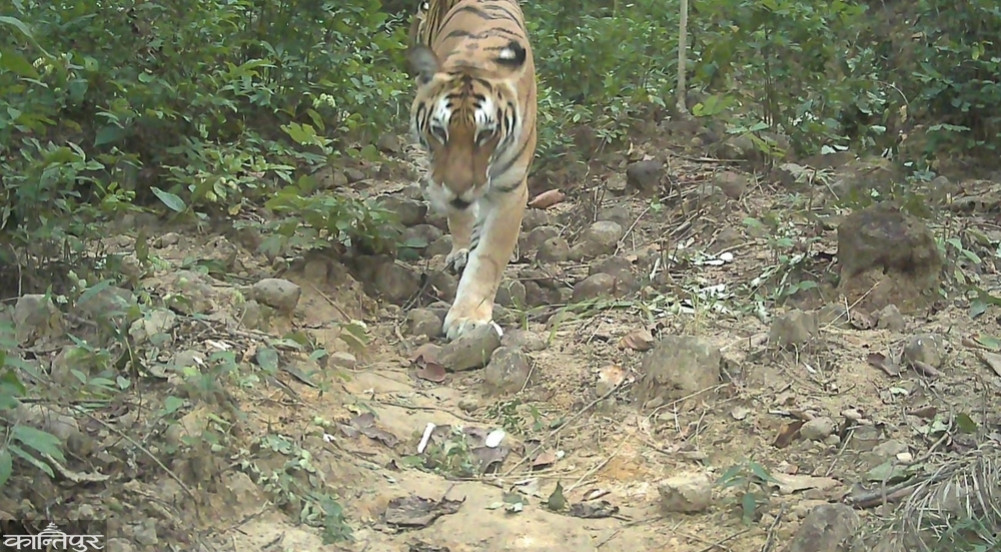
A study is being conducted by the Central Department of Zoology under Tribhuvan University with the aim of finding out the condition of wildlife, amphibians and reptiles in the province. In this process, a good number of tigers have been recorded. The highest number of tigers have been caught in camera traps in Kapilvastu and Dang.
We use Google Cloud Translation Services. Google requires we provide the following disclaimer relating to use of this service:
This service may contain translations powered by Google. Google disclaims all warranties related to the translations, expressed or implied, including any warranties of accuracy, reliability, and any implied warranties of merchantability, fitness for a particular purpose, and noninfringement.
Tigers have been sighted in 6 more districts of the province. Tigers have also been sighted in districts other than Banke and Bardiya, which are considered national parks and tiger conservation areas. Conservationists here are excited after tiger records, which are considered an indicator of the health of the forest ecosystem.
According to a study that has been underway for the past three months, tigers have been recorded in Rupandehi, Kapilvastu and West Nawalparasi of Lumbini Province. Tigers have also been sighted in Dang, Palpa and Arghakhanchi. Out of the 12 districts of the province, tigers have been recorded in camera traps conducted in 6 districts, except for Banke and Bardiya, which are considered national parks and protected areas. The study is currently underway in two more districts. Preparations are underway to begin the study in the remaining two districts in three weeks.
A study is being conducted by the Central Department of Zoology under Tribhuvan University with the aim of finding out the condition of wildlife, amphibians and reptiles in the province. In this process, a good number of tigers have been recorded. The study will also help in collecting basic data required for maintaining human-wildlife coexistence with the support of the University Grants Commission, said Dr. Hari Prasad Sharma, Professor and study team coordinator of the Central Department of Zoology, Tribhuvan University.
The maximum number of tigers caught in camera traps is in Kapilvastu and Dang. Four tigers have been seen in Kapilvastu. Tigers have been found in the North Tilaurakot partnership of the East-West Highway and various community forest areas and Kharkhani forests. 68 cameras were installed in these forests. Eight cameras were placed in an area of 400 square kilometers and captured tiger images. Analyzing all this, camera trap field coordinator Vachan Prasain said that there were 4 different tigers. In Dang, 4 tigers have also been caught in cameras. Tigers have been caught in camera traps in Amelia, Satbariya and Arjunkhola and in the Chure area of Chaklighat. 69 cameras were placed in 425 square kilometers.
This is the third time that a tiger has been recorded in Kapilvastu. The second time was in 2080 Poush, two tigers were recorded in Buddhabhumi Municipality and one in Vijayanagar Rural Municipality. Two tigers have been recorded in West Nawalparasi. While studying an area of 325 square kilometers with 52 cameras, a tiger was seen in Baba Goriya Community Forest. One tiger has been caught in a camera trap in Rupandehi. The study was conducted by placing 40 cameras in 250 square kilometers of Rupandehi. An adult tiger has been recorded on camera near the Gaushala near the Forest Research Center (Vanabatika Park) Ganeshnagar.
Two tigers have been recorded in Palpa. One was seen at an altitude of 1,110 meters near Mathagadhi Fort in Mathagadhi Rural Municipality and another at an altitude of 536 meters in Danda Logar above Jhumsa Khola in Tinau Rural Municipality, said study team coordinator Dr. Sharma. A tiger has been recorded near Shitaganga Municipality in Arghakhanchi. The tiger was found at an altitude of 934 meters near the settlement. A study was conducted in about 800 square kilometers by installing 44 cameras in Palpa and 50 in Arghakhanchi.
A study is being conducted in 225 square kilometers by installing 36 cameras in Gulmi. A study is being conducted in 250 square kilometers by installing 40 camera traps in Pyuthan. The team has stated that it will now know whether there are tigers in both these districts within a week. Although 20 tigers have been caught in the cameras placed in the 6 districts, at least 14 different tigers have been caught, said study team coordinator Dr. Sharma. All the tigers are adults.
Camera traps were placed in the national forest, community forest and mountains of the Chure region. Cameras were placed on potential paths where wildlife can move, river banks, and double-lane firelines. Cameras were placed on mountain paths, bridle paths, salt and water sources. The study will begin in Rolpa and East Rukum after two weeks. The 20-member team led by study team coordinator Sharma has been studying for two years. The team includes experts, specialists, researchers and students studying zoology. The study, which began in November 2024, will end in July 2026.
Apart from tigers, the camera traps have also caught leopards, wild cats, wild tigers, deer, wild boars and deer. Deer, chital, wood bear, ghoral, dumsi and wild boars have also been caught. Along with wildlife, birds, fish, amphibians, reptiles and mammals are also being studied. Four cameras were placed in 25 square kilometers by making a grid of five by five square kilometers. Field coordinator Vachan Prasai said that the camera traps were set at a distance of one kilometer from one camera to the other.
Field member Sobhit Adhikari said that camera traps were set for 21/21 days in all places. More than 50/60 leopards have been caught in 6 districts. Since these tigers are found in the Chure region, mountains and forests, they are native to this place. That remains to be investigated. Chure's tusks can also move around. Chure is connected to Banke, Dang, Kapilvastu, Arghakhanchi and Palpa. There is Suhelwa Wildlife Reserve in India on the border. Since it is adjacent to the Nepali border, it seems that tigers can move into Nepal from there.
Nepal is currently counting tigers in protected areas. Camera trapping in non-protected areas seems to increase the number of tigers. This will help in working on the condition of wildlife, forest management and conservation policy plans along with tigers, said WWF Nepal representative Dr. Ghanshyam Gurung. 'It will help in planning the development of wildlife habitat and ecotourism,' he said.
It is said that this study will also help in reducing illegal wildlife poaching and human-wildlife conflict. Tiger censuses are currently being conducted in parks and protected areas in Nepal. The recording of tigers in non-protected areas is expected to further increase the number of tigers. However, the recent increase in human-tiger conflict has increased fear and anxiety in society. ‘All parties should work together to resolve this in a timely manner,’ said Tolkraj Chapagain, a senior forest officer at the Ministry of Forests and Environment. ‘This will also benefit ecotourism.’
Earlier, in 2018, a tiger was first seen in the border area of Rupandehi, Kapilvastu and Palpa. A joint study on biodiversity in the Chure region conducted by the President’s Chure Terai-Madhes Conservation Development Board and the National Nature Conservation Trust showed that there are male tigers in Rupandehi and Palpa along with Kapilvastu. A female tiger was seen in more than one place on the border area of Rupandehi and Palpa, and a male tiger was seen about 40 kilometers west of that in the northern area of Kapilvastu, said tiger expert Dr. Baburam Lamichhane, who participated in the study. According to the 2022 national census, the number of wild tigers in Nepal has reached 355.