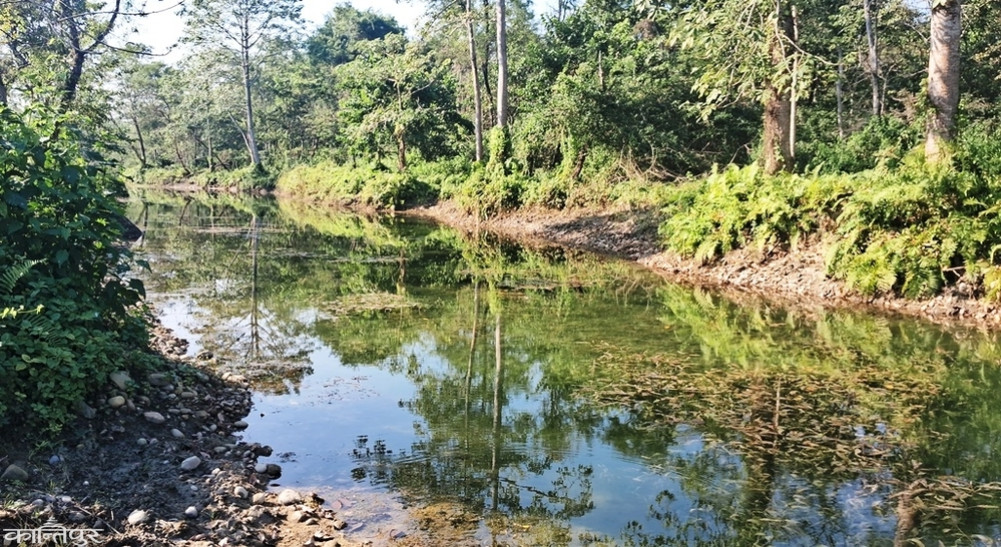
As water shortages have led to wildlife encroachment into the community forests of Nawalparasi, water management has begun by installing artificial ponds and solar-powered boreholes in the community forests.
We use Google Cloud Translation Services. Google requires we provide the following disclaimer relating to use of this service:
This service may contain translations powered by Google. Google disclaims all warranties related to the translations, expressed or implied, including any warranties of accuracy, reliability, and any implied warranties of merchantability, fitness for a particular purpose, and noninfringement.
Due to climate change and uncontrolled extraction of natural resources, lakes and wetlands within the forest are drying up.
Wetlands, ponds and lakes, which were sufficient for wildlife to play in until a few years ago, are now not even drinking water for animals. Due to which, when wildlife enters settlements for water and food, it causes damage to humans and agriculture.
In order to protect water sources in forest areas in East and West Nawalparasi, artificial ponds have been constructed to manage water for fire control in case of fire.
Consumers and stakeholders are trying to protect wetlands by constructing ponds in various community and intermediate forest areas of the district. It is expected that the artificial ponds constructed in this way will be a source of water for fire control during the dry season and will also be convenient for wild animals and livestock.
In West Nawalparasi district alone, 35 artificial ponds have been constructed. In the current fiscal year, one artificial pond has been constructed within each of 8 community forests and 3 outside the forest area. Raju Chhetri, head of the Division Forest Office, Nawalparasi, who has already managed 24 ponds and water sources, said.
Due to water scarcity, wildlife and livestock enter settlements in search of food during the summer and there is a shortage of water to extinguish forest fires. ‘The wetlands and water sources within the forest are drying up.’ We have been constructing new ponds to protect water resources for the past few years, said Raju Chhetri, head of the Division Forest Office. ‘This aims to reduce conflict between humans and wildlife and to preserve biodiversity along with forest conservation.’
Additional ponds have been constructed after the use and impact of the artificial ponds constructed as model projects in Bardaghat and Sunwal a few years ago were good. The Forest Office and the President's Chure-Terai Madhesh Conservation Program have been implementing the plan. As the water level in the Simsar area is decreasing, the Model Intermediate Community Forest of East Nawalparasi has managed water by burying boreholes to provide water to wildlife and to provide water for drinking.
A borehole powered by solar energy has been dug inside the forest in Kawasoti Municipality-13. The Century Ghol, which used to have plenty of water even in dry weather until a few years ago, is now being filled with water by burying boreholes in the winter, said Rajkumar Gurung, chairman of the community forest. 'The Simsar area is drying up every year. Due to lack of water, wildlife tends to change places to play and drink water,' he said. 'Last year, water was arranged by pulling it through a generator.' Now it has become much easier after boring.'
The boring, which is automatically powered by solar energy, operates during the day and shuts down at night. When the water in the wetlands dries up, wildlife enters the settlement and changes its habitat for food and water. Other community forests in this area have also been filling the wetlands with water through solar-powered boring to provide water for wildlife. A 142-foot-deep boring has been dug here. The solution in which the boring is buried will have water for twelve months.