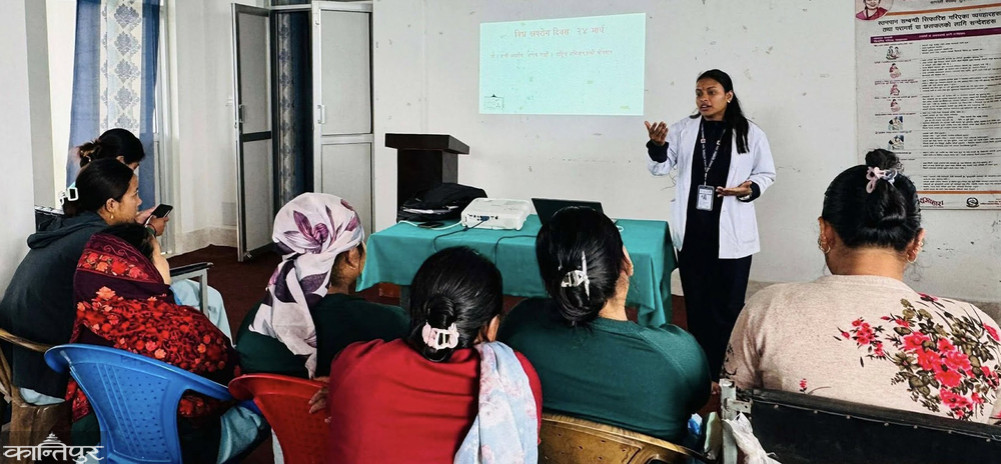
Branch Chief Jhabindra Neupane informed that the community-based CB (DOTS) and community search and rescue programs are yet to be implemented.
We use Google Cloud Translation Services. Google requires we provide the following disclaimer relating to use of this service:
This service may contain translations powered by Google. Google disclaims all warranties related to the translations, expressed or implied, including any warranties of accuracy, reliability, and any implied warranties of merchantability, fitness for a particular purpose, and noninfringement.
In 2080/81, the Lumbini Provincial Government implemented the TB-Free Municipality Program in Tansen Municipality. The Municipal Health Branch has stated that a budget of 27 lakhs was received in 2081 Baisakh. In three months, 131 thousand 400 was spent on salaries, 125 thousand on program management and 120 thousand on tuberculosis research.
In 2081/82, 14 lakhs were received. 569 thousand 400 on salaries, 234 thousand on microplanning, 118 thousand on active tuberculosis research, 131 thousand on youth mobilization program, 93 thousand 500 on awareness at the ward level and 22 thousand on contact screening, and 35 thousand on community-based CB (DOTs). In this way, 376 thousand 400 was spent in the first year and 12 lakh 3 thousand 700 in the second year on the TB-Free Municipality Program.
The branch has stated that there is a budget of 7 lakhs in the current fiscal year as well. There is a budget of 195 thousand, including 125 thousand for active tuberculosis detection, 38 thousand for program review, and 32 thousand for contact screening. Branch Chief Jhabindra Neupane informed that the community-based CB (Dots) and community-based detection programs are still pending. Despite the implementation of the TB-free municipality program, 6 people died of tuberculosis in Tansen last year.
In the previous fiscal year, Tinau Rural Municipality conducted the Community Dots program, and 24 thousand for tuberculosis modular training for health workers of the metropolis, sub-metropolitan cities and municipalities, and under the TB orientation and door-to-door TB detection program, active tuberculosis detection programs in risk groups of tuberculosis and communities with low access to health services, contact testing of household members, and TPT for tuberculosis prevention in children under five years of age. 89 thousand for the program, transportation of medicines and lab materials in emergencies, printing of form formats for recording and reporting, updating of E-TB register, World Tuberculosis Day related programs, on-site training and supervision, semi-annual review of tuberculosis programs and cohort analysis were 1 lakh.
In the current fiscal year, transportation of medicines and lab materials in emergencies and on-site training and supervision and planning and cohort analysis of tuberculosis programs were 95 thousand and active tuberculosis detection programs in risk groups of tuberculosis and communities with low access to health services and contact testing of household members of PBC patients were 1 lakh 5 thousand, said Krishna Karki, head of the health branch.
But last year, 5 people lost their lives to tuberculosis in Tinau. There is data that 1 person died in the current fiscal year as well. Not only Tansen Municipality and Tinau Rural Municipality, but also all 10 local levels of the district are running similar programs.
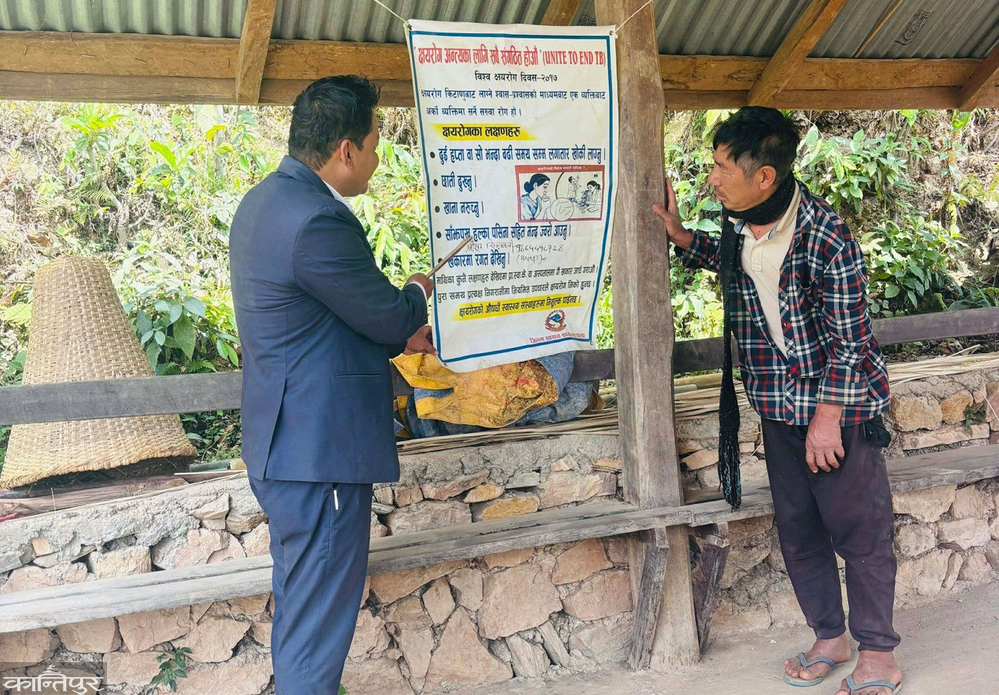
Tuk Prasad Pokharel, Acting Office Chief of the Health Office Palpa, said that despite the program being run every year, the number of tuberculosis patients has not decreased. According to him, the tuberculosis detection rate in the district is much lower than the government target. This confirms that a large number of infected people in the community are still outside the scope of treatment. ‘According to the World Health Organization’s target, 533 new patients should be detected in Palpa every year,’ he said, ‘only 322 people have been detected in the last fiscal year.’
This figure means that 211 tuberculosis patients have not been identified annually. Budget has been allocated to all local levels. However, 25/25 tuberculosis patients have lost their lives in the last two years.
Acting Chief Pokharel said that since the detection rate of new tuberculosis patients is low, the risk of transmitting the disease to other people is high. In the past three years, 134, 154 and 138 people per lakh population were confirmed to have tuberculosis. The success rate in treatment is 90, 95 and 91 respectively. In the last three years, it has been 25, 13 and 25. According to the health office, the rate of detection of patients in Nisdi rural municipality of the district is 198 per lakh people, while in Ribdikot rural municipality, this rate is 125 per lakh people. Nisdi is satisfactory and Ribdikot is poor. He said.
There are 70 DOTS centers in the district even at the local level. Laboratories are operating in every municipality. Among the patients who need to take regular medicine, 4 people in Palpa are out of contact. 62 percent of the patients found are men and 38 percent are women. When a person's immune system is weak, the dormant germs in the body become active and cause tuberculosis, said Bishwanath Neupane, program officer at the health office.
The disease is transmitted through the respiratory tract and 80 percent of the total infected people have pulmonary tuberculosis and 20 percent have tuberculosis of other organs, he said. The main symptoms of tuberculosis are persistent cough, weight loss, mild fever in the evening, sweating, loss of appetite and chest pain. People who smoke, drink alcohol and use drugs, have undergone organ transplants and have a weak immune system are especially likely to get the disease. The government has set a goal to eradicate tuberculosis by 2030. He said that the challenge is in implementing the government's goal of declaring Nepal tuberculosis-free.
The challenge for the government is also the inability to identify tuberculosis patients due to social stigma.
Still, no first-stage tuberculosis patients have been found in the villages. Those who become sick finally get tested for tuberculosis. The government has arranged free treatment for tuberculosis patients. The risk groups for tuberculosis include senior citizens, children, health workers, HIV-infected people, people with diabetes, pregnant women, prisoners and detainees, and people who have undergone organ transplants. He said that the problem is also caused by the patients themselves not caring, the health workers not being proactive, and the people's representatives of the municipality not giving priority.