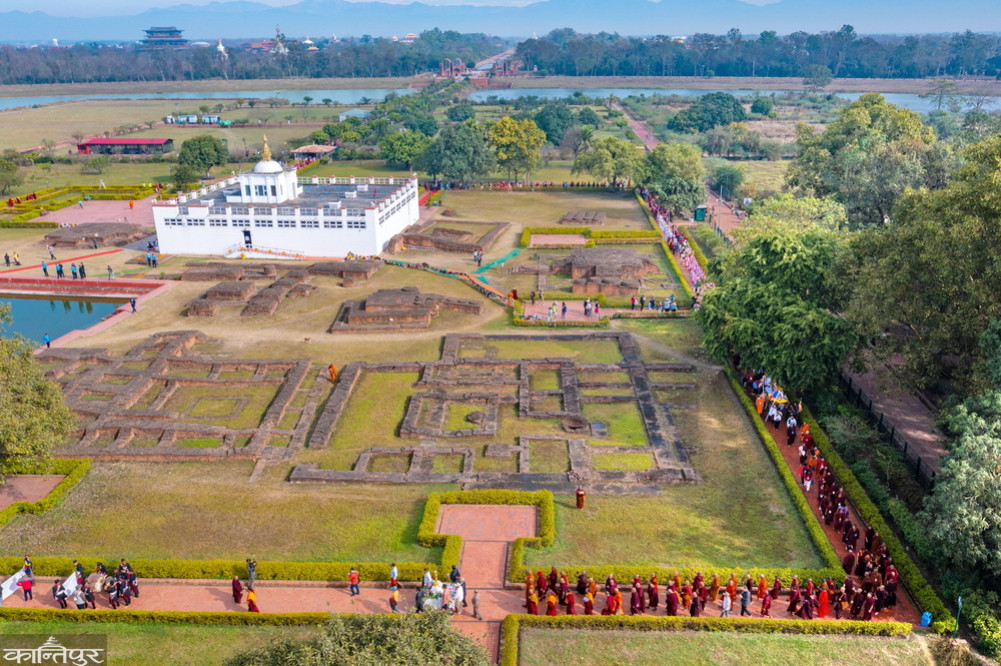
Deepak Shrestha, member-secretary of the Lumbini Development Fund, said that he has received formal information that the World Bank board meeting held in Washington, DC, USA, made the decision on March 13. The bank has supported the development of Lumbini as a spiritual, cultural and tourist destination.
We use Google Cloud Translation Services. Google requires we provide the following disclaimer relating to use of this service:
This service may contain translations powered by Google. Google disclaims all warranties related to the translations, expressed or implied, including any warranties of accuracy, reliability, and any implied warranties of merchantability, fitness for a particular purpose, and noninfringement.
The World Bank's board meeting has approved a loan of $85 million (12.5 billion 66 million) to implement the Greater Lumbini Area Project by connecting local residents with income generation. The World Bank has provided significant support to develop Lumbini as a spiritual, cultural and tourist destination.
Lumbini Development Fund Member-Secretary Deepak Shrestha said that the decision was formally made at the bank's board meeting held in Washington, DC, USA on March 13. According to him, the project will be for a period of five years. This is the largest amount of support Lumbini has received so far.
Under the Greater Lumbini Area Development Project, various works will be carried out in Rupandehi, Kapilvastu and West Nawalparasi, which are historical and archaeological sites related to Buddha. After the World Bank's decision reached the Ministry of Finance, the draft loan agreement has been sent to the Ministry of Law. Lumbini Development Fund Senior Director Gyanin Rai said that the project will be implemented as soon as the Council of Ministers decides to accept the loan after returning from the Ministry of Law. The
project will be operated by the Ministry of Urban Development and Tourism. The urban development project implementation unit is located in Bhairahawa. Preparations are underway to place the project implementation unit of the Urban Development and Building Office and the Ministry of Tourism under the Lumbini Development Fund. However, Senior Director Rai said that this project has a different objective from the work remaining under the Lumbini Development Master Plan. However, he informed that some of the work to be done under the project will support the master plan. According to
Rai, work will be done at four places under the project. Work will be carried out in the one-square-kilometer-by-one-square-kilometer Secret Garden area of Lumbini, the birthplace of Buddha, Tilaurakot (ancient Kapilvastu), the Shakya capital of Kapilvastu, Ramgram in western Nawalparasi, where Buddha's ashes are located, and Devdaha in Rupandehi. The Lumbini Museum in the Lumbini complex will also be a work site.
'Work will be done based on three main pillars,' Rai said, 'Infrastructure improvement and destination development, destination planning and visualization, and local economic development and private sector involvement will be supported by an action plan.' Under the project, toilet facilities will be provided to pilgrims and tourists entering the sacred garden of Lumbini, construction of a place to light incense/lamps, a place to remove shoes and slippers, and beautification of the Mayadevi temple complex.
Discussions will be held on the preservation of the ruins found during excavations around the Mayadevi Temple from 1992 to 1996, to preserve and make them safe, and to instill a 'Buddha spirit' in Buddhists after entering Mayadevi. Similarly, arrangements will be made for a suitable place, drinking water and toilets for the preservation of religion and culture according to local customs and traditions.
The Development Fund has stated that work will be done by making a physical development plan for the sacred garden area. The area declared a protected area will be worked on with active participation and discussions with the Department of Archaeology, UNESCO, ICOMOS, the Buddhist community and stakeholders. A well-equipped ticket counter and toilet will be built. A good visitor center, conservation-friendly bus park, parking lot and road will be built in Tilaurakot, Ramgram and Devdaha. Walkways, toilets, digital boards and transitive signage will be installed. Water supply, sanitation and drainage works will also be carried out. It is said that conservation and development work will also be carried out on the land acquired in Tilaurakot. Similarly, the sites related to Buddha will also be connected through road upgrading and networking.
The Ministry of Urban Development will do the physical infrastructure work. The Ministry of Tourism, Lumbini Development Fund and Nepal Tourism Board will do the destination planning and conceptualization work, said Senior Director Rai. ‘The structure of the Mayadevi Temple is also old. It was made reversible by connecting it with nuts and bolts so that it can be opened and removed,’ he said. ‘It weighs 400 metric tons more with 285 metric tons of iron and the roof structure on top. The bottom is supported by 159 wooden pillars.’ Senior Director Rai said that since it has been 20 years since the temple was built, the current condition of its structure will also be discussed. Under the
project, Lumbini Museum is to be made an international standard Buddhist museum. It will be planned and upgraded. Under the local economic development and private sector involvement program, it is said that locals will benefit from tourists coming to the greater Lumbini area. Programs to generate income and create employment from tourism will also be implemented. Employment opportunities will be created by identifying the types, demand and marketing of local products. Similarly, there is a program to create guides at the local level, provide them with timely training and help create employment opportunities. Four local levels will also implement some programs under the
program. Lumbini Cultural, Kapilvastu, Devdaha and Ramgram municipalities will work on development, employment opportunities for locals and tourism promotion by linking them with tourism. It has been said that one municipality will be allocated three million dollars. However, it has also been said that it can be increased by looking at the effectiveness and usefulness of the work. Out of the total $85 million, $45 million has been allocated for the greater Lumbini development work. Of this, $15 million has been allocated for the Circuit Garden (sacred garden) and $15 million for the Lumbini Museum. $5 million each has been allocated for Tilaurakot, Devdaha and Ramgram, said Fund member-secretary Shrestha.
Talks with the World Bank about the project had been going on since 2016. However, Gopikrishna Sharma, a member of the Fund's council, said that it had reached a standstill due to the officials who came to the Fund in the meantime. He said that the problem arose when the Fund's officials tried to advance the project for personal gain. 'After convincing the World Bank for the last one year with a lot of effort, we are now in a position to get a loan,' he said. 'Now that the project is certain to be implemented, the face of this area will change.' We are very happy about this.' Elad Seinfeld, Senior Disaster Risk Management Specialist at the World Bank, came to Nepal with the task of advancing the project. After nearly a year of repeated discussions with the Ministry of Finance, Ministry of Tourism, and Lumbini Development Fund, the results have been fruitful.
The Lumbini Development Master Plan, which was formulated in 1978, was supposed to be completed in 17 years by 1995, and since it has not been completed yet, there is room for questioning about this plan, said Lumbini Hotel Association President Leelamani Sharma. That is why he said that faith and trust in Lumbini should be increased by doing more than talking. Lumbini is also the most visited tourist destination in the country.