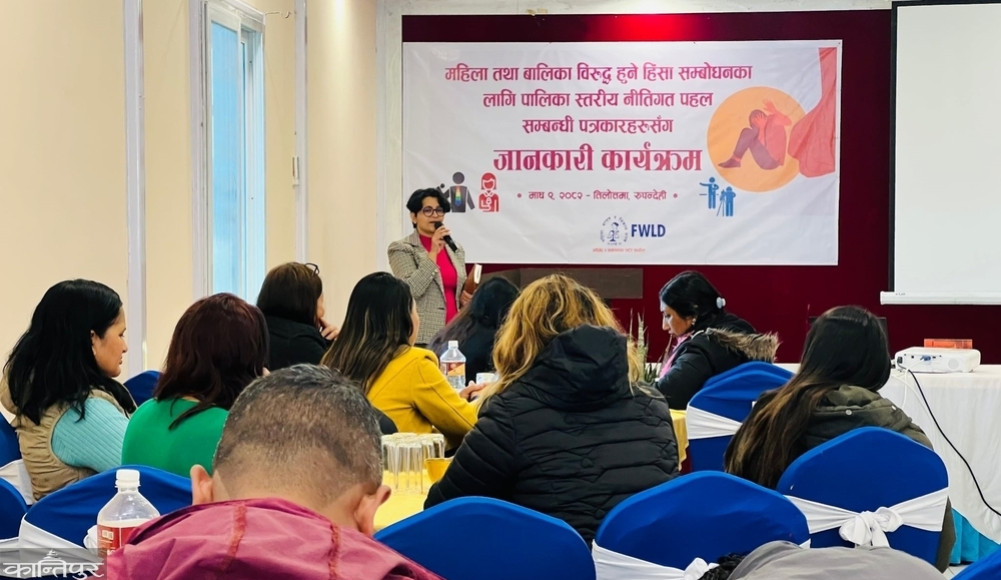
A press interaction program was organized in Tilottama on Friday to provide information about municipal-level policy initiatives, in which information was provided about the activities undertaken by the local level.
We use Google Cloud Translation Services. Google requires we provide the following disclaimer relating to use of this service:
This service may contain translations powered by Google. Google disclaims all warranties related to the translations, expressed or implied, including any warranties of accuracy, reliability, and any implied warranties of merchantability, fitness for a particular purpose, and noninfringement.
Four local levels in Rupandehi have started formulating laws and policies to reduce violence against women and girls. Tilottama Municipality, Kanchan, Omsatiya and Suddhodhan Rural Municipality in Rupandehi have started reducing violence against women and children through laws, policies and procedures.
Recently, policy discussions are ongoing in four local levels of Rupandehi, namely Tilottama, Kanchan, Suddhodhan and Omsatiya, for an act on violence against women and girls. The Women's Law and Development Forum and Creative Organization Nepal have provided technical assistance to make stakeholders aware of the act and its implementation.
A press interaction program was organized in Tilottama on Friday to provide information about municipal-level policy initiatives to address violence against women and girls, in which information was provided about the activities carried out by the local level.
Gender-based violence The Women's Law and Development Forum and Creative Organization Nepal have provided technical assistance in the formulation of the act and policy and its implementation.
Sabin Shrestha, Director of the Women's Law and Development Forum, said that policy initiatives have been initiated to prevent violence against women and girls and to protect and secure them. 'As time changes, the forms of gender-based violence have changed.' "Acts and policies against gender-based violence at the local level are necessary to solve the problems of gender-based violence and violence against girls, to reach victims, to facilitate the judicial process, and to facilitate them immediately," said Director Shrestha. "Only then can the return on investment in their field be shown."
Violence against women and girls not only causes problems for women and girls, but also pushes society backward. "Therefore, it is necessary for the local level to develop laws, policies, and create protection plans for the safety of women and children," said Shrestha, who is also an advocate.
Tilottama Municipality, which has started a campaign to make Tilottama a gender-friendly municipality, has operated a gender-based violence prevention fund. According to Sanjhana Bhandari, head of the Women and Children's Branch, it has operated a safehouse in collaboration with creative organizations. A men's network has been created against violence against women. It is working on 116 indicators to make Tilottama a gender-friendly municipality.
Kanchan Rural Municipality has enacted a Gender-Based Violence Rehabilitation and Fund Operation Act. Along with this, the municipality chair Nawaraj Dhakal said that a campaign for the safety of women and girls and the reduction of violence has also been launched.
Shuddhodhan Rural Municipality, which focuses on ward-level programs to reduce gender-based violence, has formed a committee against human trafficking. Chairman Bishnu Prasad Basyal said that he is also working on developing the capacity of children to make the rural municipality child-friendly.
An act is necessary to reduce gender-based violence. However, even though laws have been made at the local level, the implementation aspect is challenging. Omsatiya Rural Municipality Chief Administrative Officer Krishna Prasad Panthi said that if the municipal heads are sensitive to the implementation of the act, it will be easier to implement the laws against women and girls.
Pratima Panthi, Program and Management Director of Creative Organization Nepal, said that they have worked on implementing the act and policies made by the local level, organizing orientations, discussions, holding board meetings to inform the target group, etc.