Those waiting in line on the roadside of the fog-shrouded Nepalgunj Bazaar in search of work have two worries - if they don't get a wage, they will have to return empty-handed in the evening, and if they do get a job, what will they do in the cold?
We use Google Cloud Translation Services. Google requires we provide the following disclaimer relating to use of this service:
This service may contain translations powered by Google. Google disclaims all warranties related to the translations, expressed or implied, including any warranties of accuracy, reliability, and any implied warranties of merchantability, fitness for a particular purpose, and noninfringement.
Every morning, there is a line of people standing along the roadside of Nepalgunj Bazaar looking for work.
Those who line up on the side of the road covered in fog in search of work are worried about two things – if they don’t get work, they will have to return empty-handed in the evening, and what will they do when they get it?
Construction and farming work is difficult to find these days due to the extreme cold caused by the fog and cold wave. Even if they get it, it is difficult to work due to the freezing cold.
Ram Bahadur Chaudhary, 45, of Banke Baijnath, works as a daily wage laborer. He says that work has become less as the winter sets in. ‘There is less construction work in winter, and there is no farm work either,’ he says. ‘If you don’t get work, it is difficult to feed your stomach, and even if you do get it, your body starts shivering due to the cold. If you work five days a week, you will be exhausted for two days.’
Mina Tharu of Kohalpur, who works in construction, also has problems going to work due to the cold. She says, ‘When you work in the cold, you get a fever or cough, but you don’t have money to buy medicine, and if you don’t work, you can’t eat.’
It is difficult for daily wage workers to light a stove during the winter season. ‘The fear of not getting work in the morning, the worry of returning empty-handed in the evening all make the nights even colder,’ said Mina.
The cold weather that has increased since the beginning of the month has affected the poor and workers the most. Along with children and the elderly, rickshaw and cart drivers and daily wage laborers have been the most affected by the cold wave and cold.
The cold wave and fog have increased significantly in Banke for the past two weeks. The cold wave has disrupted life in the area after the cold wave has increased significantly. Due to the extreme cold, there has been very little movement of vehicles and people on the roads in the morning and evening. The attendance of service recipients in government offices and children in schools is also low.
Due to the increasing cold, the main markets of Nepalgunj, Tribhuvan Chowk, Sadar Line, Gharbari Tole, BP Chowk, Birendra Chowk and Pushpalal Chowk, have reduced traffic. Businessman Nandalal Vaishya said that the movement of people in the market has decreased due to the cold wave.
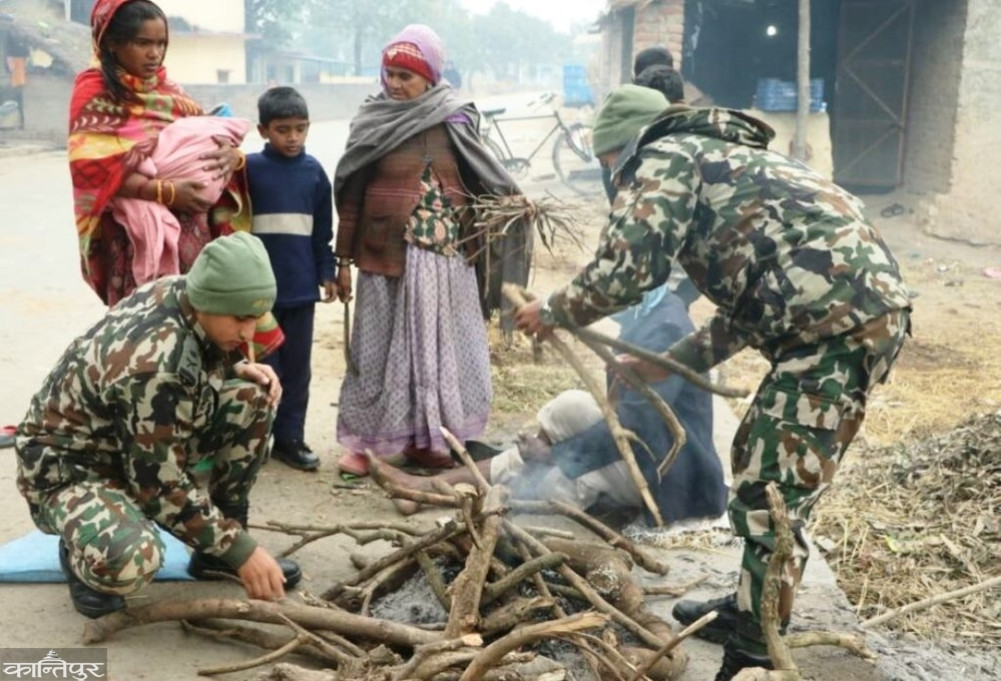
Nepalgunj Sub-metropolitan City has started distributing firewood to protect against the cold. According to Ramhari Sharma, Chief Administrative Officer of the Sub-metropolitan City, keeping the workers in mind, arrangements have been made to light fires by burning firewood at the intersections. ‘The aim is to provide relief to the workers who leave for work in the morning by lighting fires at the intersections, even for a short time,’ he said. ‘For that, the Sub-metropolitan City is distributing firewood within the city.’
The District Disaster Management Committee has updated the cold and cold wave pre-preparedness and response plan and is working accordingly. According to the committee’s projection, about 176,000 people from 36,000 families in Banke may be affected by the cold and cold wave this year.
The temperature in Nepalgunj has also been dropping for the past few days. The Nepalgunj Airport Office has stated that the temperature here has dropped to 9 to 13 degrees Celsius in recent days.