The literacy rate of 7 districts is more than 96 percent, and the SEE pass rate is also 62.06 percent.
We use Google Cloud Translation Services. Google requires we provide the following disclaimer relating to use of this service:
This service may contain translations powered by Google. Google disclaims all warranties related to the translations, expressed or implied, including any warranties of accuracy, reliability, and any implied warranties of merchantability, fitness for a particular purpose, and noninfringement.
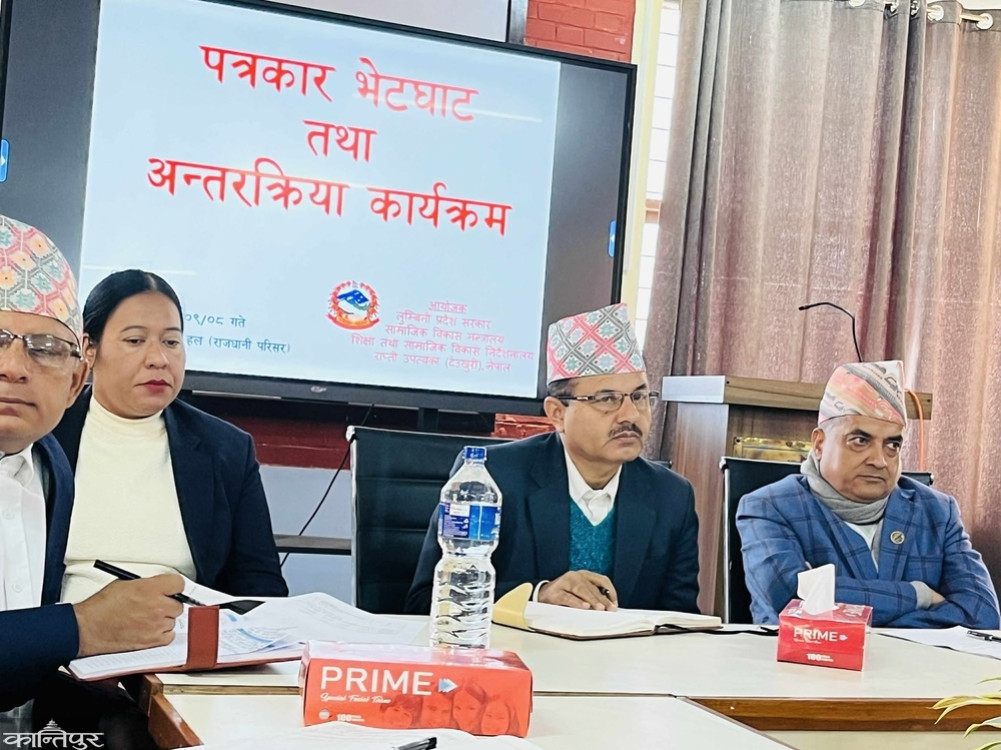
After all districts have been declared literate, the entire Lumbini province is set to be declared a 'literate province'. The Ministry of Social Development announced in a press conference on Tuesday that a special program will be organized in Deukhuri, Dang, next Sunday to declare the province a literate province.
Considering education as the main basis of human development, the province is going to declare literacy by continuously implementing programs that prioritize lifelong learning and natural education. By improving the literacy rate, all 12 districts of the province have been declared literate and the high school graduation rate has also improved. The province is going to be declared literate after the literacy rate of 7 out of 12 districts of Lumbini reached above 96 percent.
Social Development Minister Janmajya Timilsina said that all 12 districts of Lumbini province have been declared literate in terms of achievements. ‘The literacy rate has reached above 96 percent in districts including Palpa, Arghakhanchi, Gulmi, Dang, Rupandehi, Banke, Kapilvastu,’ he said, ‘A significant improvement has also been seen in the results of the SEE examination. The pass rate in the academic session 2080 was 38.65 percent, but it has reached 62.06 percent in 2081.' He said that the local levels with the highest literacy rate are Butwal Sub-metropolitan City of Rupandehi, Tilottama Municipality and Tansen Municipality of Palpa.
According to the 2024 data, Nepal's Human Development Index is zero.62, while Lumbini Province's index is in fourth place with zero.60. The 'Literary Nepal' campaign launched by the Nepal Government aims to make all citizens above the age of 15 at least literate.
The 'Literary Nepal Year 2076' concept approved by the Council of Ministers had a clear objective of preparing the basis for lifelong learning. Minister Timilsina said that education, health and per capita income are the main indicators in the global assessment of human development. Among them, education is the most important basis and it will have a positive impact on other indicators as well.
‘Education has been given priority globally to achieve the Sustainable Development Goals,’ he said, ‘Lumbini Province has made remarkable progress amidst its own social and cultural diversity.’
According to the Second Periodic Plan, the target has been set to increase the literacy rate above five years from 78.08 percent to 98 percent. A plan has been put forward to link literacy with skills and income generation, develop alternative programs for out-of-school children, and systematically develop and mobilize community information centers, child development centers, and schools, said Begam KC, a senior education officer at the ministry. According to Schedule 8 of the constitution and the Local Government Operation Act 2074, the responsibility for secondary education, non-formal education, and literacy programs has been given to the local level.
According to Diwakar Bhandari, acting secretary of the ministry, the government of Nepal has made arrangements to declare an area literate if 95 percent of the population in the age group of 15 to 60 is literate according to the UNIS standards. He said that the skills of being able to read and write, general calculations, daily behavior, banking, mobile use, and understanding time and date are considered the basis of literacy.
‘Accordingly, the criteria for declaring Lumbini Province as a literate province have been met by running literacy, lifelong learning, informal and alternative education programs in Lumbini Province,’ he said. ‘For this, coordination has been made with the Ministry, Education and Social Development Directorate, Education Training Center, Lumbini Technical University, 12 Education Development and Coordination Units, 6 Social Development Division Offices, 109 local levels, the provincial-level Madrasa Education Coordination Committee, 4,439 community schools, 5,722 community child development centers, and 329 community information centers.’ He said that Chief Minister Chet Narayan Acharya will declare the literate province.