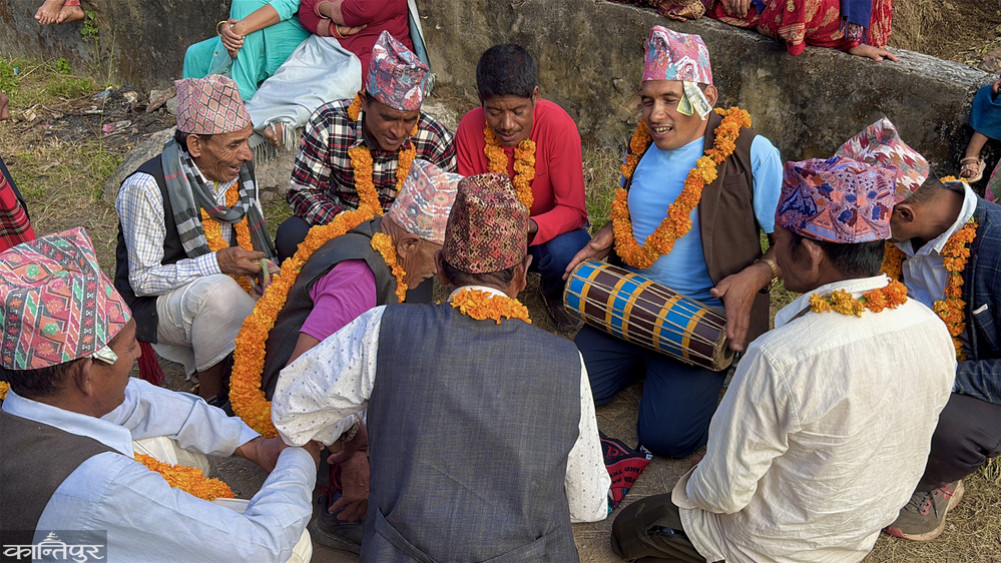
There is an increased risk that various original dialects such as Khyali, Bangari, Singaru, and Paesaru, which are performed at various festivals, fairs, and social gatherings, will be limited to the current generation only.
We use Google Cloud Translation Services. Google requires we provide the following disclaimer relating to use of this service:
This service may contain translations powered by Google. Google disclaims all warranties related to the translations, expressed or implied, including any warranties of accuracy, reliability, and any implied warranties of merchantability, fitness for a particular purpose, and noninfringement.
‘I have written a letter to Kailash, I have written a letter to Kailash, I have lived and met my friend again, what is it, what is it?’
At the traditional dance and song gathering held on the occasion of this year's Tihar in Sisne Rural Municipality-3, Pokhara, 86-year-old local Manram Budha presented these words in the Singaru dialect. He lamented that they had met in the song and that they would not meet again in the coming year. He also expressed concern that the new generation had not followed the original dance and song that they had preserved as best they could.
This is a common concern today. The bitter reality is that original customs, culture, songs, music and dances are not being passed down from generation to generation. Tejendra Budha, a local artist from Pokhara, says that the various original dialects such as Khyali, Bangari, Singaru and Paesuru, which are presented at various festivals, fairs and happy gatherings, are at risk of being limited to the current generation only.
'We have been able to learn from our grandfathers and uncles and fill them with rhythm and dance to these dialects.' There is also fun in it. But our children and grandchildren have no interest in it,' Khadka said, expressing concern, 'How can this culture continue like this? I doubt that the next generation will maintain it like this.'
The first thing is that the presence of the young generation in the village is decreasing every year, another local, Dil Bahadur KC, said that their priorities are on other things. 'The new generation's eating habits, behavior and way of having fun are different. I don't see the youth having the courage to talk openly with us and imitate our good things,' he said.
Earlier, from Agona to Angan, people of all age groups used to come together and openly communicate and share happiness and sorrows during various festivals and occasions, but now Mahendra KC, a former teacher from Pokhara, says that the trend is breaking. ‘We used to sit with our children and have long conversations, discussions and dialogues. Some were about household matters, some about customs and culture, and some about relationships. But now it seems like nothing has happened. I am feeling very sad,’ he added, ‘Original songs and dances including Singaru are our foundation, and their protection is necessary. For this, joint action by citizens and the government is necessary.’
Due to the lack of transmission of original dances and songs, the effectiveness of their presentation is also decreasing. There are fewer people who awaken it and enjoy it. Local senior citizen Madhu Khatri shared her experience of expressing happiness, sorrow and love through such original songs. She said, ‘The artists (artists) used to express their sorrows through the lyrics of the songs, and some even used to express love. And there would be a crowd of people listening and watching. It would have been so much fun back then. But now there is no one to listen to it.' She also expressed her concern while remembering the old days.