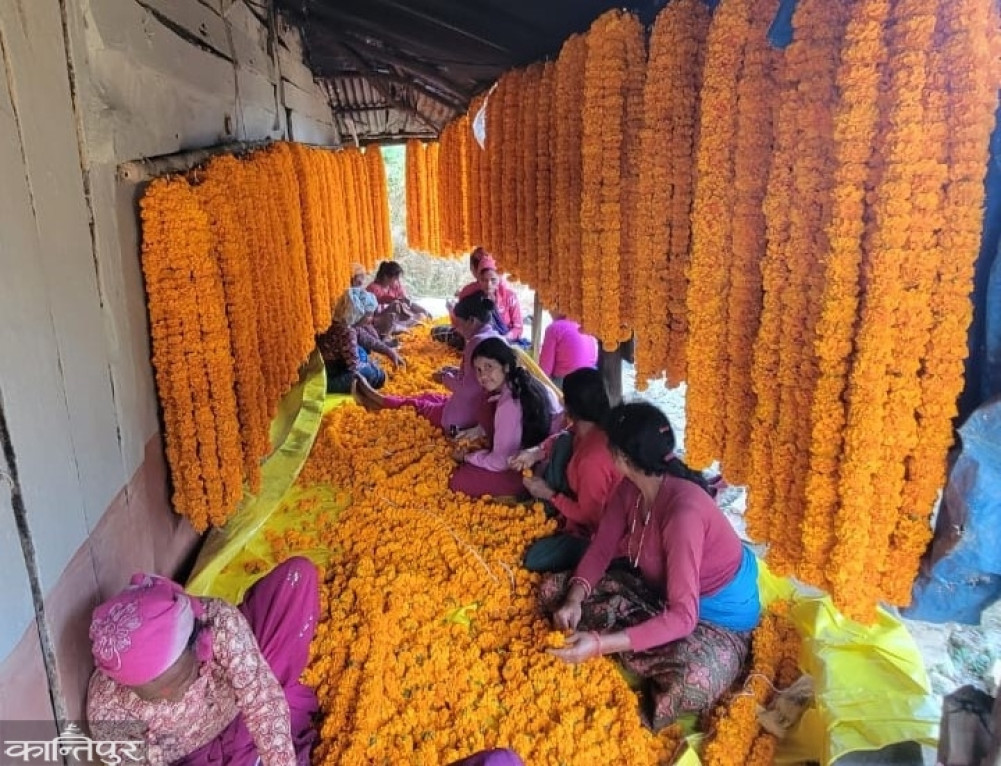
On Monday, 11 women were making garlands. One woman can make up to 70 garlands a day. Flower farmer Bhat said that 1,300 garlands were sold on Sunday.
We use Google Cloud Translation Services. Google requires we provide the following disclaimer relating to use of this service:
This service may contain translations powered by Google. Google disclaims all warranties related to the translations, expressed or implied, including any warranties of accuracy, reliability, and any implied warranties of merchantability, fitness for a particular purpose, and noninfringement.
The fields where we used to struggle for years and days and not have enough to eat for six months. Sometimes it was difficult to even get the seeds of the crops back. Now, flowers are blooming there in abundance.
After learning about flower farming through the media and YouTube, Tej Bahadur Bhat, a teacher at the local Buddha Basic School, started growing flowers in Kirtipur Danda, Simalpani, Shitaganga Municipality-13. Last year, he planted flowers instead of cereals in the same paddy field. After flower farming was successful on 3 ropanis of land, Bhat, who was enthusiastic, added five ropanis and is now growing flowers including centaury, velvet and other flowers in an eight ropani field. The villagers are also surprised after the first flower farming on the hill.
He is now struggling to sell the flowers and garlands produced during Tihar. ‘Last year, he earned 80 thousand rupees,’ he said, ‘this year, he is expected to earn more than three hundred thousand rupees during Tihar.’ The garlands are exported to local villages and cities including Kapilvastu and Butwal.’
The women of the village are picking flowers from the garden and making garlands. Bhat has also given work to the women of the village along with earning his own income. On Monday, 11 women are making garlands. One woman makes up to 70 garlands a day. Bhat pays the women a daily wage of Rs. 600. He said that he sold 1,300 garlands on Sunday. 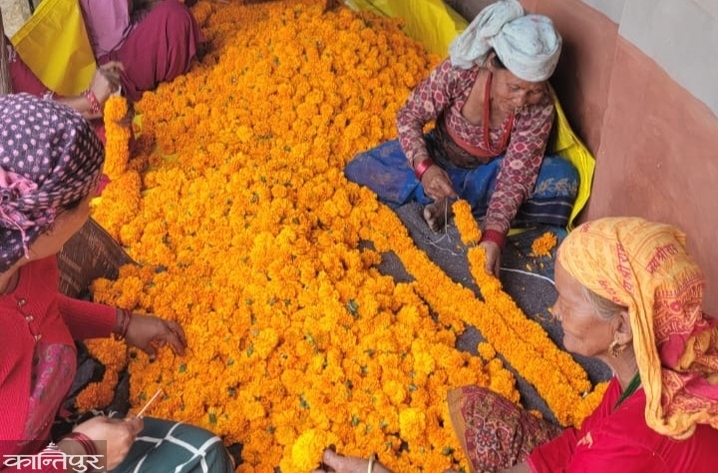
He said that a garland costs Rs. 80 and the flowers are being sold from home for Rs. 350. In this way, garlands made of hundred leaves and velvet are sold not only during Tihar but also at other times. Since garlands are more attractive than food in welcoming guests at any event, wedding, or worship, the organizers prefer flower garlands.
‘There is a demand for garlands from auspicious occasions to death,’ he said, ‘Devotional flowers are also used by visitors to the Supa Deurali temple. They are also exported to the Terai.’ He said that the demand for garlands and flowers is increasing. He said that customers demand flowers and garlands over the phone.
He works in the Bhat flower farm in the morning and evening. He teaches at school in the afternoon. Other family members are also enjoying flower farming. He said that the goal is to become self-reliant through flower farming. ‘Various types of flowers, including local ones, have been produced,’ he said, ‘There is a lot of demand. I will continue to expand flower farming.’
Due to the easy transportation facilities, people from the Terai and distant villages come to buy garlands at home on motorcycles and cars. Ward chair Durga BC said that even though villagers plant two to four flower plants for Tihar, commercial flower cultivation in fields used for grain cultivation is new.
He said that other farmers in the village have been attracted to flower cultivation as this type of commercial farming provides self-employment to farmers compared to the traditional farming system.