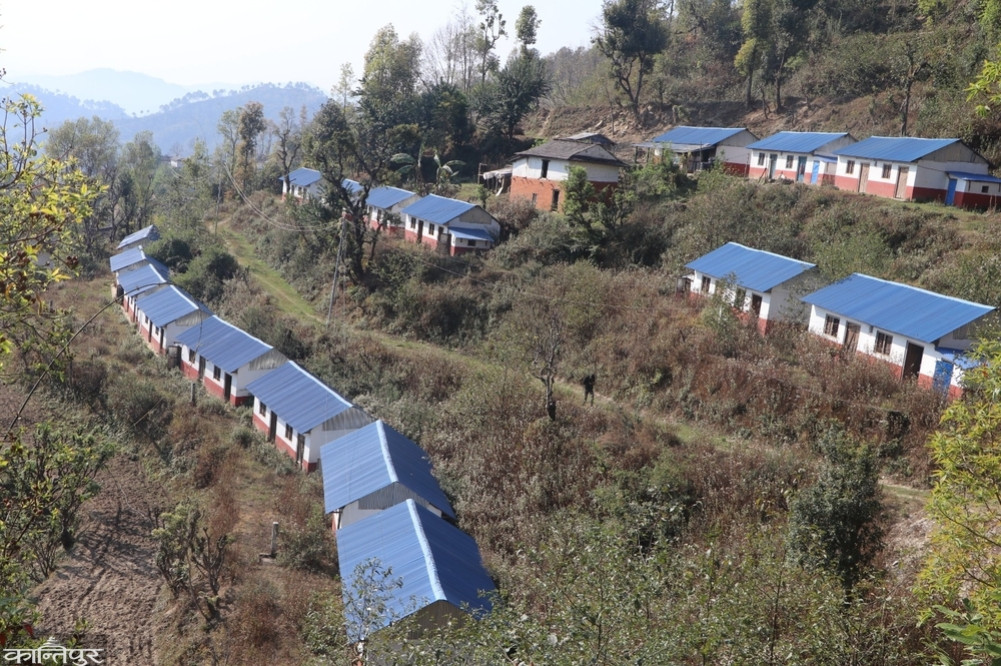
Even though the houses are well-equipped, rural farming families are saying that they cannot afford to live in settlements that are cramped and lack even a vegetable garden.
We use Google Cloud Translation Services. Google requires we provide the following disclaimer relating to use of this service:
This service may contain translations powered by Google. Google disclaims all warranties related to the translations, expressed or implied, including any warranties of accuracy, reliability, and any implied warranties of merchantability, fitness for a particular purpose, and noninfringement.
Due to lack of housing in the integrated settlements built for families displaced by the earthquake and road accidents, houses are becoming dilapidated and overgrown with bushes.
Only 13 of the 48 houses built in four places in Sirseni, Madane Rural Municipality-3 are inhabited. Although the one-story zinc-roofed houses have electricity, drinking water and toilets, 35 houses are suffering due to the cramped settlements. The settlements are being surrounded by bushes due to lack of habitation.
The victims of the earthquake and road construction have not come to the settlements built for the displaced, citing the problem of being far from their farmlands. They are still living in risky houses.
Victim Maya Bishwakarma said that she did not live in an integrated settlement because all the houses in the settlement were in one place and there were conflicts between livestock and children. ‘After living in the village, we had to raise chickens, goats and livestock,’ she said. ‘We cannot all live in one place by giving only connected houses without employment.’ Even in the constructed house, there is no space other than a small bed and a simple drawer.
Another victim, Nirmala Sunar, said that it would be a relief if they built separate houses and at least had land for a vegetable garden. ‘There are only small houses, the land is far away,’ she said, ‘It is not possible to move to the village like in the city.’ The number of families forced to live in old dilapidated houses is 35. They are saying that even though the houses are equipped with facilities, rural families who do farming cannot live in a settlement that does not even have a small garden and vegetable garden.
13 families who have moved to the settlement are showing problems even after they have settled. The families who have yet to move to the settlement say that there are no other facilities there except for the house. They are demanding that there be a place to grow vegetables, a place to keep livestock, separate streams and even employment.
The settlement was built through the Integrated Settlement Development Plan for displaced and vulnerable families during the construction of the Saljhandi-Sandhirkhak-Dhorpatan road. Madane Rural Municipality acquired land in the fiscal year 2075/076 and built integrated settlements in Batakachaur and Khanyukharka the following year through the municipality and the reconstruction authority in Kafalpata at a total cost of Rs 30 million, said Madane Rural Municipality Information Officer Suresh Pokherel. Targeted households are living in two out of 18 houses in Batakachaur, two out of 10 houses in Kafalpata, seven out of 18 houses in Khanyukharka and two out of two houses in Sim. The other houses are vacant.
Ward Chairman Chet Bahadur Sen said that the integrated settlements are empty because the targeted households refused to leave their old settlements. ‘They are staying in their own communities despite the risks,’ he said. ‘Despite repeated requests, the victim families did not come to the settlements.’ He expressed disappointment that wild animals are currently living in the integrated settlements. He said that since it is in the name of the displaced family's landlord, it cannot be used elsewhere and they will not use it either.
Madane Rural Municipality Vice-Chairperson Sarita Khadka said that the integrated settlement could not be successful because the victim family did not come to the settlement and settle there. 'The municipality has requested it, but the beneficiary family is in their old house,' she said, 'It can be used if there is a problem in the event of a disaster, otherwise it was not successful in our integrated settlement.' She said that if there is a problem, she will try to make a law and make it suitable for others to live in.