Millet cultivation area and production are decreasing every year, now only 2 thousand 822 hectares of millet are being cultivated in the district.
We use Google Cloud Translation Services. Google requires we provide the following disclaimer relating to use of this service:
This service may contain translations powered by Google. Google disclaims all warranties related to the translations, expressed or implied, including any warranties of accuracy, reliability, and any implied warranties of merchantability, fitness for a particular purpose, and noninfringement.
Hudda culture, which is in vogue while cultivating millet, is gradually disappearing in Gulmi. Since it takes a long time to plant millet alone in a large area, there is a practice of setting quotas so that many fields can be planted on the same day.
During farming, a kind of group formed by farmers to work in turn is called Hudda . Hudda is not only associated with Khetala, but also with local folk songs, Madal, Jhyali and Sahanai. The Huda culture which is prevalent in the eastern part of Gulmi and a little less in the western part is now slowly disappearing.
Malika rural municipality-6 Arjaika Dadhiram Aryal's turn was held every year in July from 2030 to 2050. Dadhiram told that grandfather Atramam and father Chabilal Aryal used to plant millet through Huda to plant millet in the 16-plant area. "Now the field for planting millet has reduced to 5," he said, "Hudda is disappearing, along with our old customs are also disappearing."
Dadhiram is now 45 years old. However, he said that he only remembers seeing the Huddah culture of millet planting in his childhood. "The traditions of singing hudda when planting millet in the garden and wali when planting paddy in the fields have disappeared," he said, "If you - all of us are concerned about farming and culture, it can be revived again."
In Chhatrakot Rural Municipality-1 Hunga, not only planting culture, millet planting has stopped. Tikaram Neupane of Jherdi in Hunga complained that millet planting has stopped because he himself took 25 to 30 people to do the work. 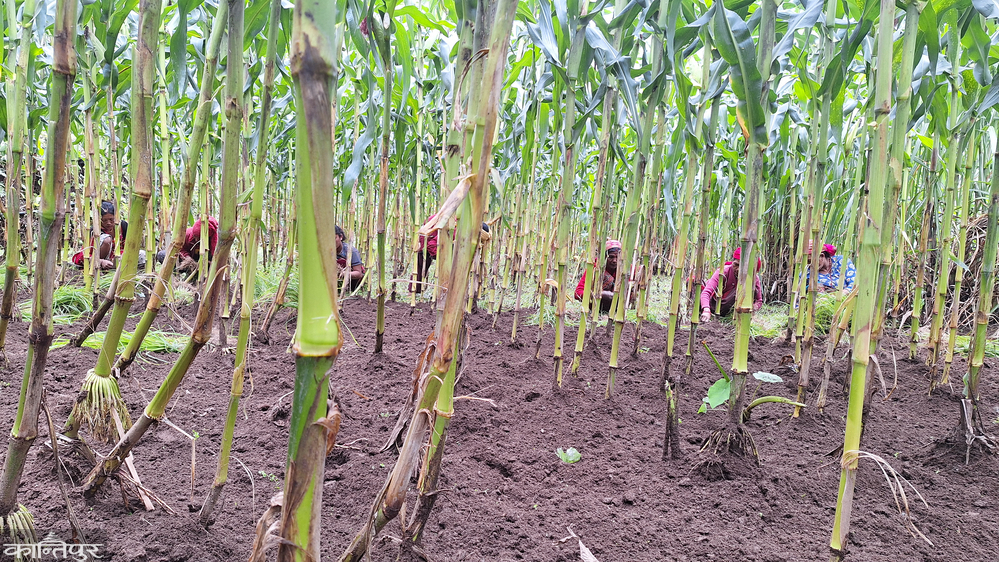
'When the young man went abroad, his bride fell in Butwal . Now we have only 60 old people in the village,' he said, 'Now not only Hudda, millet plantations are in danger of extinction.'
He planted millet through Hudda for 10 years and said that this culture has been lost for the last few years. Tikaram complains that the land in the village is barren and the farmers stopped farming when the monkeys destroyed the farming areas.
Arjaika's Durga Parajuli said that the Huda tradition of planting millet has been displaced. He said that due to his desire since childhood, this year he planted millet in the field of 12 ropani area through Hudda. ``When I saw the practice of hudda in the neighboring pakha with Arzai, I felt a desire,'' he said, 'later it became displaced, I planted millet through hudda this year out of desire.' "I planted millet for the first time to preserve the old culture," he said.
Sahanai players were paid Rs 2,000, other instrumentalists and singers were paid Rs 1,000 each, male workers were paid Rs 750 and female workers were paid Rs 400 each for planting millet.
Parajuli said that there is a shortage of farmers even with good wages. The 52-year-old said that he has revived the tradition he has seen since childhood.
The planting of millet was resounded with madal, zhyali and sahanai with old folk songs, seti dobhan of Pokhara with the local saying 'My love is there, water mine nihu pari aau yata'. This disappearing tradition was also seen in Malika's print. Local Jiwa Giri has planted millet through this tradition.
According to the data of Krishi Gyan Kendra, both millet production area and productivity have decreased in the district in recent years. In the financial year 2079/080, 3 thousand 826 metric tons of millet was produced in 2 thousand 921 hectares. Similarly, in the financial year 2080/081, 3,690 metric tons of millet was produced in 2,883 hectares.
In 2081/082, 3,648 metric tons of millet was produced in 2,850 hectares, said Shiv Prasad Banjade, information officer of the center. In this way, both the area and production of millet production has decreased every year. This year too, the center is projected to decrease further .
The area of millet production in this financial year will be 2 thousand 822 hectares and it is estimated that 3 thousand 612 metric tons of millet will be produced. So far, 72 percent of millet planting has been completed in the district.
Recently, the demand for millet in the city is increasing, but the production is declining. Due to the lack of returns according to the investment, the attractiveness of millet farming is gradually decreasing. Millet cultivation in corn fields has not been developed as commercial cultivation.
Deviram Aryal, Chairman of Malika Rural Municipality, said that various programs are being implemented for crop protection. "Huddah has been seen in one or two places, the farmers should be aware to protect it," he said, "There is a plan to encourage the farmers as the demand for millet has increased."

