The local businessmen have also formed a committee to expand and manage the dragon fruit farming started by former minister Lokendra Bista. According to the committee, 58 commercial farmers are active across the district so far. Who have prepared 30 thousand 3 hundred 15 poles and planted 1 lakh 2 thousand 565 saplings in 634 Kattha area.
We use Google Cloud Translation Services. Google requires we provide the following disclaimer relating to use of this service:
This service may contain translations powered by Google. Google disclaims all warranties related to the translations, expressed or implied, including any warranties of accuracy, reliability, and any implied warranties of merchantability, fitness for a particular purpose, and noninfringement.
The commercial cultivation of dragon fruit is now intensive and extensive in Dang. Small and big farmers are investing in dragon fruit cultivation.
Initially, in 2075, the former leader of the Maoist center and former minister Lokendra Bista introduced dragon fruit cultivation in Dang. He started dragon farming by renting 66 acres of land in Tulsipur sub-metropolitan 18 Bijauri. He started commercial cultivation by planting 7000 red and white dragon fruit plants.
Now Bista has left the farm but other businessmen are expanding it. Now a committee of dragon fruit traders has been formed. An 11-member ad-hoc committee has been formed under the coordination of Shovaram Dangi from the businessmen's meeting held on June 10, with the aim of making dragon fruit cultivation systematic and sustainable in the district.
Coordinator Dangi said that this committee aims to work on farmers' rights, product management and market network expansion. According to him, 58 commercial farmers are active across the district so far. Who have prepared 30 thousand 3 hundred 15 poles and planted 1 lakh 2 thousand 565 saplings in 634 Kattha area.
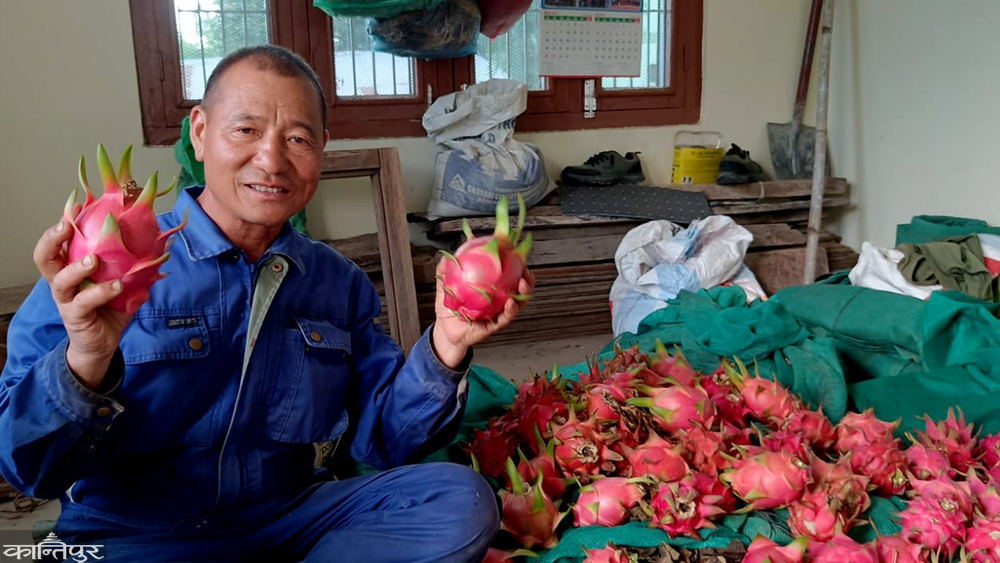
It is estimated that 155,150 kg of dragon fruit will be produced in this year's season. Dangi said that about 60 million will be in the hands of the farmers. He informed that the target is to triple the production in the coming year. He said that now the committee will be registered and they will do market management, pricing, exchange of experience, establishment of moisture center and other works.
In the beginning, dragon fruit was sold at a very high price. Bista sold red at 800 rupees and white at 700 rupees per kg. Now the red variety is being cultivated more in the district. Its price is decreasing annually. It was sold at 250 per kg in 2078 and 280 in 2079. Since 2080, the price has increased again. Coordinator Dangi said that it is being sold at 300 per kg in 2080, 330 in 2081 and 350 this year. He said that after the establishment of the
committee, prices were coordinated among businessmen and unnecessary competition in the market was stopped. Dang has red, white, yellow and red sea varieties of dragon fruit. Most of the firms have used poles and rings, while some firms have used modern technology. Dangi said that along with production, businessmen are paying attention to soil health, irrigation system and the use of biological technology. According to him, along with the increase in production, the number of consumers has also increased significantly. "Many consumers are purchasing directly from the firm, while the trend of ordering via phone and social media has also increased rapidly," he said, "Big businessmen have started sending their products to cities like Kathmandu, Butwal, Nepalganj, Pokhara." Dangi said that the expansion of dragon fruit cultivation showed the potential of economic prosperity, job creation and agricultural innovation. He said that there are still challenges such as market access, storage facilities, disease management and development of by-products.
This is the fruit of the Sinido species. Now it is being used a lot as a dessert in hotels. Jam, wine, chocolate, biscuit, powder, facial wash and other materials are also made from it. This fruit is produced five to seven times from June to November. Because its flowers bloom at night, it is also called the queen of the night. Its branches can be cut and planted. Because its plants are not strong, poles are used to support them. It can be cultivated from the lowlands to an altitude of 1,500 meters.

