Images taken 10 years ago and after will be analyzed by AI using Python software
We use Google Cloud Translation Services. Google requires we provide the following disclaimer relating to use of this service:
This service may contain translations powered by Google. Google disclaims all warranties related to the translations, expressed or implied, including any warranties of accuracy, reliability, and any implied warranties of merchantability, fitness for a particular purpose, and noninfringement.
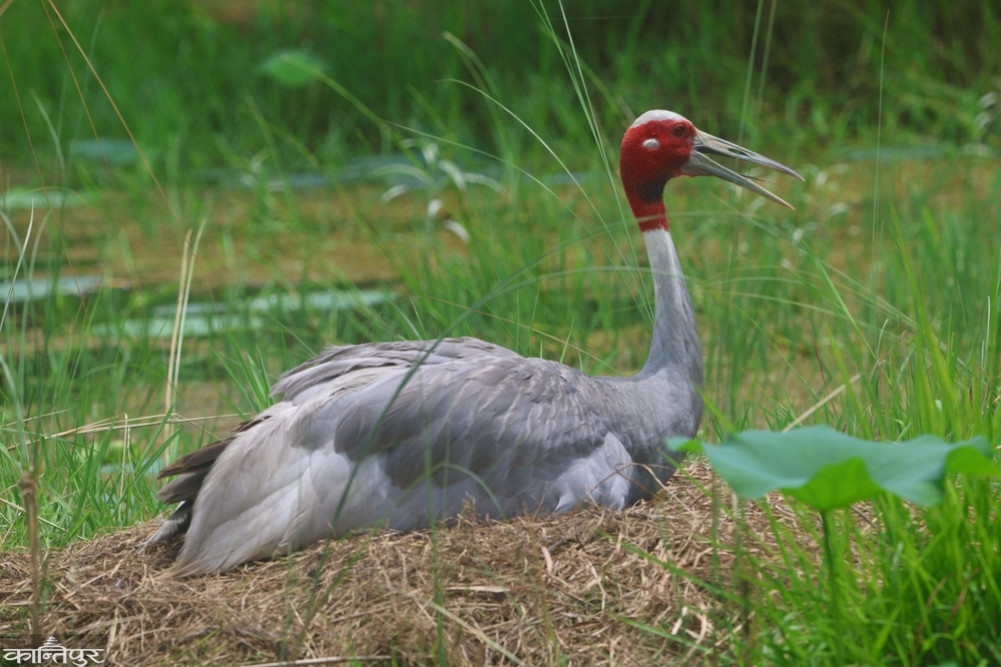
The study of the beautiful and charming stork has been started with the new technology AI. For the first time in Nepal, this kind of technology has been used to study birds.
Studies have been started around Lumbini by Bhaktapur Multipurpose Campus and Lumbini Green Youth Club with the technical support of Beijing Forest University China. University's technical team has photographed the world's rarest stork at Telar, Danava river, Gajedi and Gaidhawa lakes near Lumbini . Similarly, photographs of storks were also taken at various places on the Lumbini-Taulihwa road section, Dohani, Jagdishpur, Niglihwa, Sisahnia and Tulsidihwa.
More than 32 thousand snaps were taken in Rupandehi and Kapilvastu in 10 days. This technical team of the university came to Nepal in 2015 and took pictures at this place. At that time more than 24 thousand snaps were taken.
Dikpalkrishna Karmacharya, teaching assistant of Bhaktapur Multipurpose Campus, said that the photos taken 10 years ago and after will be researched using Python software through AI. "This research shows whether the stork that was photographed 10 years ago is still there," he said, "it also helps to know the age of the stork."
How is the movement of storks in Rupandehi-Kapilvastu inter-district, he said that it would help to know whether the storks that have built nests in one place build another place or not, one pair goes to the nesting place and the other goes or not.
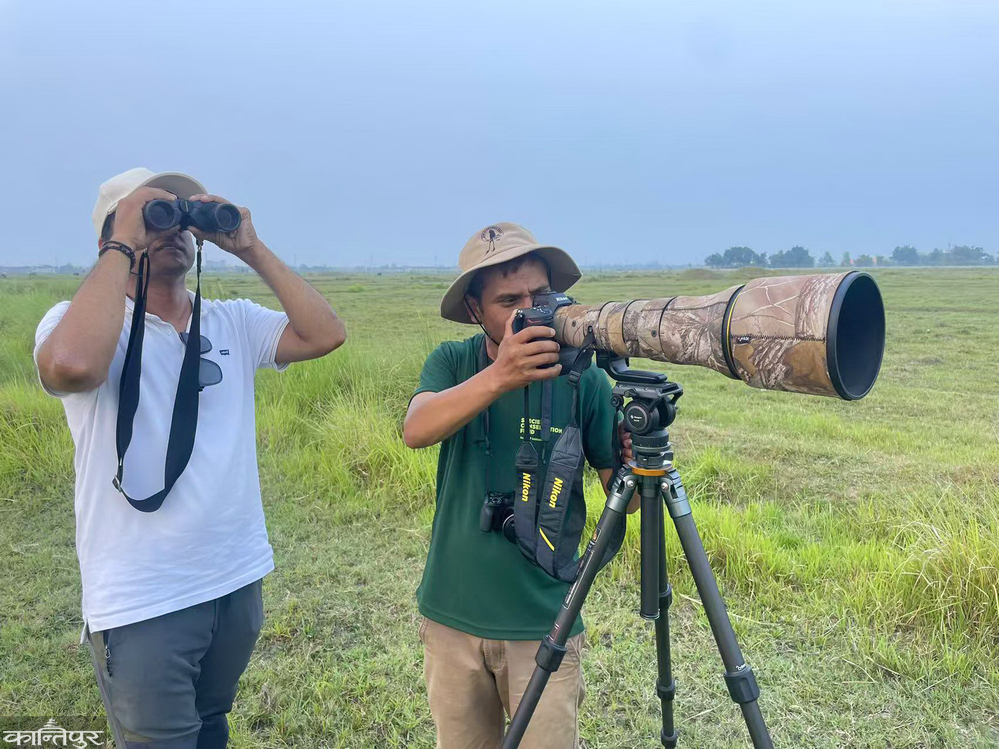
Lumbini Green Youth Club President Arjun Kurmi said that such a study will provide factual information about the behavior of storks and help in making conservation plans.
All snaps are captured with GPS data. According to the researcher, a picture of a stork is taken from the face and the left and right sides. Zoologist Dikpalkrishna Karmacharya said that even though they look the same when they see storks, they all have different faces. Karmacharya, also a member of the working committee of the Bird Conservation Association (BCN), says that the way to distinguish between different storks is from the neck up to the face.
'After putting the photos of storks in the software and analyzing the results,' he said, 'after about 3 months, the technicians of Beijing Forest University will prepare the data and send it to us . This kind of research done on birds is the first in South Asia.' A similar technique has been used in China for the first time in the Kalikanth Saras.
A professor of Weizing Forest, which belongs to the world's largest forest science university, and a research student studying Kalikantha Saras are assisting in the research .
'Bird study using new technology is the first time in Nepal,' ornithologist Dr. Hemsagar Baral said, 'This helps bring out a lot of things that are not known about storks . Adds a new dimension to conservation . Contributes to the development of tourism.'
600 storks in two districts. The stork, which is considered to be a symbol of love and harmony, has been declared the 'city bird' by the Lumbini Cultural Municipality. India's Uttar Pradesh has declared it a 'State Bird'. Stork is one of the 9 bird species listed under Nepal's Wildlife Protection Act 2029. In China, the stork is also considered a first-class national protected wildlife . The Kalikantha stork has been kept as the 'city bird' of Lhasa, the capital of Tibet.
A study conducted in 2080 showed that there are 690 storks in Nepal. In which about 600 storks found in Kapilvastu and Rupandehi ornithologist Dr. Hem Bahadur Katuwal said. Therefore, these two districts are hotspots for storks.
In 2000, the stork was listed as a rare bird in the world after becoming less visible. This is the tallest bird that can fly. The role of this bird in crop protection is seen as it eats insects including snails that damage crops. Experts say that animals such as leopards, tigers, bears and other animals come near and give information by shouting in advance .
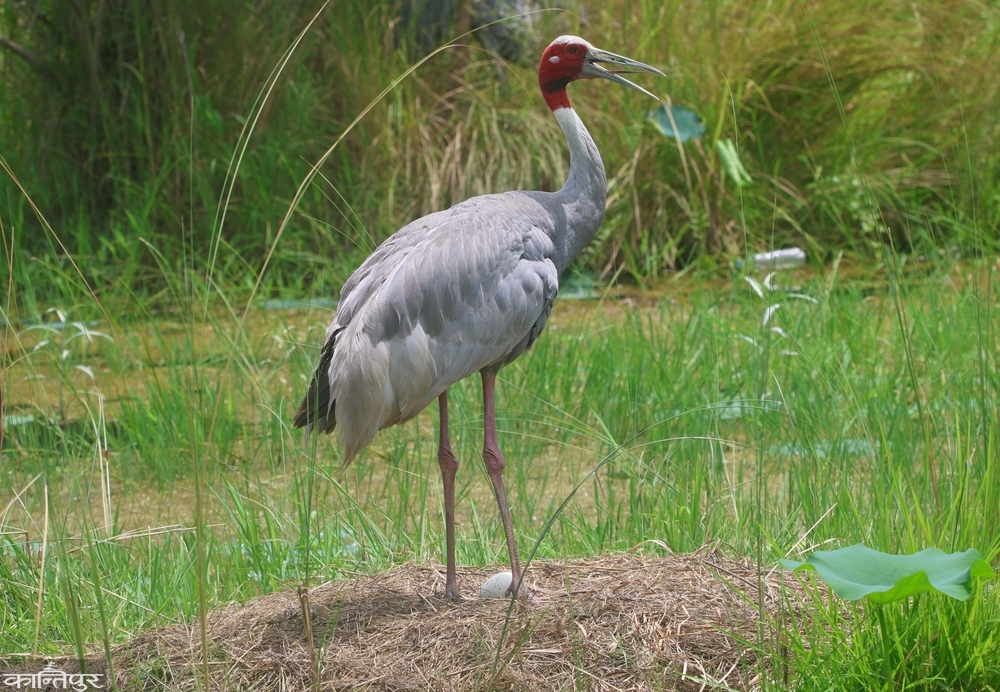
Storks hatch their young in 31 to 34 days . Out of 15 species found in the world, four species of storks are found in Nepal. Among them are Saras, Karyangkurung Saras, Lakshmana Saras and Kalikantha Saras . Karyangkurung, Lakshman and Kalikantha are winter visitors. These storks migrate from the North Pole in winter and go to the southern part through Nepal, while some stay here . There are 9 species of storks in China.
It is about two meters tall when standing and about three meters long when it flaps its two wings . Its weight ranges from 6 to 10 kg . It is an omnivorous species. It eats vegetation (seeds and their roots) and snakes, insects, wasps.