Women who went underground during the Maoist People's War are now earning a living by weaving Alloka cloth
We use Google Cloud Translation Services. Google requires we provide the following disclaimer relating to use of this service:
This service may contain translations powered by Google. Google disclaims all warranties related to the translations, expressed or implied, including any warranties of accuracy, reliability, and any implied warranties of merchantability, fitness for a particular purpose, and noninfringement.
Be it a meeting or a casual visit, it is customary in Rolpa to give gifts to the guests - clothes and accessories made from allo. The use of Allo's clothing and materials has increased as a sign of welcoming and loving guests.
Allo is a local product here. Due to this, the use of goods produced from Allo has increased as a symbol of Rolpali love.
In order to promote local products, the Rolpa Municipality has made a policy decision to use Alloka cloth as the formal dress of the public representatives. When attending an executive meeting, convention or regular meeting, every member wears an allokai dress (a coat of allokai cloth and a cap or shawl).
Bags, purses, shirts, etc. are also being produced from Allo's cloth. Rolpa bags are increasingly being given to any new visitor who comes to Rolpa. "Finding the thread and bringing it to the industry is sad. But after weaving clothes from the yarn, it is a pleasure to sell them,' says Srimaya Roka of Thabang, who has become a business entrepreneur by running the Allo Dhago industry.
Anyone can enjoy using materials such as bags, hats, mobile purses, etc. woven from Allo . Gita Thapa Acharya, a former entrepreneur and deputy head of Rolpa Municipality, says that the use of aloe has increased after the peace process.
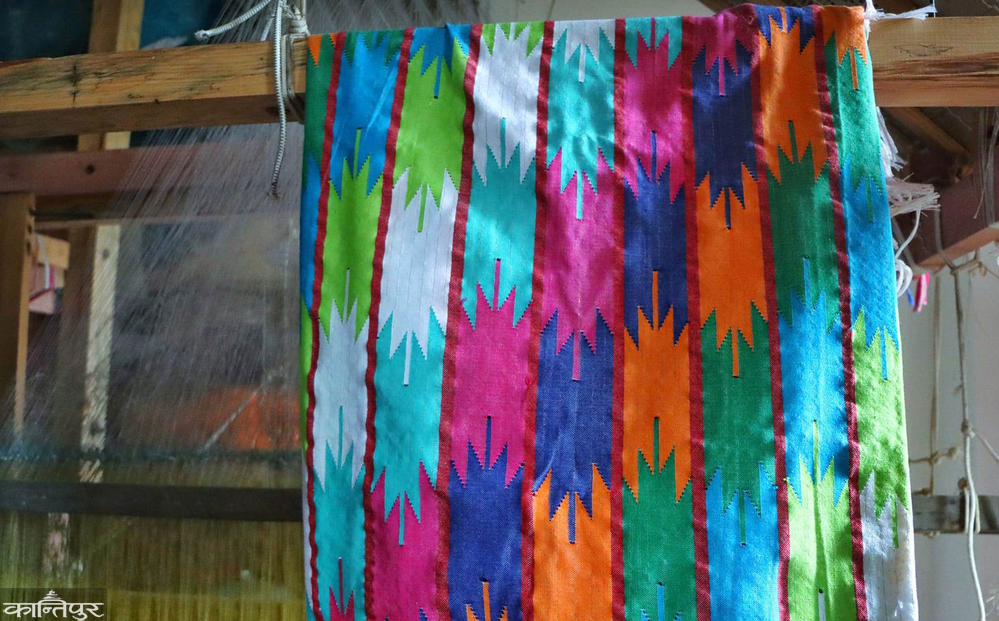
She says, "Before being elected to the city, my main job was to run the aloe industry". Due to my background in politics, I got the chance to be elected in the city, now I am thinking of going back and running the allo industry again.'' Many years ago, Rolpa community allo and textile industry was started to operate in Libang with the activism of him and his friends. From the beginning, not everyone was invited to run Allo Industry.
"In the beginning, we ran the industry with a partnership of 17 people", she says, "Later the industry also grew, we also had more directors". Had to work day and night. Time was spent in making materials such as coats, bags, pants, hats, shirts, purses, etc.'
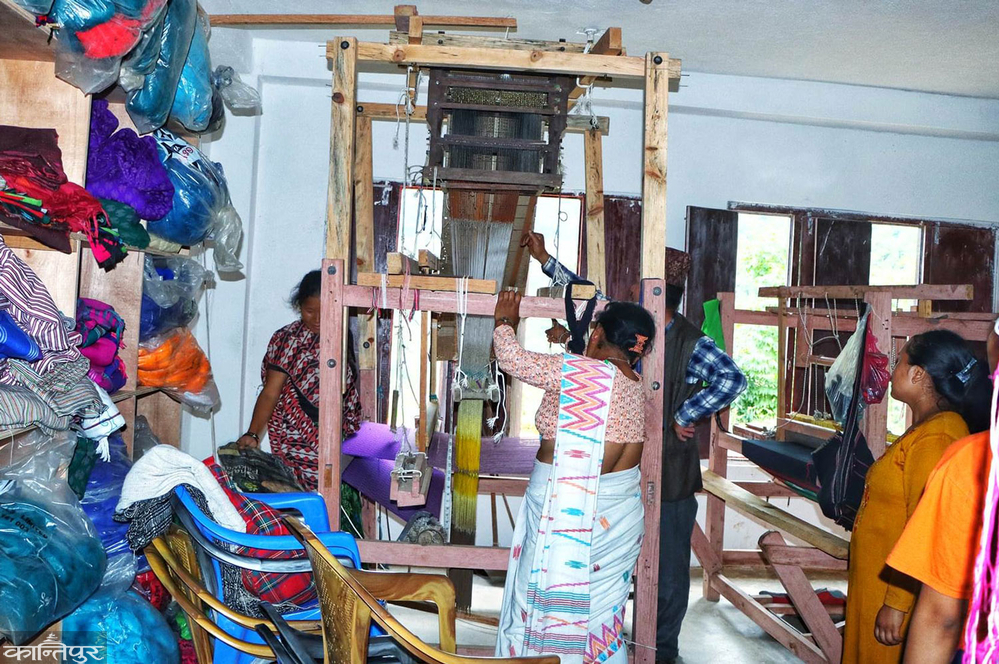
The industry is still operating, with only women as members in the steering committee of the industry. They started with general training from the District Domestic and Small Industries Development Committee and have now become skilled women entrepreneurs from all over the district in the same industry.
Women who went underground during the Maoist People's War are now earning a living by weaving Alloka cloth.
After the peace process, most of them have the experience of establishing small industries and developing skills. Those who worked in the small industries and businesses run by the party during the Maoist People's War have started enterprises after the peace process.
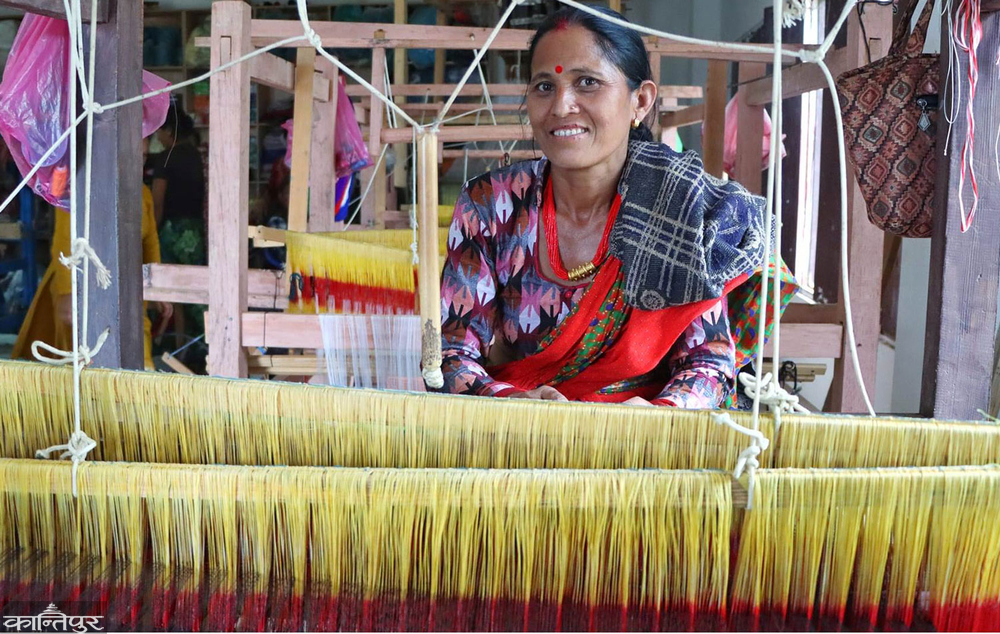
There is an investment of at least 50 thousand to 20 lakhs in small and big owl industries . Allo industries in Rolpa are operated collectively and individually. According to a statistic, about 12,000 tons of hemp and 2,200 quintals of hemp and 2,200 quintals produced in the district can create jobs for many people.
Among the trending cotton industries are Rolpa Community Cotton Yarn and Textile Industry in Libang, Livan Cotton Yarn Industry in Homa, Navadurga Cotton Yarn Industry in Iribang, Phulbari Hand Paper and Cotton Yarn Industry in Mirul Tutu, etc. Some of these industries have been producing yarn and cloth while some are producing only yarn.
According to the Domestic and Small Industry Development Committee, there is an investment of about 60 million Barabar in the industry operating in the district. The number and level of industries increased after the distribution of cloth weaving looms from Allo yarn. When the household distributes goods in this way, it provides at least 60 percent of the budget discount to entrepreneurs, including cotton.
The aloe plant known as Lekali Sisno is also called Puwa in Rolpa. In the local Magar Kham language, Allo is understood by the name Puwa. More than 1,500,000,000,000,000,000,000,000,000,000,000,000,000,000,000,000 There was no practice of cultivating aloes since it was found abundantly in the forests from the tradition. But after its use started to increase, it started to be cultivated .
There has been an increase in the interest towards Allo as it is used and beneficial as a necessity when conducting industry professionally. Recently, the demand for aloe has increased not only in the local market but also in the international market.
'As the demand for allo is high, we are engaged in its collection and distribution.' Rampura Rokamagar of Thabang, who is buying allo yarn in Libang, says, 'We deliver allo yarn to the international market.' She and her twin sisters have been doing business together for a long time.
The same Allo cloth that is cheap in Rolpa is sold at a high price when it reaches the capital. Businessmen say that after being transported to the allo processing industry in Nepaltar in the capital, the real allo thread and the cloth made from it will reach the international market. Junpura Roka, the eldest of the twin sisters, says, 'It is not only a good job, but also an acquaintance.' The twin sisters alone do a turnover of 60 lakhs annually .
The price of Allo cloth in Rolpa is the lowest 1 thousand 200 per meter . According to this calculation, for a men's coat made of allo, the cost of buying cloth is 4 thousand 200 rupees. A bag woven from allo costs 325 rupees, a hat costs 300 rupees, a woman's burqa costs 550 rupees, and a scarf costs 500 rupees. The Domestic and Small Industries Office has stated that there is a figure of about 40 million worth of allo yarn and cloth alone coming out of Barseni district.
production is estimated to be around 15 million. Among the three channels through which allo is exported are Sulichaur in the east, Holeri in the south and Nigalpani in the west. The order of export is 50% from Sulichour, 30% from Holeri and 20% from Nigalpani. Along with allo, other natural yarns such as Bhimal, Banana, Ketuki and Patua yarn have also increased in production and sales distribution.

