We use Google Cloud Translation Services. Google requires we provide the following disclaimer relating to use of this service:
This service may contain translations powered by Google. Google disclaims all warranties related to the translations, expressed or implied, including any warranties of accuracy, reliability, and any implied warranties of merchantability, fitness for a particular purpose, and noninfringement.
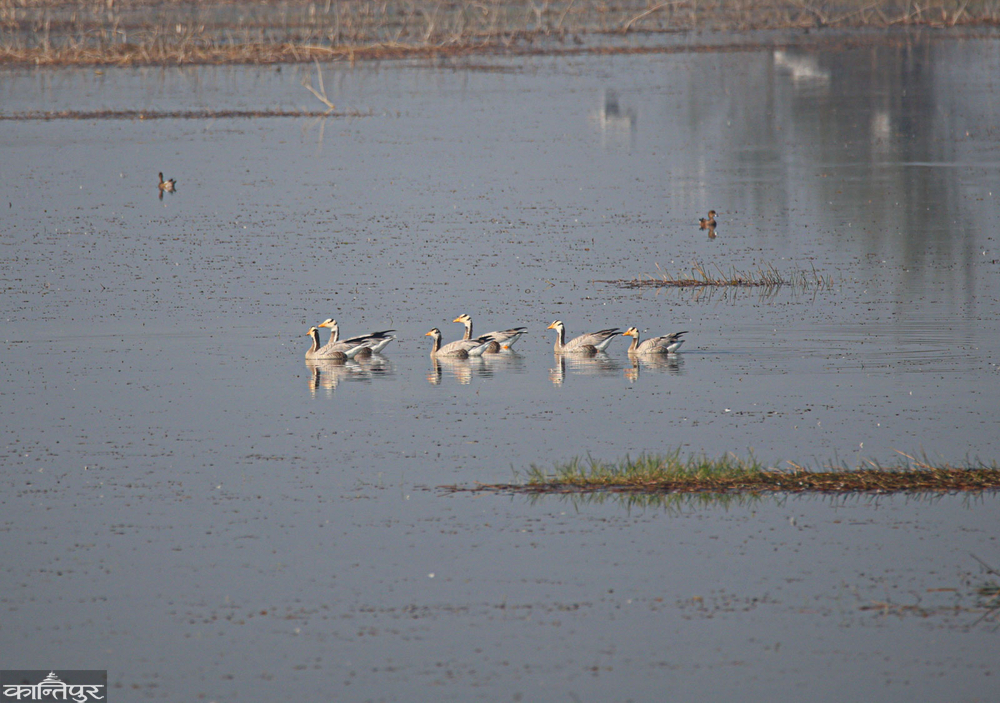
After crossing the highest place in the world, Mount Everest, 6 ducks have arrived at Jagdishpur Panchhi Reserve. After crossing the 8 thousand 848 meters high peak, the group of Khoyahans reached the Jagdishpur lake which is 95 meters above the sea level.
At this time, the ducks are roaming in the lake. While counting the birds, the team led by ornithologist Hathan Chaudhary has seen seven missing ducks. He, who has been observing birds in the lake for a decade, said that he was very happy to see the bird flying high above Mount Everest for the first time in Jagdishpur.
'It shows that the diversity here is excellent because the ducks can fly from a very cold place with minus temperature to Jagdishpur with normal temperature,' he said A research conducted by an American organization by attaching a satellite tag and a small video camera to the bird, the Khoyahans Sagarmatha, which migrates to Nepal. Ornithologist Choudhary said that it is confirmed that they are coming from above. During the winter, the ducks that come in November return to April/May. "This bird, called bar-headed goose in English, flies at a height of 9,375 meters above Mount Everest during its migration," senior ornithologist Dr. Hemsagar Baral said, 'Even now they come to Nepal by the same fly route.' He said that he migrated to Nepal from there. Ornithologist Dinesh Giri said that the information about flying above Mount Everest surprised the world's bird lovers.
'At high altitude, oxygen and temperature are very low. It is also very difficult for animals to fly. Breathing problems increase at higher altitudes. But how the ducks can easily fly around at such a height has surprised and intrigued everyone," said ornithologist Giri. That is why it is also called a wonderful bird, he said.
'When coming from around 5,000 meters height, there is a fear of attack by Suparna Mahachil,' he said, 'that's why it may have flown up.'
The body of Khoyahans, which looks very attractive, is white with a slight gray color. One third of the head and neck are white, the rump and legs are yellow. There are two black stripes on the neck and black eyes. The tip of the wing is slightly black. This bird is 68 to 78 cm long and 2 to 3 kg in weight, which likes rivers and riverbanks. It likes agricultural land. Tourists flock to India to see the khoya ducks that can fly continuously for 7 hours. However, we do not have any inquiries about this.
Ornithologist Baral said that a pair was seen for the first time in Jagdishpur in 2017 after records were kept in 2008. "After that, 6 have been seen for the second time after 8 years," he said. Similarly, this year, black swans and yellow-billed black swans have also been seen in Jagdishpur.
These two birds, which were first seen in 2017, have been seen for the second time after eight years. The yellow-billed goose comes from the arctic northern region of Siberia and the goose comes from northern China, southern Russia, Siberia and Mongolia. Ornithologists say that these birds also come to Nepal along with Khoyahans around Mount Everest or crossing the mountains.
Bird caught for the first time in Jagdishpur
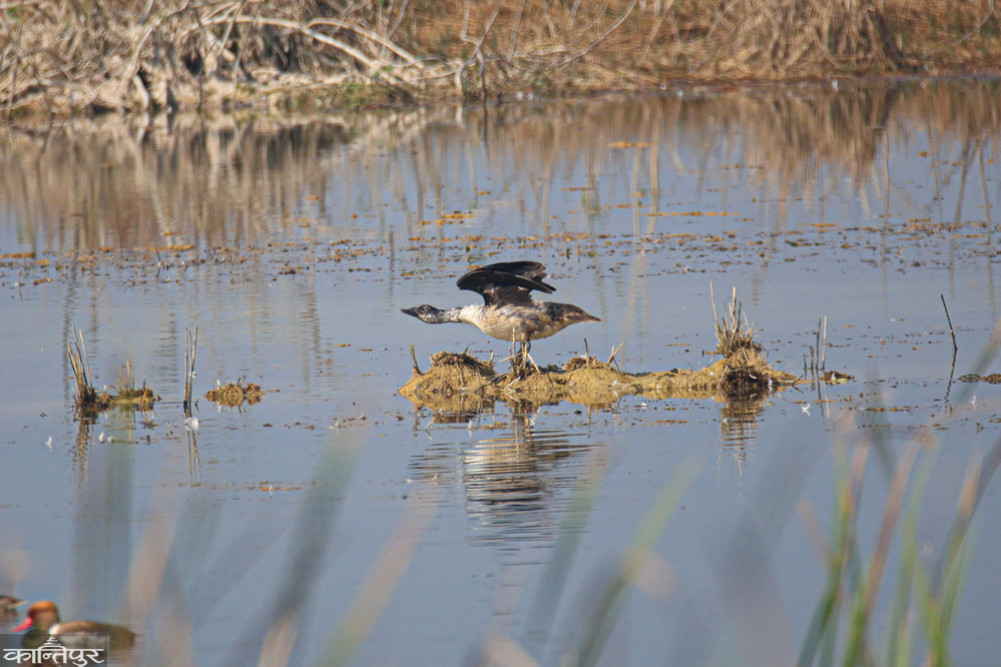
Raithane bird caught for the first time in Jagdishpur Lake, which shelters the most water birds in the country It has been seen. One was recorded at the north eastern corner of the lake during the bird count. The bird that was first seen in Kailali in December 1952 in Nepal was seen in Kapilvastu after 73 years by senior ornithologist Dr. Hemsagar Baral said.
Raithane bird, which is in crisis nationally, is estimated to be at most 300 in Nepal. "This bird was recorded for the first time in Kapilvastu," said senior ornithologist Baral, "it has not been seen in Rupandehi for 45 years." It is mentioned in the Nepal Nature Conservation Society's news letter that it was seen by L. Underwood for the first time in Gaidhwama lake in Rupandehi in February 1980. Raithane duck is the largest among the 6 species found in Nepal.
Silsile, Harihans, Nadun and Nakata found in Terai, green-headed ducks in the mountains and chakhewa chakhewi in the mountains are carrying babies. This bird is mostly found in Kailali and Kanchanpur in Nepal. This bird is named Nakata because the big meat grows in the nose of the rooster during breeding. It is different and attractive from other birds.