Dairy operators say: There was no market, they could not compete with imported dairy products
We use Google Cloud Translation Services. Google requires we provide the following disclaimer relating to use of this service:
This service may contain translations powered by Google. Google disclaims all warranties related to the translations, expressed or implied, including any warranties of accuracy, reliability, and any implied warranties of merchantability, fitness for a particular purpose, and noninfringement.
Milk producing farmers have complained that they are in trouble. They said that while the dishes made from Indian milk are easily imported into Nepal, the milk collected by the farmers here is not getting the market.
Due to the fact that milk and milk products from India are easily available in the market here through the open border of Ruppandehi district, the farmers expressed their grief that the businessmen and customers do not buy the milk they collect and the dishes they make because the price is high. Also, they said that they are going to have trouble raising cattle if they don't get the payment they should get from selling milk.
Most of the farmers of Mr. Saljhandi Milk Producers Cooperative Society Ltd. said that every day they have to sell their cattle and buy and drink the milk themselves.
Sainamaina ward no. Farmers belonging to Shree Saljhandi Dairy Cooperative Society Limited located in 11, accused the government of focusing on the migration of the farmers even when the cooperative operated the industry and made the food and took it to the market. The cooperative, which has 409 share members, has been collecting 4,500 liters of milk daily and delivering it to Butwal and nearby markets.
'Milk production is low in summer but consumption is high, so it is not difficult to sell,' President Tilakram Ghimire said, 'There is a problem of high production and low market in winter.' He said that it was ironic that he was forced to send the milk to the market through cooperatives even though he did not get it.
He says that in the summer, he made and sold sweets and ice cream, but stopped those two products in the winter. Ghimire said that since meat food is more preferred than milk, it has become a challenge for them to raise cattle. He said that sometimes when the fat of the milk decreases until it reaches the market, the businessmen give false publicity, and the problem is that the customers do not agree to buy, and there is no other option but to pour the milk.
Farmer Leeladevi Gyawali said that the citizens of Nepal, which is considered an agricultural country, should not think that they can make a living by rearing cattle. Remembering that in the past milk was produced and sold from house to house, she said that when it was collected from cooperatives run for farmers and sent to the big market, it would be thrown away without being sold. 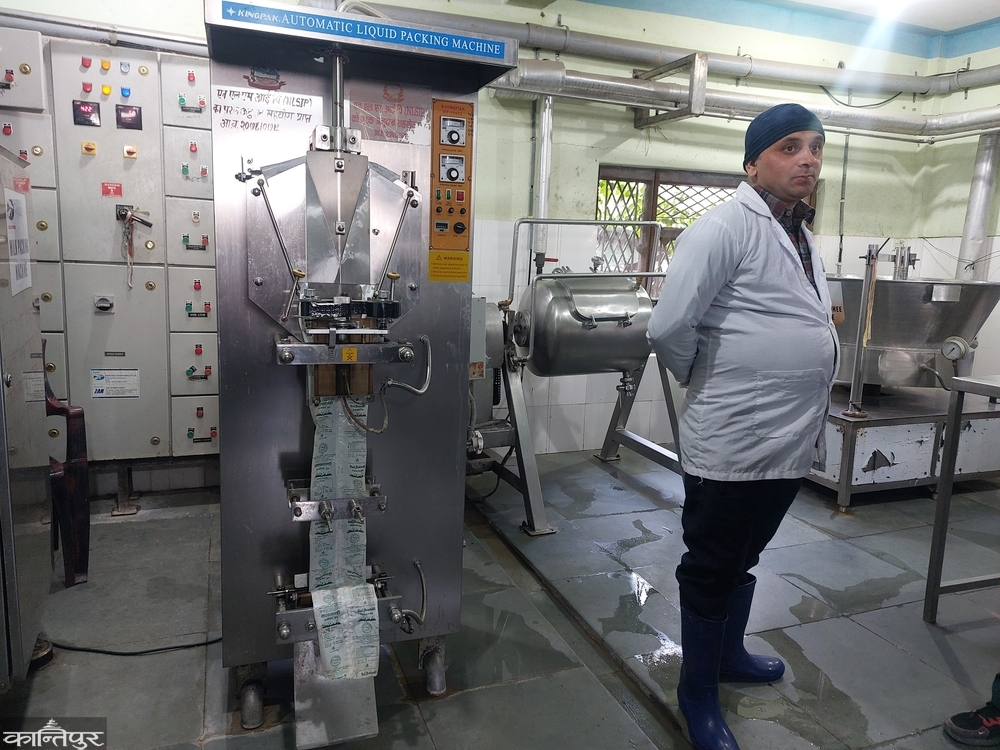
'Because the car goes to Butwal at 4:30 in the morning, milking starts from 3 o'clock, it cannot be said that it is winter or summer,' she said, 'It hurts when the milk comes back after so much trouble.' She also said that because there is no way of earning, there will be a shortage of food in the family.
Gyawali said that even the people's representative who came to the election said that when the lion comes to every house, they feel that when the price of milk is fixed at 93 paisa, there will be no one to eat. Even if there is nothing, the local government should fix the price to give the farmers up to 2 rupees, he said. She has not received the payment amount for the past 1 year and said that she would be happy even if she only gets the money that she deserves because she has spent millions on buying fodder, buying grass, and treating cattle.
Similarly, farmer Tikaram Pandey said that after asking the government-run DDC to give enough milk, we will buy it, they took it but suddenly stopped giving money. When he asked why he did this, he remembered the old habit of arguing that the milk was not sold, so it was made into ghee, the stock of ghee was too much, it was not sold in the market, and payment could be made only after it was sold.
He said that they were confused when DDC suddenly said, "Don't bring, we won't buy" the milk that DDC demanded a lot as the milk of Saljhandi Cooperative. "When I went to the DDC that said there were 10 tons of ghee, I did not see even 10 quintals," he said. There is a market, and the businessmen started buying it after they asked to buy milk from there.'
In the year 2050, Pandey, who is also the founder president, informed that they started the cooperative by collecting 43 thousand 30 liters of milk from 49 share members in the first year after establishing the cooperative in Saljhandi.
Not only this, but the current president Tilakram Ghimire says that when they make milk powder and deliver it to the market, their production is overshadowed because there is a huge supply of Indian powder. According to him, the provincial government also reduced the subsidy of Rs 2 to the milk producers in 2079/80. He said that they were upset when they said that there was no procedure by giving a verbal assurance that 93 paisa would be reduced to 2 rupees in cooperation with the municipality.
Chairman Ghimire said that they had to suffer only because the insurance company did not give the amount given by the government for animal insurance. Currently, the milk collected from the cooperative has 16 million rupees left to be raised in the market. The cooperative is collecting milk by dividing the farmers who are keeping more than 10 cattle in a special way and the others in a general way . Not only this, he also said that the cooperative distributed 43,000 liters of milk for free during the lockdown during the corona virus.
This cooperative has 6 collection centers in Sainamaina and Kanchan Rural Municipality and has been operating grain industry for 6 years. Ghimire informed that the grain produced by this industry, which was established at a cost of 36 lakhs, will be provided as a subsidy to the farmers. He said that apart from the weather, the demand of businessmen and customers, the declining population is also a problem in not selling farmers' milk. The total share capital of the cooperative so far is 1 crore 5 lakh 10 thousand 500 rupees.

