We use Google Cloud Translation Services. Google requires we provide the following disclaimer relating to use of this service:
This service may contain translations powered by Google. Google disclaims all warranties related to the translations, expressed or implied, including any warranties of accuracy, reliability, and any implied warranties of merchantability, fitness for a particular purpose, and noninfringement.
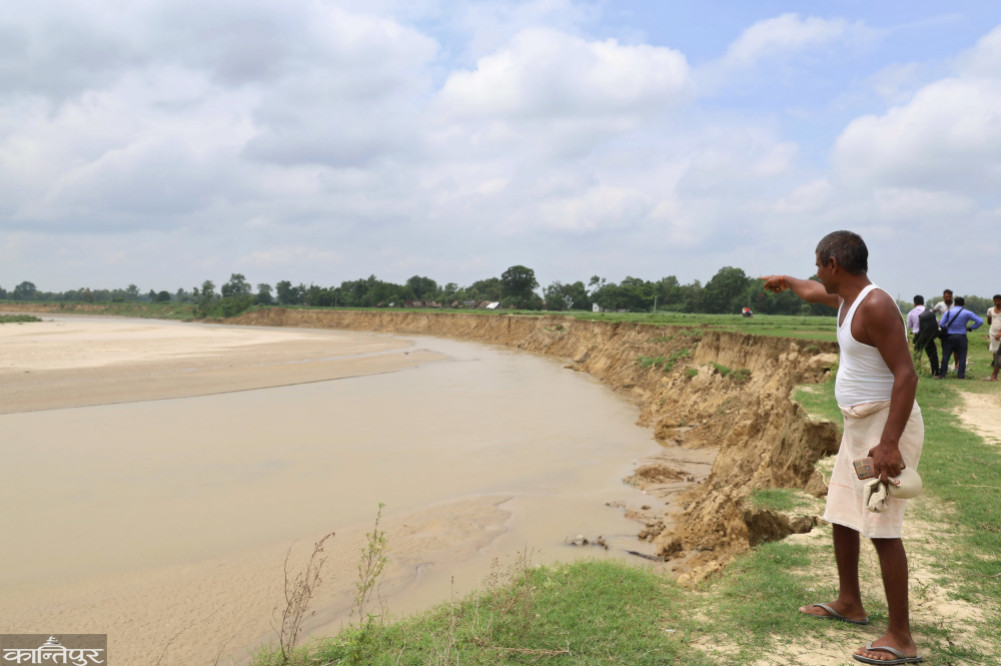
Increasing erosion every year, the river is about to reach the yard. There is no room to move back as it is connected with Dasgaja. 64-year-old Ramsagar Choudhary of Krishnanagar municipality-12 Bhadui village is under stress as the cultivable land is being cut every year and it is touching his home. "There is no place to move now," he said. There is a river ahead. As soon as the clouds came down and it was raining, I had to chant God's name.
He said that he became a squatter when 22 bigha fields were cut by the river in 15 years. Like him, Islu Upadhyay of Bhadui said that he lost his hunger and thirst after 17 bigha fields were cut by the river in 18 years. "Now there is only 3 bighas left, there is concern about how to make Chulochau for 7 families," he said.
The Arra (locally called Charanghwa) river that flows through the Indian border has been in trouble for the local people since it has been carrying away agricultural crops every year. The arable land of 75 houses in four villages namely Bhadui, Manpur, Hathiagarh and Joshidihwa has been eroded by Arra river every year. It has started reaching near the river village . The flood since the third week of last June has caused problems to the locals. Every year, as arable land turns into wasteland, their production is decreasing . "The paddy and wheat of one's own farm is the means of running a household," Chowdhury said, "The land is decreasing. It seems that there will be a problem to tie hands.' 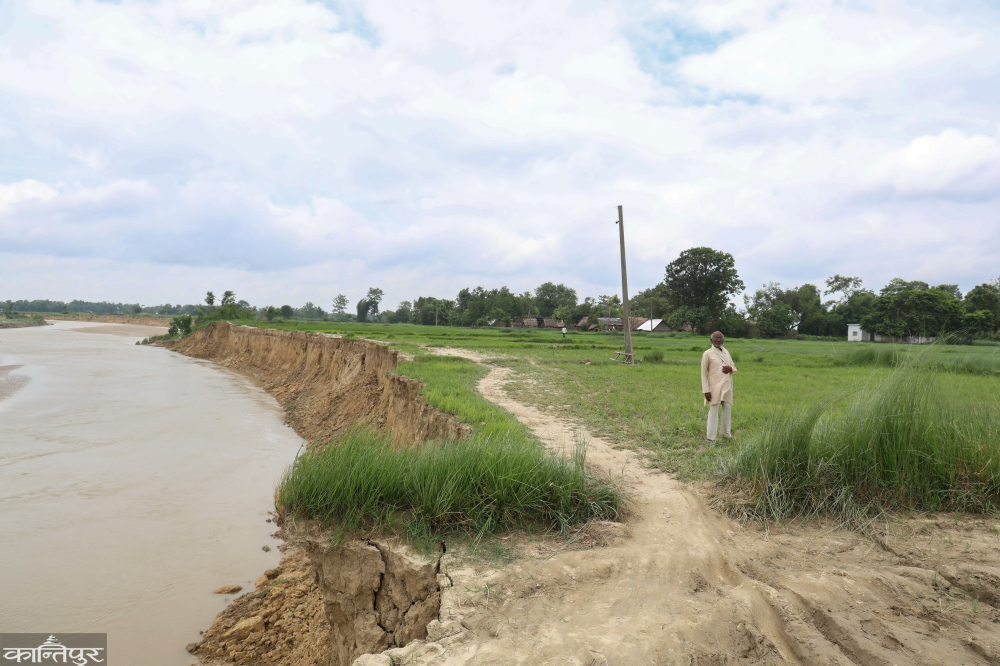
The road leading to Bhadui village is a narrow road made by plowing fields after the river has washed away.
Bhadui village is the most affected by river erosion. 17 houses in this village are surrounded by the river on three sides. Dasgaja is also connected to the open south side. To the east and west, the fields of many people in the village have been merged into the river. Another village Manpur has 35 houses. This village is in the grip of erosion from the north and east. Similarly, Hathiagarh village, which has 15 houses, is also facing the problem of erosion every year. It is cutting the village from the north and west. Similarly, Joshidihwa village, which has 7 houses, has been cut from the north and reached the river near the settlement. Baliram Murau of Manpur said that 50 to 100 bigha fields of these 4 villages are being cut every year. "It will have an impact on grain production," he said, "now it will be difficult to maintain a household."
There is no means of employment in these villages which are in backward areas of the district. It is difficult to get 10th class pass across the slums. There are only one/two government employees . Janakram Chaudhary of Bhadui said that the source of income in such a place is farming, but the suffering of the villagers started when the arable land was cut every year. Bhadui village is only 70 meters away from the river. From the other three villages, the river flows continuously. "The road leading to the village is not well arranged," he said, "cars cannot reach the village due to the river." During the rainy season, it is very difficult to travel. The river rises and the road to Krishnanagar, the Nepali market, becomes slippery during the rainy season. 3/4 months of rains have to rely on the Indian markets of Majgwa and Pachpedwa, 13 km west across the border. Janakram told that there is a compulsion to go there to buy or treat the house to avoid the storm. 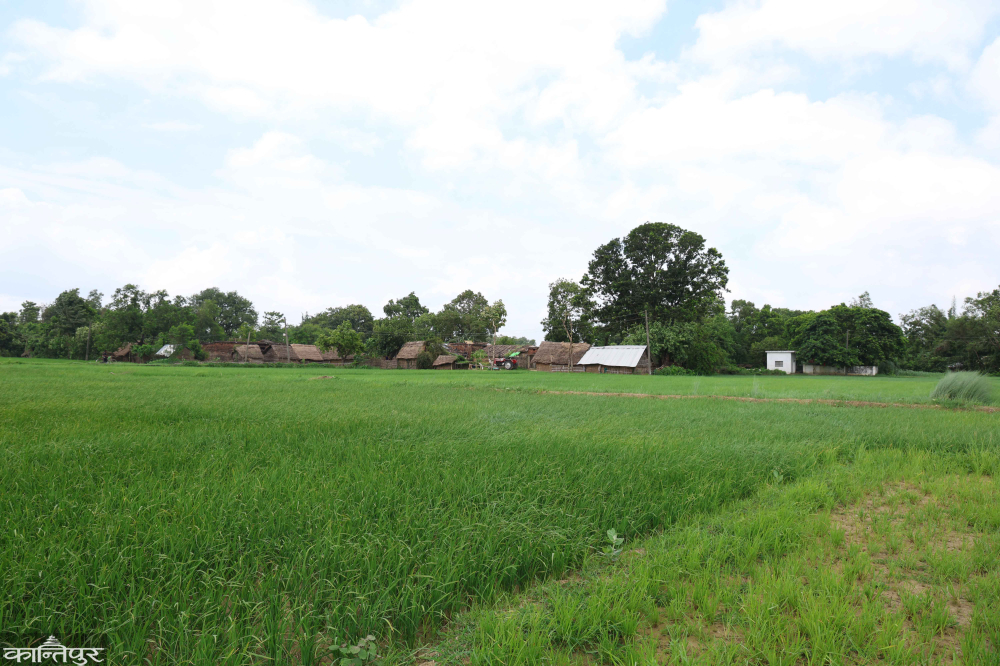
Bhadui village hit by river erosion.
This year's flood has cut down one and a half hundred bigha of paddy fields planted by farmers in Bhadui and Manpur. Wazir Pathan of Manpur said that in 10 years his 29 bigha fields were eroded by the river and now only 3 bighas are left. Ramsagar Choudhary of Bhadui said, "I said that I would work hard in the farm and take care of the house. I spent more than one lakh and planted paddy in 10 bighas, but everything has been washed away." What to do now, the mind has stopped working.'
After the recent flood swept away the 4 meter wide and 300 meter long gravel road connecting Manpur-Bhadui, the locals are having trouble moving around.
When it is a poor, deprived and backward place, people's representatives do not reach much . There is not even one representative representing these four villages in the municipality. Locals complain that their problems have not been addressed since other representatives of the municipality did not come. However, this time, Rajat Pratap Shah, the head of the city, came to listen to the complaints of the flood victims. "Locals are suffering a lot due to river erosion. Control is not possible with the city's efforts alone,' said city chief Shah, 'we have started working together with the state and union government.'