The Bagmati Literature Festival will last for two days, where there will be debates on various aspects of literature, as well as performances of plays, songs, music, ghazals, and poetry.
We use Google Cloud Translation Services. Google requires we provide the following disclaimer relating to use of this service:
This service may contain translations powered by Google. Google disclaims all warranties related to the translations, expressed or implied, including any warranties of accuracy, reliability, and any implied warranties of merchantability, fitness for a particular purpose, and noninfringement.
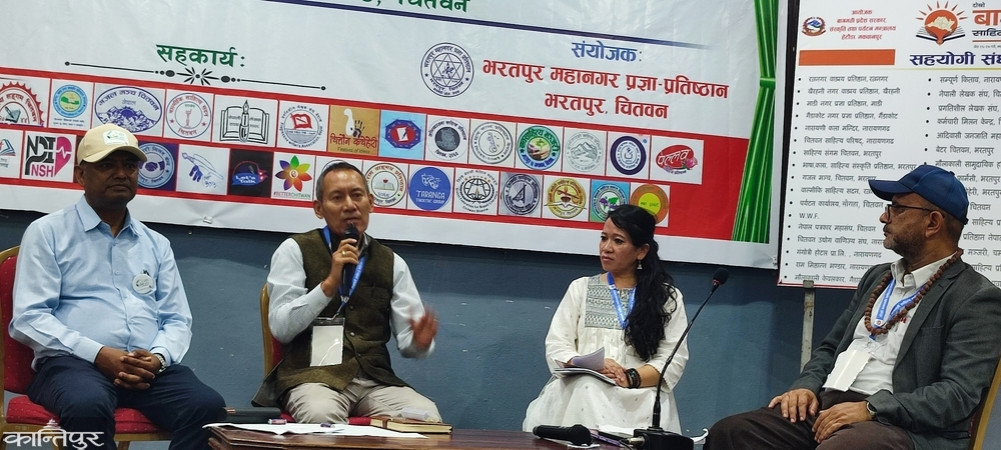
A discussion was held in Narayangadh on Saturday about the meaning and purpose of environmental literature. On the opening day of the second Bagmati Literature Festival, Bharatpur Divisional Forest Officer (DFO) Bishnu Prasad Acharya discussed the topic with writers and litterateurs Roshan Sherchan, Laxmi Rumba and Kamaljung Kunwar, focusing on the topic ‘The Courtyard of Environmental Literature, Wide or Narrow’.
Sherchan, who studied forestry, said that the description of nature is not a new topic in Nepali literature and the history of environmental literature is not long either. ‘Nature should not be described only in images and flavors, but the causes of the crisis faced by the environment should also be explored. Then, we should be able to give a message of conservation, this is the meaning of environmental literature. It is not enough to just praise nature,’ he said.
Another speaker, Laxmi Rumba, said that the direct impact of the environmental crisis is seen on indigenous peoples. ‘If trees and forests are destroyed, it affects the lifestyle of the entire community. It is necessary to raise this voice,’ she said. Rumba, who is the treasurer of the Environmental Literature Foundation, believed that environmental literature is necessary to raise awareness and sensitize people about the suffering caused by the environmental crisis.
Kamal Jung Kunwar, the author of the famous book ‘Ghindalai Char Barsha’ and former Chief Conservation Officer of Chitwan National Park, said that environmental literature should make people understand that trees are the basis for balancing nature or whether they are cut down and consumed to make things like chairs, tables and drawers. He urged that environmental literature be given a wider space in all genres of literature, including stories, poems, essays and plays.
Sherchan was of the opinion that it is too early to assess the status of environmental literature in Nepal, as it has only been around three decades since its inception. Lakshmi Rumba opined that the environmental literature that emerged due to the global crisis has gone on a wide journey from Sandhuro and has now reached a moderate state. Kamaljung Kunwar said that it should also be connected to the educational, academic and spiritual fields. Kunwar said that since the war against nature cannot be won, it should be properly utilized, not exploited. He mentioned that the concept of parks, reserves and protected areas came with this thinking. Kunwar had replied to a question asked by Bina Thing, concerned that when various products consumed by locals in parks or protected areas are stopped, traditional knowledge and technology are lost and this will add to the crisis in the environment.
‘There are discussions about the traditional professions and livelihoods of the tribals. Initially, the rivers flowing through the park were used for fishing. Later, certain criteria were set and given to the tribals dependent on this,’ Kunwar said.
The Bagmati Literature Festival will last for two days. Where there will be debates on various aspects of literature, plays, songs, music, ghazals and poems will be presented.
Participants in the discussion of literature at the festival. Photo: Ramesh Kumar Poudel/Kantipur