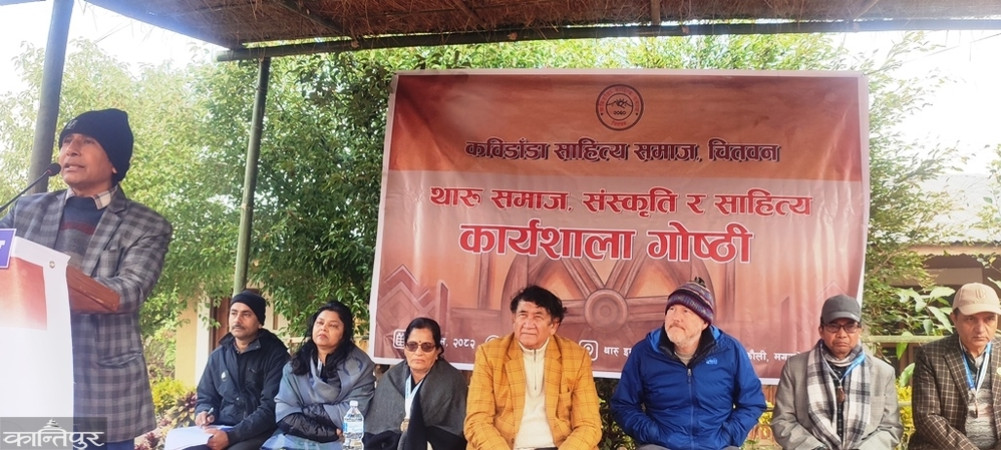
Tom Robertson, an American citizen who teaches environmental history, said in a discussion held at Janakauli Magartol, ”There were Tharus in Chitwan, and because of the Tharus, there are tigers and rhinos here.”
We use Google Cloud Translation Services. Google requires we provide the following disclaimer relating to use of this service:
This service may contain translations powered by Google. Google disclaims all warranties related to the translations, expressed or implied, including any warranties of accuracy, reliability, and any implied warranties of merchantability, fitness for a particular purpose, and noninfringement.
The largest number of tigers and rhinos in Nepal are found in Chitwan National Park and the surrounding forests. Why are there so many tigers and rhinos in Chitwan? We think it is because the park was established 50 years ago. A slightly different point came up in a discussion held at Janakauli Magartol in Chitwan on Saturday.
American citizen Tom Robertson, who teaches environmental history, said at the program, 'There were Tharus in Chitwan, and because of the Tharus, tigers and rhinos have come here.'
Tom, the main speaker at the Tharu Society, Culture and Literature Workshop, added, 'Only when there is grassland, tigers and rhinos can there be rhinos. Rhinos graze on grass. Tigers eat the chital and deer that graze on grass. That is why tigers and rhinos have come here because of the grassland.' He said that the grasslands have been preserved because of the Tharu community.
Tom said that in the past, the Tharus used to set fire to the forest area from time to time to create grasslands. He said that if they had not done this, the forest would have covered everything. After being covered by a forest with small and large trees, shrubs and bushes, the grasslands would have disappeared, and if there were no grasslands, there would have been no tigers and rhinos. But he expressed regret that this fact and history have been erased.
He also expressed his interest in the impact of the settlement development in Chitwan through the Rapti Doon Project, which is aimed at eradicating malaria with the help of the US government, on the Tharu community. 'This was a major project of US assistance in Nepal. The preparations and perspectives of the US and Nepal regarding this can be found in the papers, but I have been working on going to the community to meet, talk to, and find evidence of the impact it had on the Tharu community,' said Tom.
He said that while the US was implementing the Rapti Doon Project, which was launched in 2013 BS, it did not understand the Tharu even though it took help from those living in Kathmandu and who understood English. He concluded, 'It is not good even if you try to do good if you do not understand the history and culture of the Tharu.'
With the malaria eradication and the Rapti Doon Project developing systematic settlements, the migration from the hilly areas to Chitwan has accelerated. Before that, the plains of Chitwan were mainly inhabited by Tharus, as well as Darai Bote and Kumal communities. Tharus were here even when malaria afflicted them. Tom said that malaria also affected them. But he said that malaria did not make Tharus sick like the hill communities.
Tom was also honored by the society's president LB Chhetri at a program organized by Bharatpur's literary organization Kavidanda Sahitya Samaj. At the program, writer Neelam Karki Niharika said that society will be stronger if it moves forward by incorporating the different strengths and cultures of society. He said that the culture of the community is the ink and soul of the pen for literature.
Presenting a working paper on the topic Tharu Society, from primitive origins to modern identity at the program, Sanjay Chaudhary said that although the indigenous people used to have access to abundant land and natural resources, the government policies and laws made in the modern era have alienated them from it. Chaudhary said that the influence of other communities on Tharu culture and tradition is increasing and these subjects are now becoming elements that are kept in museums.
Another paper presenter, Krishnaraj Sarvahari, shared his views on Tharu lifestyle, society and culture. He said that although the Tharu community has a population of over 1.8 million in Nepal, there is only one Tharu language literary magazine that is published regularly. Sarvahari says that the indigenous language and literature have not been able to spread due to lack of state investment.
He said that even though the issue of Tharu has come up a lot as a political demand, it has not been reflected in literature. 'I think that if the indigenous language is taught at least at the basic level of schools, the language and culture of that community will flourish,' said Sarvahari. Reviewer Ek Narayan Poudel commented on the two papers. In the program, Associate Professor Chetraj Regmi debated with Mohan Dangaura, Kari Mahato, Babita Chaudhary and Maniraj Mahato about the emerging landscape, writing, subjects and trends of Tharu literature.