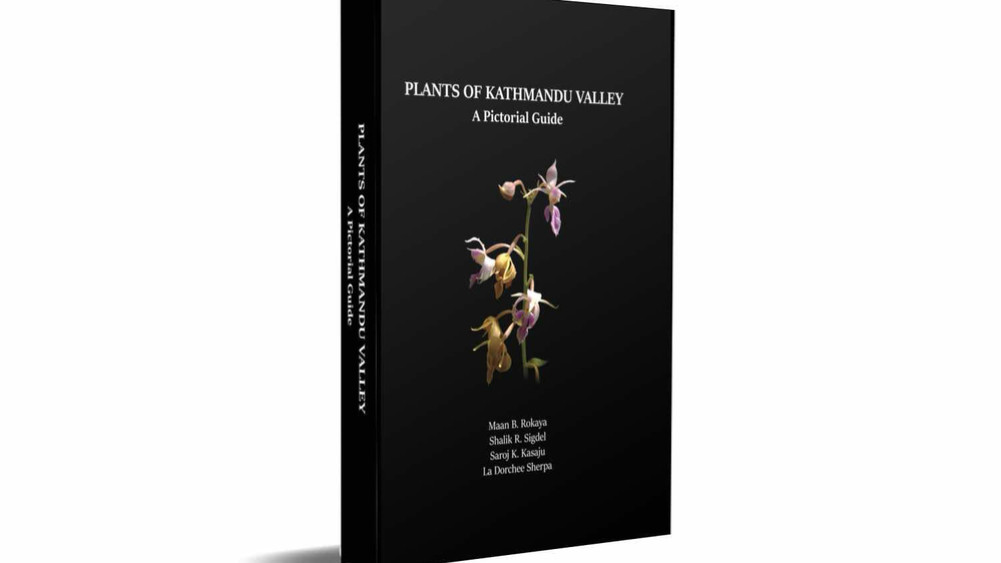
This book contains the details of the flora of Nagarjuna, Shivpuri, Kakani-Tokha, Sundarijal-Chisapani-Sankhu, Godavari-Phulchoki, Hattivan-Chandragiri, Sankhu-Nagarkot-Nala, Gokarna, Suryavinayak, Wagmati Corridor areas of Kathmandu Valley.
We use Google Cloud Translation Services. Google requires we provide the following disclaimer relating to use of this service:
This service may contain translations powered by Google. Google disclaims all warranties related to the translations, expressed or implied, including any warranties of accuracy, reliability, and any implied warranties of merchantability, fitness for a particular purpose, and noninfringement.
Nepal's presence in the study and research of botanical science is very weak. Due to limited resources, the number of people studying and researching botany is decreasing. The botanists of Nepal are forced to leave their motherland and work in different countries.
Even when they return home, they have not left their religion. In order to contribute to the flora of Nepal even when they came back home, they have continued their research work.
Among them, the botanist working at the Institute of Tibetan Plateau Research of the Chinese Academy of Sciences in Beijing, China. Dr. Shalikram Sigdel and a scientist working at the Institute of Botany of the Czech Academy of Sciences of the Czech Republic. Man Bahadur Rokaya has contributed to the study and research of plants even though he was abroad. Even while abroad, they are studying and researching the flora of Nepal. Along with these two scientists, Saroj Kumar Kasaju and La Dorchi Sherpa have recently published the book 'Plants of Kathmandu Valley: A Pictorial Guide'. Kasju and Sherpa are citizen scientists with a keen interest in plant photography.
There are few Nepali botanists who work in plant nomenclature. Therefore, the research in this area is very less. This book, published as an important contribution to the world of flora, is very useful to understand the flora of Kathmandu Valley.
Kathmandu Valley has been famous for the discovery and research of plants since the beginning. The biological diversity here is so much that new species are being found here as soon as they are discovered. This area is rich in biological diversity as mentioned in previously published scientific findings.
Kathmandu Let's say that in Nepal, the work of plant documentation was done 223 years ago. That is, since 1802, the vegetation here has been recorded. For the first time, foreigners have done the work of scientifically studying, documenting and identifying the flora of Nepal. Francis Buchanan-Hamilton, a British botanist who came to Nepal via India, first started recording the flora of Kathmandu in 1802. About 20 years after he came to Nepal, Nathaniel Wallich made a study visit to Nepal. His aim was also to get information about the flora of Nepal.
Hamilton studied/documented the flora of Bhimphedi, Chitlang and Kathmandu through the southern region of Nepal. About 20 years after Hamilton's arrival, i.e. around 1820/21, when Nathaniel came to record the flora of Nepal, he passed through the northern part of the Kathmandu valley and reached Gosaikund in Rasuwa. About 90 years after that, i.e. in 1906, Isaac Henry Burkill did the work of recording the flora of Nepal around 1906 along the same path followed by Wallich.
Even though the process of recording plants started 200 years ago, new plants are still being discovered from Nepal. More than a dozen new species of plants have been recorded from Nepal for science. Sunakhari's well-known botanist Dr. More than a dozen collected from Nepal by Bhakta Bahadur Raskoti in the last two decades were found to be new species for botany. Plants not found by Hamilton in Kathmandu Valley Sherpa and Kasju, the co-authors of this book, have discovered . Sherpa discovered a new species of Ainselu in 2021 from Shivpuri-Nagarjuna National Park . Kasju discovered a new plant species for science in 2020 from Bhaktapur in 2017. The plant of the species Thunbergia was also named Thunbergia casjuwana in honor of Kasju. The honor of the Sherpa was also placed in Aisul's Rubus Dorji.
Two botanists and two 'citizen scientists' who are interested in plant photography, this book is very useful for those who want to understand the flora of Kathmandu Valley. It covers most of the vegetation . The authors have described the flora found in the hills near the valley in the book with good pictures.
This scientific book is mainly divided into 3 parts. Kathmandu Valley can be understood in the first lesson. Anyone who does not understand the Kathmandu Valley, its geographical, biological, history, people And can understand the culture . In the second section, there is a mention about the plants found in Kathmandu Valley and its biological diversity.
The third chapter records the plants found here. 885 species of 120 families of plants recorded in the book have been recorded. Where all the 885 plants are discussed with their scientific names, uses, local names, cover information, flowering and fruiting time details and places found in Nepal and the world.
This book contains details of the flora of Nagarjuna, Shivpuri, Kakani-Tokha, Sundarijal-Chisapani-Sankhu, Godavari-Phoulchoki, Hattivan-Chandragiri, Sankhu-Nagarkot-Nala, Gokarna, Suryavinayak, Wagmati Corridor areas of Kathmandu Valley. This book is very useful. .
This 500-page book, weighing 1 kg and 700 grams, provides information on the geographical location of the plants found in Kathmandu and is also very useful for anyone interested in the field of plants . With the tireless efforts of two botanists and 2 citizen scientists for 12 years, a description of the flora of Kathmandu Valley can be prepared, and the official bodies of the Nepalese government should not delay the publication of 'Flora of Nepal'. 'Flora of Nepal' will be a record of all types of plants found in Nepal . With the effort of 4 people, the records of the flora of the valley will be prepared, and if the entire state power is used, the country's 'Flora of Nepal' can be completed soon.