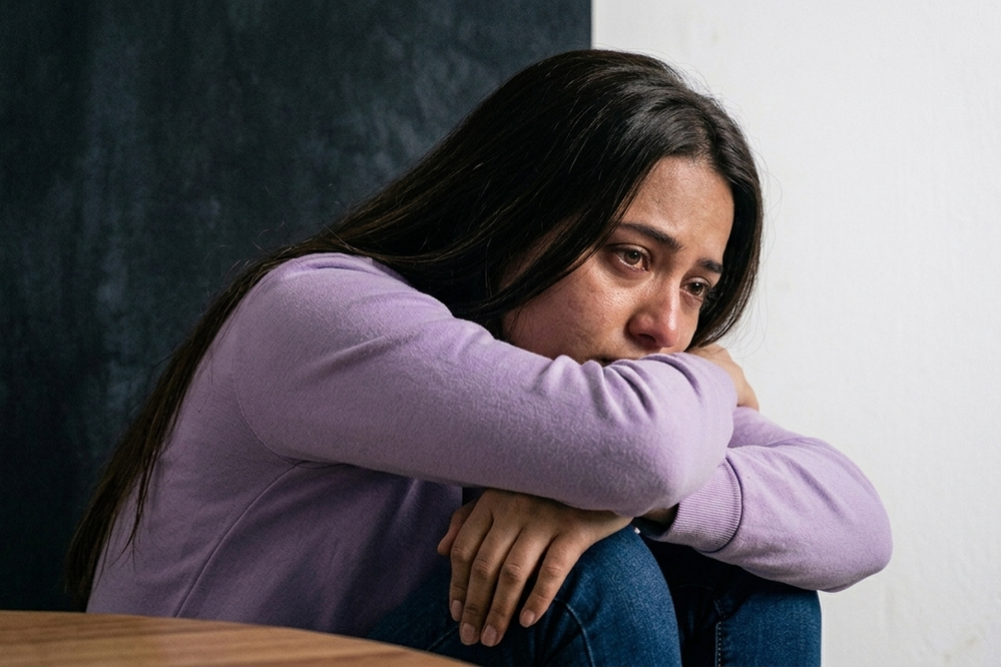
When questions are gradually asked about family and marital history, the aspect of intimate partner violence begins to emerge. In Nepal, the culture of directly expressing psychological distress is still not strong.
We use Google Cloud Translation Services. Google requires we provide the following disclaimer relating to use of this service:
This service may contain translations powered by Google. Google disclaims all warranties related to the translations, expressed or implied, including any warranties of accuracy, reliability, and any implied warranties of merchantability, fitness for a particular purpose, and noninfringement.
'Intimate partner' violence refers to violence that occurs within close relationships—such as from a husband, boyfriend, or a trusted person. This type of violence first creates feelings of fear and insecurity in the victim.
Because of the constant fear that something could happen at any time, they are forced to remain perpetually alert. As a result, symptoms such as being easily startled, anxious, losing self-confidence, and losing interest in daily life begin to appear. When the violence continues for a long time and there is no one to help, feelings of despair, loneliness, and emotional exhaustion increase.
In some cases, severe anxiety, depression, and mental health problems such as post-traumatic stress disorder are seen. Victims may also experience sleep problems, irritability, anger without reason, and feelings of shame and guilt. All of these affect both domestic and professional life. In severe cases, suicidal thoughts have also been observed.
A large number of people come for treatment or counseling after being victimized by this type of violence. Some people come directly saying, ‘I have been abused,’ while most victims come with physical symptoms. They present with complaints such as headaches, stomachaches, numbness, and body fatigue.
When family and marital history is gradually inquired about, the aspect of intimate partner violence begins to emerge. In Nepal, the culture of directly expressing mental distress is still not strong.
Why do many people consider this type of violence normal? There are many reasons for this. First, fear of retaliation. Many fear that if they speak out about the violence, it will only increase. Some have experienced increased abuse after disclosing it.
Second, ‘trauma bonding.’ The person committing the violence is the same person to whom the victim is emotionally attached. The belief that ‘he is my husband’ or ‘it is my duty’ leads victims to suppress their own suffering.
Third, self-blame. Many women consider the violence to be their own weakness. The mentality of ‘it happened because of me’ or ‘I deserved it’ is seen.
Along with this, cultural influence is also deep. There is a generalization that ‘a little bit happens in every home’ or ‘it will get better with time.’ Especially the pressure to save the marriage and keep the family together forces victims to remain silent.
Economic dependence and social perspectives also have an impact. Women who are financially dependent on their husband or partner fear that their future will become even more insecure if they file a complaint. The future of their children, society’s perspective, and the ostracism that follows divorce—all of these force them to endure.
Another problem is the lack of services and information. Victims are also forced to remain silent due to lack of knowledge about legal rights, helpline numbers, and safe shelters. In some cases, it is seen that even healthcare providers do not take such violence seriously. The biggest challenge is silence itself—the inability to speak about the violence, the fear of being blamed when seeking help, and the lack of awareness about rights. As long as victims do not feel safe enough to speak out, intimate partner violence remains invisible.
(Pant is a psychiatrist at Tribhuvan University Teaching Hospital, Maharajgunj.)