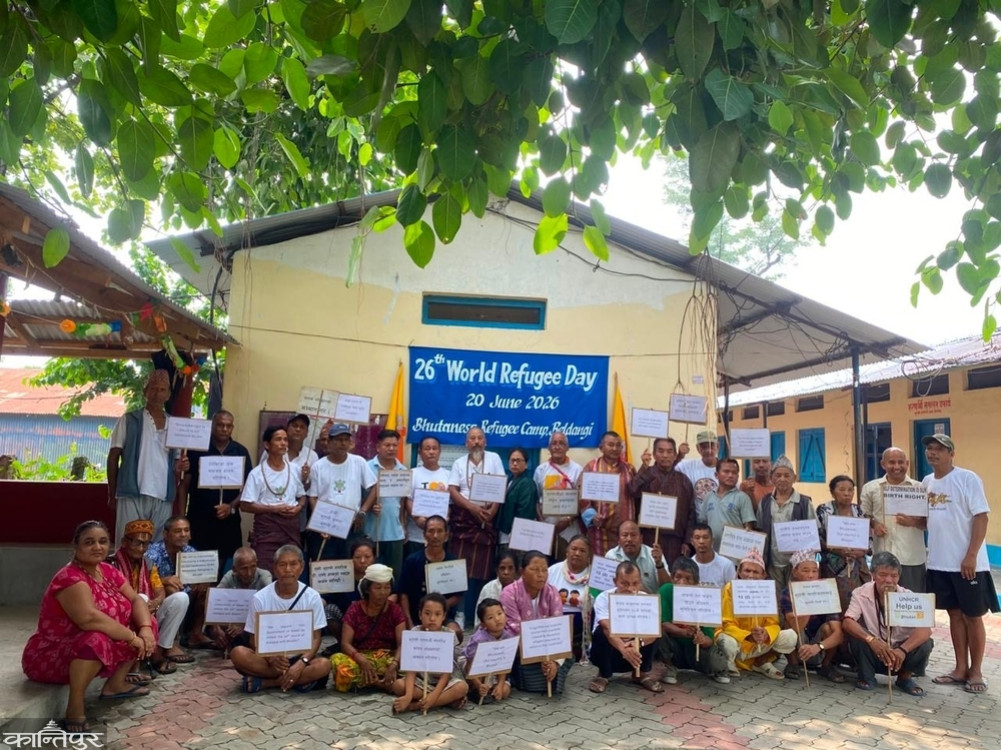
About 6,500 Bhutanese refugees in camps in Nepal have sought support from the international community, saying their main desire is to return home rather than be resettled.
We use Google Cloud Translation Services. Google requires we provide the following disclaimer relating to use of this service:
This service may contain translations powered by Google. Google disclaims all warranties related to the translations, expressed or implied, including any warranties of accuracy, reliability, and any implied warranties of merchantability, fitness for a particular purpose, and noninfringement.
Bhutanese refugees, who have been living in Nepal for more than three decades, have urged the United Nations High Commissioner for Refugees (UNHCR) to take the initiative for their safe, dignified and speedy repatriation.
On Saturday, in the context of World Refugee Day, the Bhutan Independent People's Forum (BIPF) and the National Reconciliation Committee Bhutan (NRCB) submitted a joint appeal to UNHCR Representative in Nepal Monique Sokhan, stating that the basic aspiration of repatriation, rather than rehabilitation, of Bhutanese refugees is still unfulfilled.
They have also urged Prime Minister Balendra Shah to take the initiative for dignified repatriation. They have also urged Prime Minister Shah to take diplomatic initiatives to ensure the voluntary and dignified repatriation of Bhutanese refugees in camps in Jhapa and Morang. The memorandum submitted to the Office of the Prime Minister and the Council of Ministers has drawn the government's serious attention to the problems of Bhutanese who have been living as refugees for more than three decades. The memorandum states that the displaced citizens of Bhutan have been facing social, economic, educational and cultural difficulties for a long time. It is stated that despite the provision of housing, health, education and basic services with the help of international agencies including UNHCR, World Food Programme and World Health Organisation, the problem has not been resolved in a long term. According to refugee representatives, more than 113,000 Bhutanese refugees have been resettled in countries including the US, Canada, Australia and Denmark through third country resettlement programs. 6,500 refugees are still living in camps in Jhapa and Morang, hoping to return home. They have said that they want to return to their homeland, Bhutan, with dignity and safety. They have expressed their pain at losing their property, homes and livelihoods, citing political persecution and threats to their lives, saying they were forced to leave the country. 'Leaving our country was not a choice, but a means of survival,' the appeal states. 'Even after years, our desire to return to Bhutan in a safe and dignified manner remains unfulfilled.'
Both organizations have urged UNHCR to take the initiative to find a peaceful and just solution in coordination with Bhutan and the relevant parties. They demand that the international community play an active role in creating an environment for repatriation while ensuring the rights, dignity and identity of the refugees.
The appeal, signed by DB Subba, General Secretary of the Bhutan Independent People's Forum, and Krishnabir Tamang, Coordinator of the National Reconciliation Committee, Bhutan, urges the intensification of diplomatic and humanitarian efforts for a long-term solution to the Bhutanese refugee problem.
The issue of Bhutanese refugees in Nepal has remained unresolved for more than three decades. Despite the completion of the third-country resettlement program, groups of refugees demanding repatriation have been continuously raising the demand that the Bhutanese government create an environment for the return of its citizens.