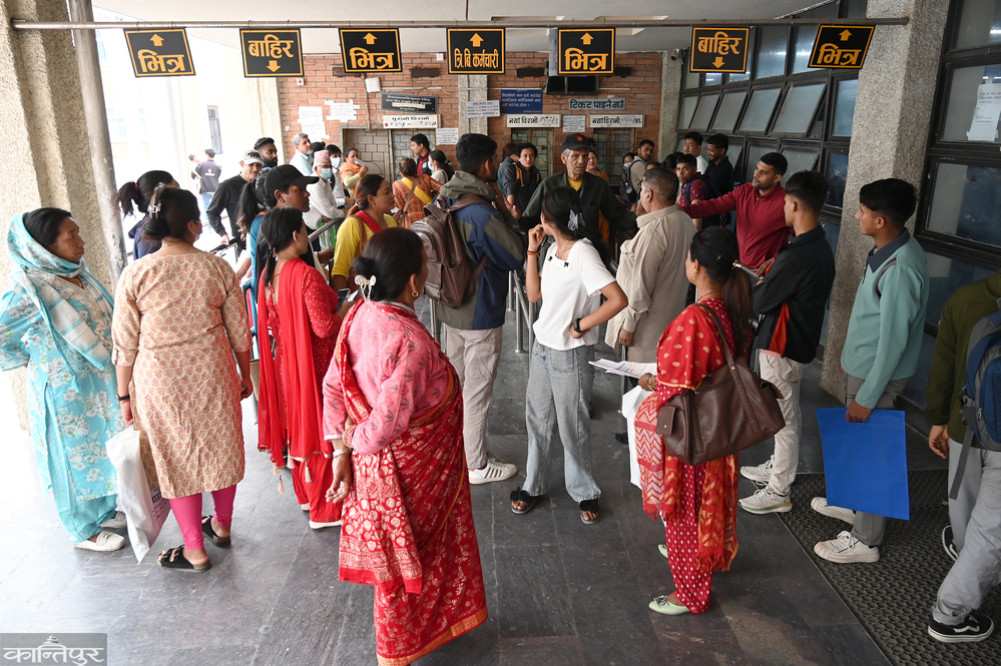
Nobel Medical College Information Officer Naveen Dahal says, ”Earlier, there were many patients who sought treatment through insurance. Now, the number of patients has decreased. Due to the lack of insurance facilities, many poor citizens have been deprived of treatment.”
We use Google Cloud Translation Services. Google requires we provide the following disclaimer relating to use of this service:
This service may contain translations powered by Google. Google disclaims all warranties related to the translations, expressed or implied, including any warranties of accuracy, reliability, and any implied warranties of merchantability, fitness for a particular purpose, and noninfringement.
After the government decided to suspend the health insurance program in private hospitals, patients with chronic and complex diseases including kidney, heart, and cancer have been directly affected. Poor families, especially those dependent on regular treatment and dialysis, have been under additional financial and mental stress.
Pramod Poddar of Inaruwa-1, Sunsari, had been getting regular dialysis at Nobel Teaching Hospital in Biratnagar for three months through health insurance. He has become worried after the government's decision and Nobel saying that it will not provide the service through insurance.
Pramod's wife Toya says, "There is no way we can take the patient to another hospital. There is no way we can pay for treatment here. We are confused about what to do now."
The government has stated that the insurance facility will remain the same in private emergency services. However, there are complaints from service recipients that private hospitals are not providing any services through insurance, not just emergency services. Due to the government's decision and the private hospital's standoff, the families of the patients are going through double pain.
After the government's decision on two days off a week and insurance, the pressure of patients in government hospitals has not subsided. Especially, patients undergoing kidney dialysis have very little chance of getting a turn.
Toya says, 'It is very difficult to get a turn for dialysis in government hospitals. It is even more problematic for patients who do not have access and money.'
The situation of 52-year-old Bimal Bik of Itahari-3, Sunsari is similar to Poddar. Suffering from kidney disease, he had been undergoing regular dialysis with the help of health insurance for the past two months. Sometimes, when his health condition became complicated, he had to be admitted to the ICU, which was covered by the insurance. However, after the insurance service was closed, the burden of treatment expenses has increased significantly on the poor Dalit families. Bimal's nephew Rahul says, 'It has become more difficult to raise treatment expenses when it is already difficult to make a living.'
According to Nobel Medical College Information Officer Naveen Dahal, the most affected group after the suspension of insurance services has been the economically weaker section. 'Earlier, there were many patients who sought treatment through insurance.' Now, the number of patients has decreased,' he said, 'The lack of insurance facilities has created a situation where many poor citizens are deprived of treatment.'
Virat Medical College President Dr. Gyanendra Mansingh Karki said that the government's decision to close insurance services in private hospitals has seriously affected the general public's access to health. 'The government decided to close it suddenly without sufficient consultation with the stakeholders,' he said, 'This has affected more than 6 million insured people across the country.'
At a time when the right to health has been established as a fundamental civil right, thousands of poor patients who depend on regular treatment are in crisis due to the suspension of insurance services. Stakeholders have demanded that the government find an immediate practical solution to ensure continuity of treatment for chronically ill and economically vulnerable citizens.