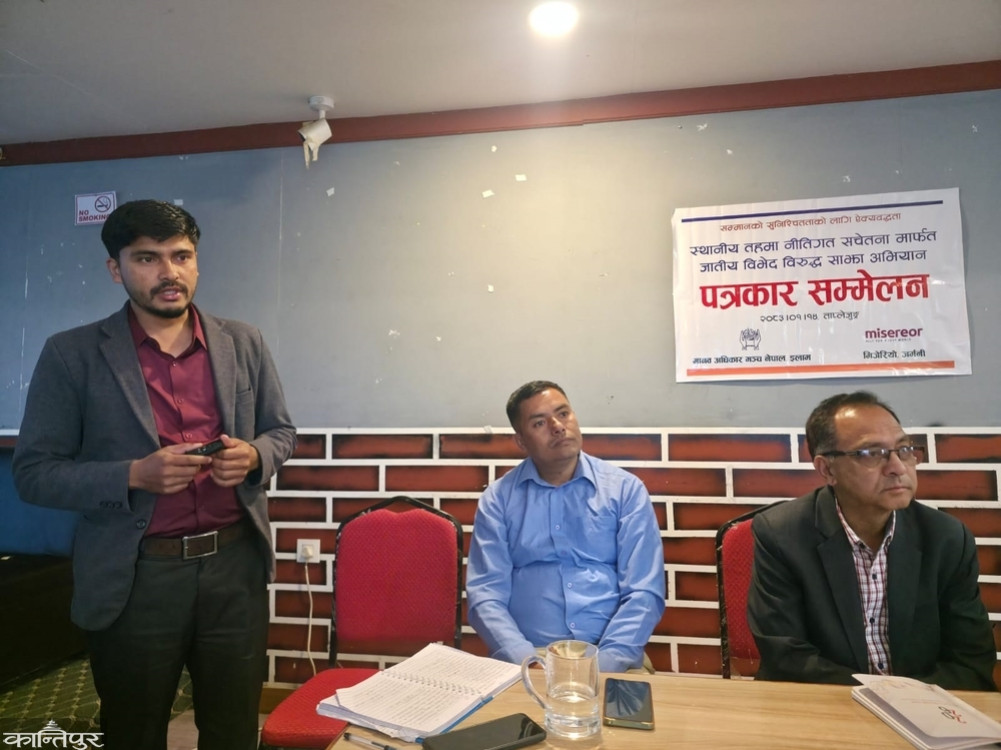
After discussions with stakeholders from four districts of Koshi Province, the forum concluded that the changing form of discrimination is more dangerous for untouchability and caste discrimination.
We use Google Cloud Translation Services. Google requires we provide the following disclaimer relating to use of this service:
This service may contain translations powered by Google. Google disclaims all warranties related to the translations, expressed or implied, including any warranties of accuracy, reliability, and any implied warranties of merchantability, fitness for a particular purpose, and noninfringement.
The Human Rights Forum Nepal has concluded that silent discrimination and psychological exclusion against the Dalit community has increased. The forum made this conclusion public after discussions with Dalits, non-Dalits, people's representatives, political party leaders and individuals from various state bodies in the four districts of Taplejung, Panchthar, Ilam and Jhapa in Koshi Province. At a program organized in the district headquarters of Phungling on Monday, Devendra Bishwakarma, director of the forum, said, "Earlier, there was direct abuse, disconnection from taps and water. Now, we have nothing, but there is a series of silent discrimination and psychological exclusion, such as not allowing us to enter the house despite the fact that there are old people at home and they do not accept untouchability." Mankumar Baraili, program coordinator of the forum, claimed that digital discrimination has also increased. "When someone raises the issue of injustice against Dalits, discrimination is made by making many arguments in the comments," he said.
The forum has concluded that the local government has also discriminated against Dalits in its budget. ‘The budget allocated for Dalits is to end social discrimination,’ said Mankumar, ‘However, if roads have to be built in Dalit settlements, if drinking water has to be provided, it has to be done from the same budget.’
After discussions with stakeholders from four districts, the forum has concluded that the changing form of discrimination is more dangerous for untouchability and caste discrimination. The forum, which has its head office in Ilam, is also running a ‘Solidarity Program for Respect and Assurance’ in collaboration with Misericordia Germany. Baraili said, ‘It was concluded in discussions with stakeholders from almost all districts that there is no discrimination against Dalits from the affluent and well-to-do classes.’ However, in a neighborhood of Taplejung's Phungling Municipality-2, Dalits were found to be excluded from activities such as marriages and fasting.' He said that such discrimination was also being practiced against Dalits who were eating and studying here. The forum concluded that not inviting Dalits in social activities and social gatherings in the same neighborhood is a form of discrimination.
Mankumar claims that trolls and insulting reactions on social media when Dalit issues are raised are another form of discrimination. Director Bishwakarma informed that the forum concluded that untouchability and discrimination persist due to factors such as looking down on people based on caste, inequality in access to justice, and the discriminatory thinking of law enforcement officials that lead to weak investigation processes. He argues that being limited to quotas or reservations at the decision-making level of the state, the state's lack of cooperation towards the Dalit community on various issues, the filing of false cases, and the inability to easily accept the leadership of the Dalit community are a series of discrimination. Netra Nepali, a Dalit leader from Meringden Rural Municipality-1, Nalbu, says that the practice of untouchability is being eliminated in some places amid discrimination. Nepali said that acts such as suppressing, suppressing, reconciling issues related to Dalits, and politically protecting the perpetrators and giving them immunity are still prevalent in society.
The forum understands that inter-caste marriages should be encouraged, religious leaders should take the initiative to modify customary norms in a timely manner, and community awareness programs should be carried out at a rapid pace. Under the program being run by the forum through the project, there is a program to reconcile different groups in the first phase, formulate a common dialogue and plan in the second phase, and suggest concrete steps to be taken by the government in the third phase by communicating with the provincial government.