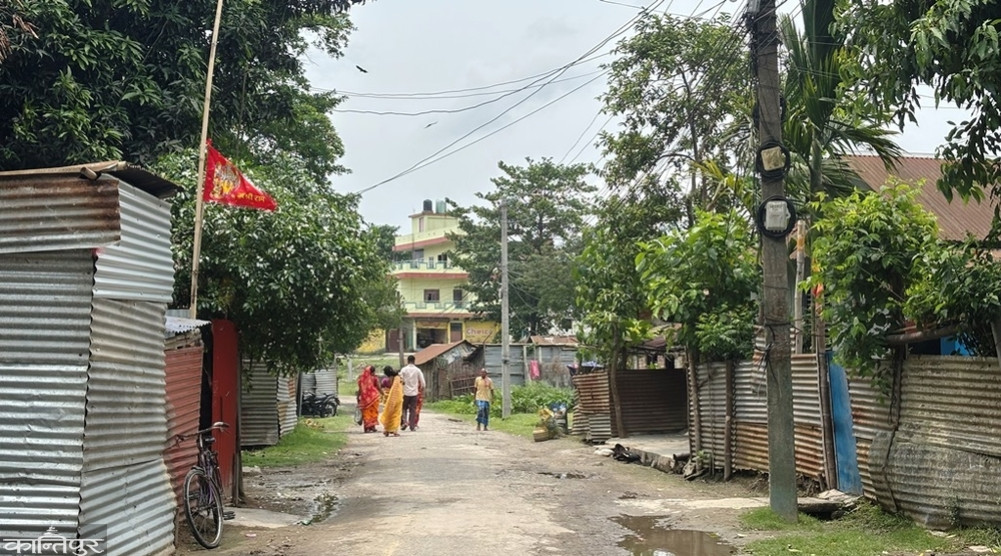
The district administration estimates that more than 10,000 squatter families are living on government and private land.
We use Google Cloud Translation Services. Google requires we provide the following disclaimer relating to use of this service:
This service may contain translations powered by Google. Google disclaims all warranties related to the translations, expressed or implied, including any warranties of accuracy, reliability, and any implied warranties of merchantability, fitness for a particular purpose, and noninfringement.
A huge settlement spreads from Ghinaghat to Hatkhola on the banks of Singhia River in Biratnagar-1. More than 2,000 squatters live in the tolls including Paropkar Ghat, Ganga Tole Kushal. There is also a dense population of squatters around Hanuman Temple in Ward-2 and in Basta Tole in Ward-4.
Farok Sheikh, 66, of Paropkar Ghat, Biratnagar Metropolitan City-1, who watched the video of the government evicting squatters from the Bagmati banks of Kathmandu on his mobile phone, is distraught. He says that he cannot sleep at night due to the worry that the government will chase him away in the same way. ‘Sometimes, I am afraid that a bulldozer will come and demolish my house,’ says Sheikh, who has been living in the settlement on the banks of Singhia River for more than 30 years. ‘We voted for proper management, but now they are starting to evict us.’ Sheikh expressed his anger, saying that if they try to evict us without any alternative, they will retaliate. ‘If we are to be evicted, we must first arrange another place to live. Otherwise, we will not move under any circumstances,’ he said.
Lal Bahadur Khadka, 66, who has been living here since 2051, said that the government is trying to chase away the problem rather than solve it. ‘In the past, old parties were elected many times. This time too, we voted for the new party on the assurance of solving the problem. Now, I am hearing that we will be evicted under the leadership of the same party that we voted for,’ he said. There are about 100 houses of squatters around Paropakar Ghat alone. Most of them earn their living by working as laborers, and neither have a decent house nor a place to stay. They say that many people will be homeless if the government evicts them.
According to local Haridev Mandal, this settlement was not built all at once. ‘We started living here since 2050/52, when it was all forest,’ Mandal recalled, ‘We have not lived like that, we have lived here by suffering and investing.’ According to him, for years, various political parties have assured us that ‘we will provide land titles’. He, who has been living in that hope for years, says, ‘Now, when it comes to eviction, it has been a lot of pain.’ According to activists active in the field of land rights, more than 7,000 squatter families currently living on government land in the Biratnagar metropolitan area have not been properly managed. Dalits, poor and backward communities are especially prevalent in those areas.’
The District Administration Office, Morang, is not sure about the actual number of squatters in the Biratnagar area. The administration estimates that more than 10,000 squatters are living on government and private land. Chief District Officer Yubaraj Kattel said that the identification of real and 'fake' squatters across Morang has begun.
According to him, detailed details of those residing in the government are being collected . 'We have already started the action . We have already put up notices to remove 58 houses in Letang,' he said, 'We will soon start the action in other areas as well.' He said that we will write to all local levels in the district to identify the squatters . 'We are examining three generations of squatters, we are also finding out the bank balance,' he said, 'We will go into action after identifying real and fake squatters .'
According to locals, both fear and anger are now increasing in the settlement . 'We want an opportunity to live with dignity,' said Harishankar Prasad Sah of Basta Tole in Biratnagar-4, 'Our demand is not to bring them to the streets from the place where they have been living for years, but to organize them .'