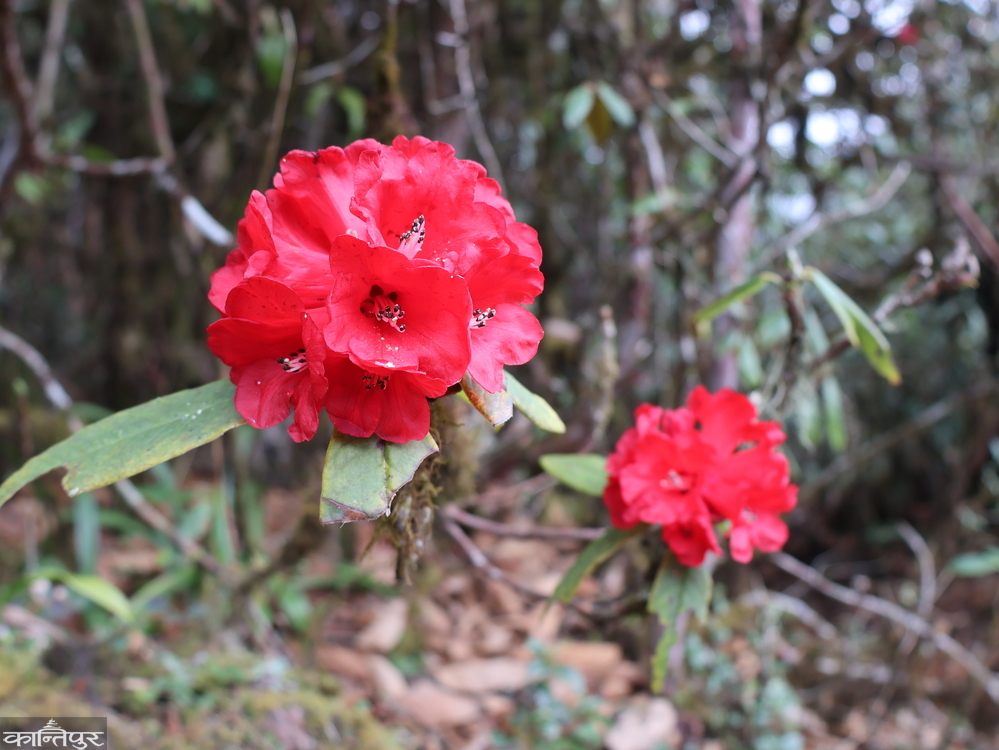
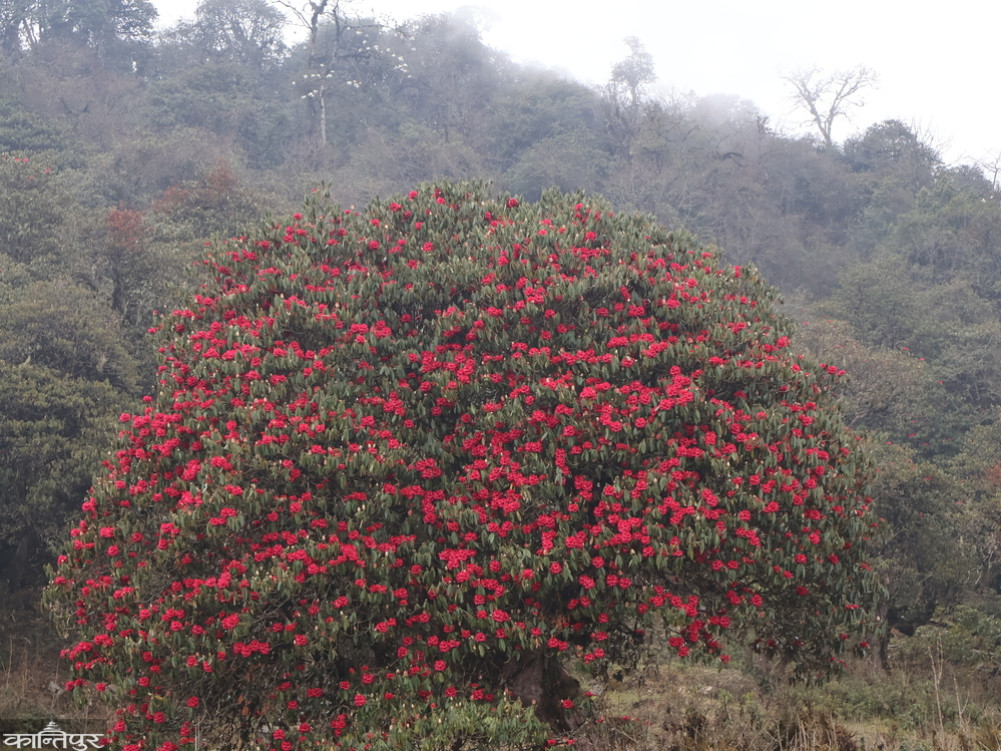
Conservationists complain that the forests in the area known as the capital of Gurans are being destroyed due to factors such as the use of firewood from Gurans, the sale of charcoal, open grazing, illegal logging, road construction in the forest, and the expansion of high-tension electricity lines.
We use Google Cloud Translation Services. Google requires we provide the following disclaimer relating to use of this service:
This service may contain translations powered by Google. Google disclaims all warranties related to the translations, expressed or implied, including any warranties of accuracy, reliability, and any implied warranties of merchantability, fitness for a particular purpose, and noninfringement.
Suraj Ojha of Phungling Municipality-4, Taplejung, has made the Tinjure, Milke, Jalajle (TMJ) area, the capital of Gurans, his destination every New Year's Day. As the president of the Community Forest Users Federation, Taplejung, he has also chosen an area that attracts trees on this day. His team includes many of his group's friends, including those from the new generation. This year too, he has planned to go to Gufa Pokhari on Chaitra 30 and stay at the cave pond and return on New Year's Day 2083 BS after visiting the Butabutas of Gurans. It takes three hours from Phungling, the district headquarters of Taplejung, to reach Gufa Pokhari, the confluence of Taplejung, Panchthar and Sanghu Bazaar, the center of Maiwakhola Rural Municipality.
Phupulhamu Sherpa's team from Papung, Mikwakhola Rural Municipality-5, Taplejung is also planning to make the Gufa Pokhari area their destination this year. She told us over the phone that they planned to go to the cave as friends of the village, as it is believed that if you wander and have fun on New Year's Day, you will get similar opportunities throughout the year.
To go to Gufa Pokhari from Papung, you have to go through Handrung, Dobhan, and Sanghu. The cave is also the pasture of the local goats. But the main plan of those going on the trip is to enjoy and enjoy Gurans.
Hundreds of people like Suraj and Phupulhamu are preparing to go to the area that is the capital of Gurans to celebrate the New Year. As they choose the Gurans area as their destination, the Gurans bushes and flower stalks also seem eager to welcome them. 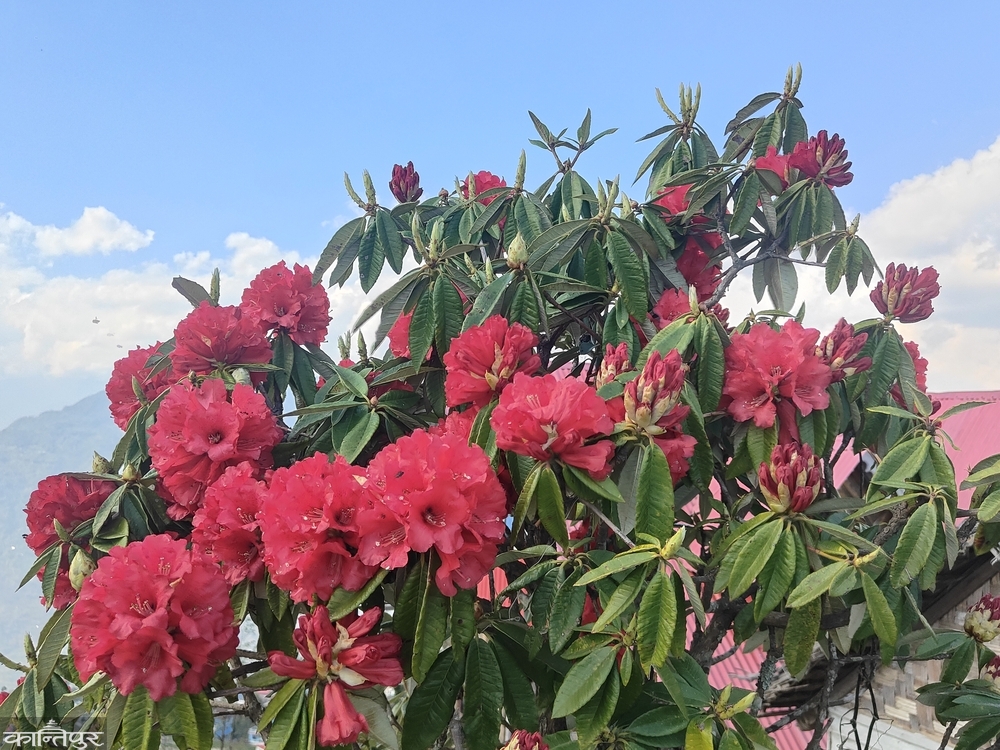
32 species of red-bellied toadstool are found in the Milke, Tinjure, and Jalajle regions, known as the capital of toadstools. Botanist Kamal Maden and a team led by Deepak Khadka, who is a PhD student in environmental science at South China Agricultural University in China, have discovered two new species, bringing the total to 32. Earlier, 30 species were found in the region. The team led by Maden and Khadka had studied the TMJ region for 12 days.
Toadstools are found from Chotlung Park in Basantapur in Tehthum to Menchhyayem and Phaktanglung and Pathibhara in Taplejung. Olangchungola, Ghunsa, and Phale, among other areas in Phaktanglung rural municipality, are usually covered in toadstools. Botanist Maden said that a new species of toadstool has been found in the region from Tinjure to Phaktanglung. This route touches the vast Himalayan trekking route from Kanchenjunga to Humla via Darchula.
The Komolma Nature Reserve in Tibet, located in Dingze County of neighboring China, is connected to the TMJ area. According to the Royal Botanical Gardens, Kew, London, there are 1,073 species of guarans in the world. The red guaran is the tallest tree species. This species is found in Nepal, Pakistan, India, Sri Lanka, Bhutan, Myanmar, and Vietnam. Researchers say that it is found in abundance in southeastern Yunnan, China, which borders Myanmar and Vietnam.
According to the guaran conservation action plan issued by the Ministry of Forests and Environment in 2017, guarans are found in 43 districts of Nepal. The largest tree, the red-leaved guarans, is found in eastern Nepal from Taplejung, Panchthar, Ilam, Dhankuta, Tehthum, Sankhuwasabha, Solukhumbu to Lamjung, Myagdi, Baglung, Rukum, Dolpa, Bajhang, Bajura, and Darchula. 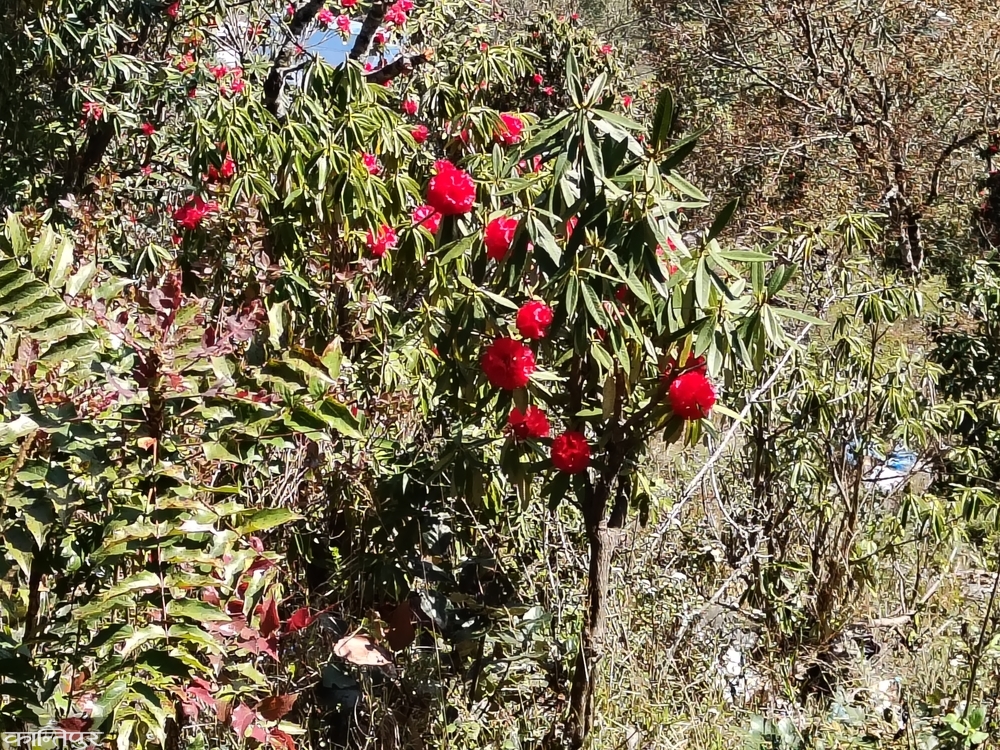
It is found in large quantities in districts including Dadeldhura and Baitadi. The flowers of this species are not only red but also white, gray, and light yellow. One species of guarans, Rhododendron aborium, is found throughout Nepal. The government has been working on an action plan from time to time to conserve species including the red-leaved guarans, which is also the national flower.
In the Himalayan and high-hilly regions, since there are few plants other than guarans, locals use it as firewood. Due to this, its conservation has become challenging, says Ojha, chairman of the community forest. 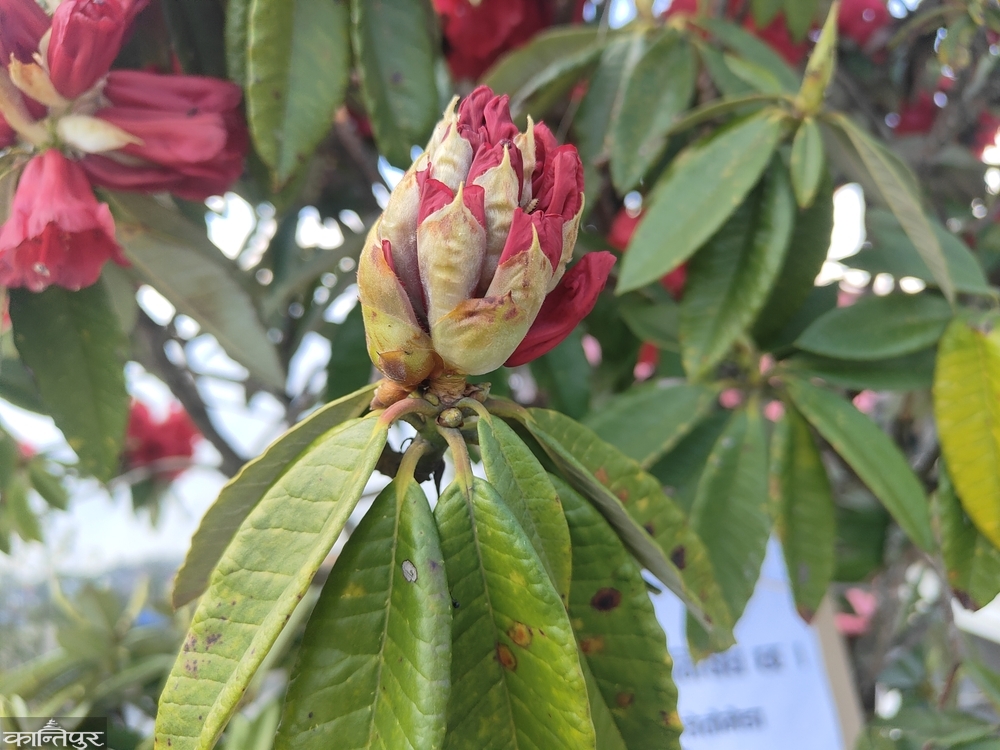
Conservationists complain that the forests in the area known as the capital of Gurans are being destroyed due to the use of firewood from Gurans, selling charcoal, open grazing, illegal logging, construction of roads in the forest, and expansion of high-tension electricity lines. Kamala Limbu, secretary of the Community Forest Users Federation, said that increasing forest encroachment and unbalanced temperatures are also posing challenges in Gurans conservation. The statistics of the Forest Research Department state that the Gurans mixed forest area in the country is 699,596 hectares.