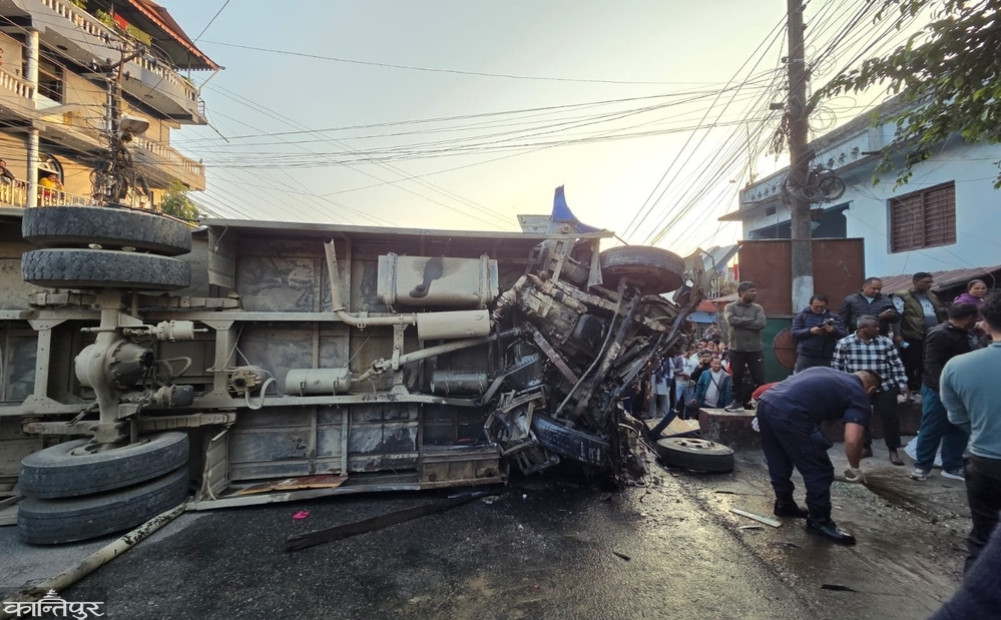
As of February this year, 308 people have died in 4,290 road accidents across Koshi Province.
We use Google Cloud Translation Services. Google requires we provide the following disclaimer relating to use of this service:
This service may contain translations powered by Google. Google disclaims all warranties related to the translations, expressed or implied, including any warranties of accuracy, reliability, and any implied warranties of merchantability, fitness for a particular purpose, and noninfringement.
Accidents have increased significantly in Koshi Province. According to the data of three fiscal years, there has been an increase in accidents. Along with accidents, human losses have also increased. Lack of coordination among stakeholders to reduce accidents has become an additional challenge.
In the fiscal year 2079/080, there were 3,463 accidents in the province. Of these, 371 people died, 258 were seriously injured, and 5,750 were slightly injured.
In the fiscal year 2080/081, there were 4,626 accidents. In those accidents, 452 people died, 371 were seriously injured, and 5,830 were slightly injured.
Till Falgun of the current year, 4,290 accidents have occurred. During this period, 308 people have died. According to police data, 475 were seriously injured, and 6,455 were slightly injured.
During this period, the highest number of motorcycle accidents occurred. Then there are cars, buses, trucks/tankers, jeeps and microbuses. Road infrastructure is becoming risky due to lack of coordination between the Road Department, Electricity Authority, Nepal Telecom, Drinking Water Project and local levels.
According to Saroj Shrestha, Koshi Province Coordinator of the National Federation of Transport Entrepreneurs, two-wheelers have been involved in many accidents. Shrestha said that so far, the blame for accidents has been placed on transport entrepreneurs and the government has not been able to do effective work to control them.
The rules implemented to reduce accidents have not been implemented. The traffic police have also been facing a shortage of manpower and budget. This has added challenges to accident control, said Deepak Giri, Chief Superintendent of Police of the Highway Safety and Traffic Management Office, Itahari. ‘The traffic police are conducting regular inspections, awareness campaigns and taking strict action,’ he said. Giri said that coordination among all stakeholders, infrastructure improvements and strict compliance with rules are essential for a long-term solution. Giri says, ‘Since road safety is a multi-faceted issue, equal responsibility of all bodies is necessary.’
Even though the office has implemented one rule after another for road management, it has not been implemented. In Koshi Province, road management has become chaotic due to the non-cooperation of other concerned bodies with the traffic police rules, and passengers have had to suffer.
The office had decided 6 years ago that vehicles in 14 eastern districts would not be allowed to honk except for essential purposes. After that, a campaign was launched for a year to make 14 districts of the province ‘horn-free zones’. A year later, a decision was also made to ban e-rickshaws on the main highway. But those decisions have not yet been implemented in practice.
After the protest, saying that tipper terror has increased on the roads, the police banned the use of tippers on the main highways of Koshi Province from 9 am to 11 am and from 3 pm to 5 pm. This was not strictly enforced either. Time cards have been re-imposed in Jhapa, Morang, Sunsari and Udayapur for two years due to the increase in accidents.
The traffic police keep making one rule after another, but due to the lack of effective coordination between the parties concerned with road management, including the road, transport system, electricity authority, etc., the chaos on the roads has not been eliminated, says Divash Pokharel, spokesperson for Itahari Sub-metropolitan City.