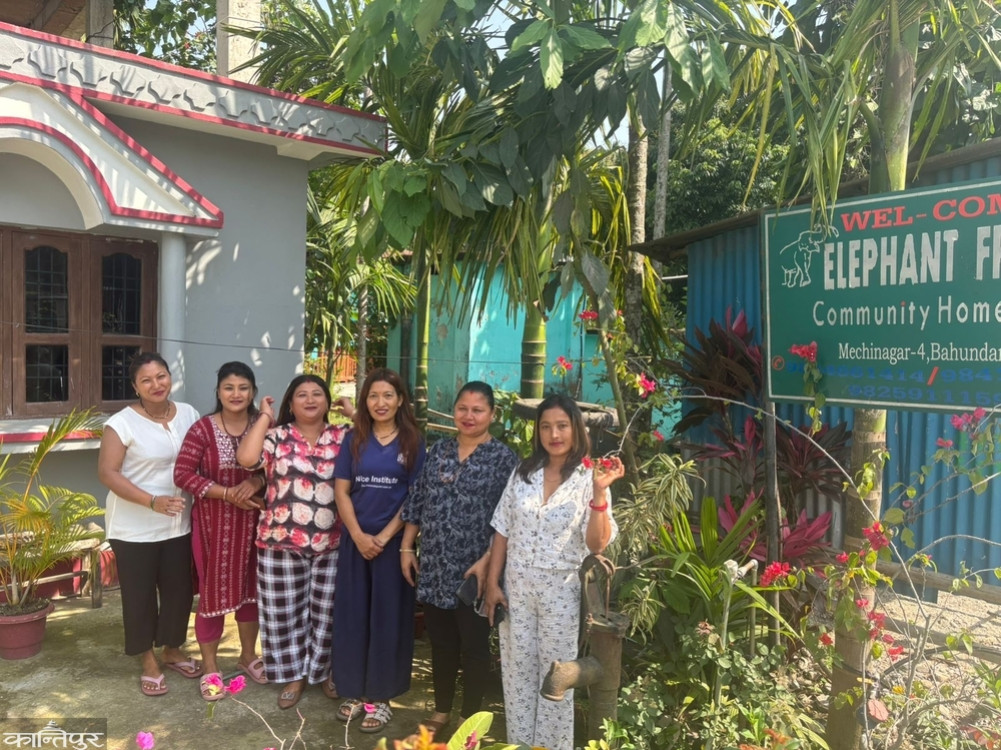
Amidst the fear of elephants, women in Bahundangi, Jhapa, are opening a new path to self-reliance and economic empowerment by running a community homestay.
We use Google Cloud Translation Services. Google requires we provide the following disclaimer relating to use of this service:
This service may contain translations powered by Google. Google disclaims all warranties related to the translations, expressed or implied, including any warranties of accuracy, reliability, and any implied warranties of merchantability, fitness for a particular purpose, and noninfringement.
The fear of wild elephants is still the same in Bahundangi village in northeastern Jhapa. After dusk, a herd of elephants that enter the village after crossing the Mechi river return with a roar. Amidst this suffering, women from elephant-affected families are trying to forget their pain by starting an ‘Elephant Friendly Community Homestay’. This venture has not only opened the door to income-generating opportunities for them, but has also given the entire village a different identity.
The homestay, which was started four years ago, has now become a symbol of the common initiative and hard work of the women of the village. Women including Geeta Pradhan, Uma Raut, Uma Pradhan, Paru Pradhan, Rupa Pradhan, Pavitra Pradhan, Shanti Pradhan, Anu Karki, Radha Nepal and others are involved in this campaign.
The way the homestay is run is also very interesting. If there are many guests, everyone cooks and feeds them collectively, while when there are few guests, they share the house and offer hospitality. ‘We are always ready to serve tourists,’ says Uma Pradhan. ‘They have so far easily managed groups of 60-70 people at the
homestay, and say they have the ability to cook and feed up to 300 people if necessary. Their specialty is to host guests in their own homes, put them to sleep, and serve local dishes. ‘We feed our guests what we eat ourselves,’ says Pavitra Pradhan, ‘We put them to sleep in the same way we sleep.’ The income generated by the
community homestay is also transparent. After deducting expenses, everyone shares the remaining amount in a balanced manner. They have experienced that the work has become easier with the help of their families. They have received training in homestay management from various organizations. They have knowledge from cooking to hospitality. 'We are ready to serve you a sweet smile and delicious food,' says Paru Pradhan, 'Service and hospitality to tourists is our identity.'
The story of Uma Raut, a woman who joined the homestay, is even more inspiring. She left her one-and-a-half-year-old baby at home and went abroad for a while, but is now self-sufficient in her own country. She left home to work in 2005 and spent two years in Saudi Arabia for the first time. She returned to Dubai from there. After spending 13 years there, she went back to Kuwait. After spending two years there, she returned home four years ago.
The years spent abroad made her a little financially strong, but the distance from her family also caused her pain. Finally, after returning home, she decided to do something in her village. The result is a community homestay. 'I spent 17 years abroad, now I will spend the rest of my life in the village,' she says.
Bahundangi village, known for its elephant fear, is now trying to attract tourists through the 'Elephant-Friendly' concept. Local women have found a way to earn money by combining their culture, cuisine and hospitality with tourism. 'This initiative has not only strengthened the economic aspect, it has also made women self-reliant and confident,' said Arjun Kumar Karki, ward chairman of Mechinagar-4. 'Today, sisters are not limited to being housewives, they are also becoming successful entrepreneurs.'