Despite six chief ministers changing in five years and spending half a crore rupees, the Kosi Provincial Assembly has not been able to pass the 'Dalit Empowerment Bill'.
We use Google Cloud Translation Services. Google requires we provide the following disclaimer relating to use of this service:
This service may contain translations powered by Google. Google disclaims all warranties related to the translations, expressed or implied, including any warranties of accuracy, reliability, and any implied warranties of merchantability, fitness for a particular purpose, and noninfringement.
The process of drafting the ‘Dalit Empowerment Bill’ had begun around the middle of the first term of the Koshi Provincial Assembly. However, five years later, this bill has not yet been drafted.
Since 2077, only six Chief Ministers have changed. Even though many ministers have changed during this period, this bill is still limited to a concept paper. The interesting part is that the provincial government has already spent about 3 million rupees on the drafting of this bill. Biratnagar’s NGOs have also spent more than 2 million rupees on dozens of seminars with the aim of pressuring the provincial government to draft the bill. Despite the budget of about half a crore rupees being spent, the bill has not been finalized yet.
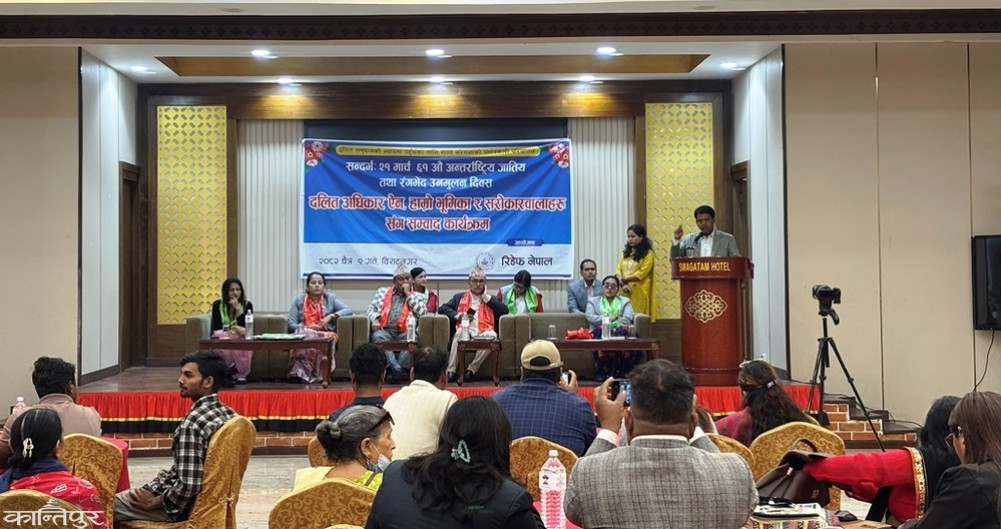
Referring to the 61st International Day for the Elimination of Racial Discrimination and Apartheid, the NGO REDEF Nepal organized a program in Biratnagar on Monday and drew the attention of concerned bodies. Minister for Internal Affairs and Law Indramani Parajuli and Minister for Economic Affairs and Planning Bidur Lingthep pledged that they would be positively involved in the formulation of the long-delayed Dalit Empowerment Act, like previous ministers.
However, none of the responsible officials or officials from the Ministry of Social Development, which was involved in the bill formulation process from the beginning, and the Chief Minister's Office, which gave in-principle approval to the draft, were present at the event. 'The fact that the responsible Chief Minister and ministers of these two bodies did not attend the event makes their intentions clear,' said Dalit rights activist Kapil Sunar, who participated in the event.
Dalit rights activists have accused Chief Minister Hikmat Kumar Karki in particular of not showing interest in the formulation of the act for a long time. ‘The Chief Minister seems to understand that the Dalit Act will add unnecessary expenses to the province,’ said Provincial Assembly member Sapna Pariyar. ‘When other laws are passed, there will be no financial burden, but when a Dalit law is made, it will be a burden.’ Pariyar accused the Ministry of Social Development and the Chief Minister of having been involved in the law for a long time.
Pariyar said, ‘Since 2077, the province has made more than 80 laws.’ However, I want to ask the government why the Dalit Act was stopped in the process.’ Pariyar, who was annoyed by the government’s obstruction, said that she plans to register a non-governmental bill in Parliament soon.
An official from the Ministry of Social Development claimed that a draft had been prepared but was stalled due to lack of in-principle agreement from the Chief Minister’s Office. The draft submitted by the concerned ministry for the preparation of the bill has to be decided by the provincial cabinet meeting to be presented to Parliament. However, rights activists have become angry after the concept paper of the act got stuck in the Chief Minister's Office and the Ministry of Social Development. According to Manohar Pokharel, head of INSEC Morang, the government should prioritize the rights of socially backward communities and make laws. This would have ensured the rights of the Dalit community. 'However, for a long time, the government has been misleading Dalits in the name of making laws,' he said. '
Provincial Assembly member Gopal Bahadur Bishwakarma expressed his regret that the government has not been serious despite repeatedly raising the voice to move the bill forward. 'It is a serious matter that even after 5 years, only the concept of the bill has been made,' Bishwakarma said. 'Not moving the bill forward is another big discrimination committed by the provincial government against the Dalit community.' An expert team formed in 2077 had collected suggestions from more than 400 stakeholders from Panchthar, Khotang, Udayapur and Sunsari.'
The bill, prepared by collecting suggestions from various districts, included special provisions in the economic, educational and health sectors for the Dalit community. But the bill could not move forward due to political instability after the then Prime Minister KP Sharma Oli dissolved the parliament.
9.7 percent of the total population in Koshi Province is inhabited by Dalits. Dalit rights activists have commented that such indifference by the provincial government has failed to give a sense of federalism. Rights activist Umesh Bishwakarma said, "We want to ask the government why the Dalit bill was kept on hold for five years."
What is in the bill?
The bill proposes to form a 'Dalit Rights Promotion, Empowerment and Development Committee' at the provincial and local levels with the aim of working for Dalit rights. The provincial committee will have 12 members, with the Minister of Social Development as the chairman and the Minister of State for Social Development as the co-chairman.
In which there is a provision to have one vice-chairperson appointed by the Council of Ministers from among the Dalit leaders who have passed the 12th standard on the recommendation of the Minister. Similarly, four people, including two women, active in the upliftment and development of the Dalit community, one from the Provincial Planning Commission, one from the Ministry of Economic Affairs and the Ministry of Planning, one from the Chief Minister and the Secretary of the Law Branch of the Council of Ministers, the Dean of the University in the province, and the Medical Superintendent of the Provincial Hospital, and the Joint Secretary of the Ministry of Social Development are going to be the member-secretaries.
It is stated that this committee will effectively implement the rights granted by Article 24 of the Constitution and the Caste Discrimination and Untouchability (Offences and Punishments) Act, 2068 BS, as well as formulate and implement special policies, plans and budgets for the promotion, empowerment, practical end of untouchability and caste discrimination.
At the local level, a 13-member 'Local Dalit Rights Promotion, Empowerment and Development Committee' will be formed, with the Rural Municipality Chairperson or the Municipality Chief Chairperson as the member-secretary. The vice-chairman will be one appointed by the rural municipality chairperson or the mayor from among the Dalit leaders who have passed the 12th exam.
Similarly, there will be 2 members from the rural municipality or the city executive, 2 appointed by the rural municipality chairperson or the mayor from among the local Dalit women ward members, 2 representatives of local parties, 1 appointed by the chairperson or mayor from among the local campus heads, 1 local hospital head, 2 members including a woman nominated by the local government from among the Dalit rights activists for at least 5 years, and 2 members from the rural municipality and the city's chief administrative officer.
The act also provides that this local government committee can make policy decisions in the field of Dalit rights, just like the province. The act also envisages a committee to eliminate and monitor caste discrimination and untouchability in both the provincial and local governments.
The Chief Minister will chair a committee of three women, including the Minister of Internal Affairs and Law, the Minister of Social Development, one Dalit community MP in the Provincial Assembly, the Provincial Chief Justice, two women nominated by the Provincial Government from among those who have been active in the field of Dalit rights for at least 5 years, the Provincial Police Chief, and the Secretary to the Chief Minister and the Council of Ministers.
A seven-member committee will be formed at the local level, with the municipality chairperson or chief chairperson as member-secretary. The committee will include the vice-chairperson or head of the municipality, one Dalit member of the executive, two women nominated by the municipality chairperson or head from among those who have been active in the field of Dalit rights for at least 5 years, the local police chief and the local staff chief as member-secretaries.
It is being said that both the provincial and local governments will monitor, monitor and supervise various activities related to Dalit rights. The Chief Minister's Office in the province and the concerned municipalities at the local level will manage the financial, physical and technical resources and means for monitoring. The act also states that free education will be provided to the Dalit community.
According to Articles 31 and 40 (2) of the Constitution and the Compulsory and Free Education Act 2075, the provincial and local governments will manage and implement compulsory, quality and free education with scholarships for every Dalit student up to secondary school. The act is going to propose that health services will also be provided free of charge to the Dalit community. A free 'health service card' will be arranged from the local level to provide health services to Dalits. The provincial government will provide the Chief Minister's Social Security Special Fund targeting the elderly of the Dalit community.
A special allowance will be provided through the provincial government program after preparing the records of both single women and men of the Dalit community. Development of traditional skills and professions of Dalits, provision of land for landless Dalits once, provision of houses for the homeless, and provision of proportional inclusive representation in all bodies of the provincial government will be made . Arrangements will be made for the elimination of untouchability and caste discrimination . In addition, the provincial government has also envisaged ration cards to provide ration to the poor and Dalit communities at subsidized rates .