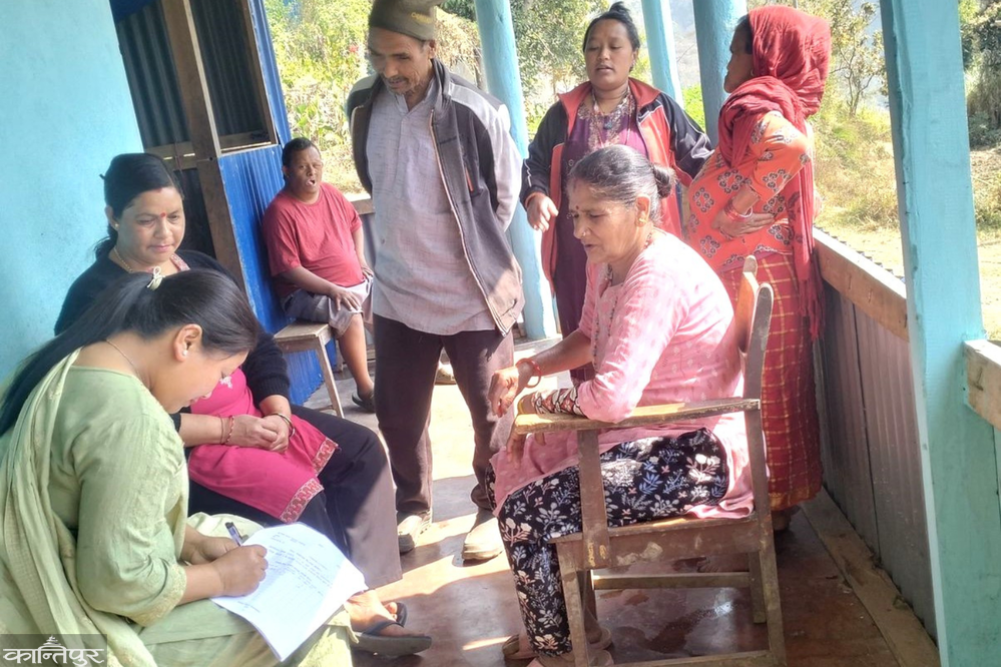
Despite claims that voter education has been made effective in all seven municipalities of Dhankuta, which has only one constituency, the results have been mixed.
We use Google Cloud Translation Services. Google requires we provide the following disclaimer relating to use of this service:
This service may contain translations powered by Google. Google disclaims all warranties related to the translations, expressed or implied, including any warranties of accuracy, reliability, and any implied warranties of merchantability, fitness for a particular purpose, and noninfringement.
Among the elections held in Dhankuta in the past 12 years, this time the percentage of votes that were invalidated in the House of Representatives election has been the highest. Out of the total votes cast in the election held last Thursday, 7.45 percent of the votes were invalidated. This is the highest percentage of invalid votes among the elections held since 2070 BS.
In the election held on Falgun 21, out of a total of 31,182 votes cast, only 28,866 were valid. Where 2,316 votes were invalid, according to the Office of the Chief Electoral Officer. The total number of voters in the district was 118,425.
For the election, the Election Office had conducted voter education in 60 wards of seven municipalities in the district. While it was claimed that voter education was provided by human resources deployed for voter education in every house, the number of invalid votes has increased significantly. Child development workers, health workers and social workers were mobilized among the volunteers for voter education.
In the 2079 BS House of Representatives election, 2,717 votes, or 3.91 percent of the total votes, were invalid in Dhankuta. However, at that time, more votes were invalid in proportional representation than in direct representation, said Suraj Shrestha, Information Officer of the Election Office. There were 116,991 voters in the direct representation of the House of Representatives. Of which 69,414 votes, or 59.36 percent of the votes were cast in the direct representation. Out of that, 66,727 were valid votes.
Similarly, 70,219 votes or 59.51 percent of the votes were cast in the proportional representation. Of these, 66,320 votes were valid. 3,899 votes or 5.55 percent of the votes were invalidated, according to the District Election Office.
Similarly, in the 2074 BS election to the House of Representatives, 5.48 percent of the votes were invalidated in the direct election. In the second Constituent Assembly election held in 2070 BS, 4.69 percent of the votes were invalidated in the direct election and 5.65 percent of the votes were invalidated in the proportional election.
As claimed, voter education has been made effective in all 7 municipalities of Dhankuta, which has only one constituency, but the results are different. According to District Election Officer Madhav Adhikari, the main reason for such a significant number of votes being invalidated is the limited time for voter education. He also said that this situation has come about due to the shortage of election materials and resources.
Among the reasons for invalidating votes is the negligence of the polling officer. More than 20 ballot papers without the signature of the polling officer have been found in Sangurigadhi Rural Municipality. Similarly It has been found that the main ballot paper that is to be invalidated has been marked with a thumbprint instead of a swastika. Similarly, it has been found that two or more symbols have been stamped on the same ballot paper during the counting process.
Similarly, it has been found that people have left their votes blank without stamping any ballot paper, said Election Officer Madhav Adhikari. ‘People who have not voted are being found during the counting process every time,’ he said, ‘Despite effective voter education, the increase in invalid votes is a matter of concern.’