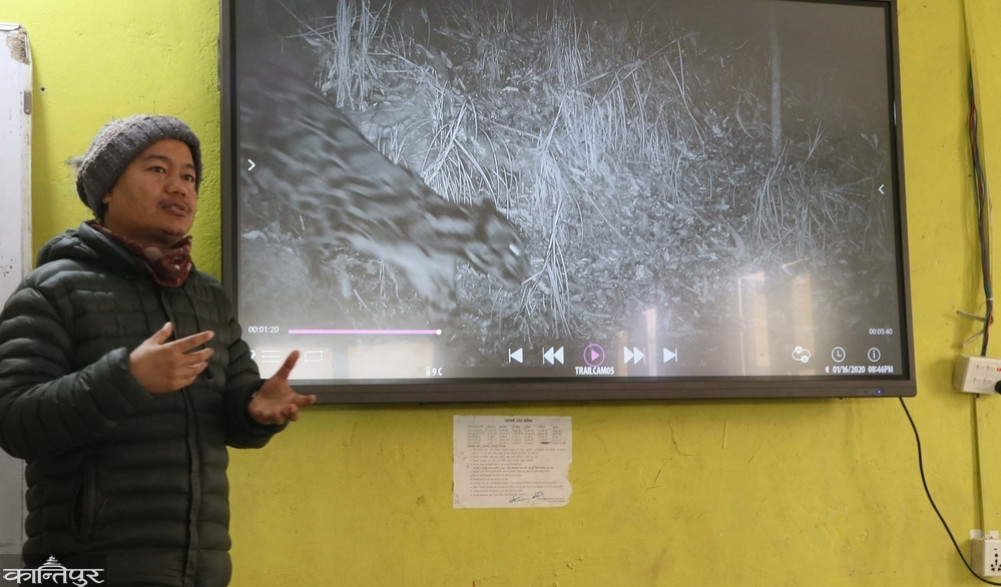
Thirteen cameras were placed in various community forests, trapping 16 different species of mammals, including species on the critically endangered list, in their natural habitats.
We use Google Cloud Translation Services. Google requires we provide the following disclaimer relating to use of this service:
This service may contain translations powered by Google. Google disclaims all warranties related to the translations, expressed or implied, including any warranties of accuracy, reliability, and any implied warranties of merchantability, fitness for a particular purpose, and noninfringement.
Wildlife, including the critically endangered black lizard, has been captured in camera traps placed in community forests in Jalpa, Kharmi, and Hauchur in the district.
It was informed in the context of the public seminar on salak conservation and camera trap results held on Poush 19 that 16 different species of mammals including salak were captured on camera.
According to Jeevan Rai, Executive Director of the Nature Conservation and Study Center, who participated in the camera trap survey, when 13 cameras were placed in various community forests of Diktel Rupakot, Majhuwagadhi Municipality-12, Jalpa, 11, Kharmi and Rawabesi Rural Municipality-6, Hauchur, 16 different species of mammals including one species on the list of critically endangered, three species of sensitive species, two species of near-endangered and 10 species of least concern were trapped on camera in their natural habitat.
According to him, when camera traps were installed for 4 to 6 months in 2025, the critically endangered black salak, the sensitive species of Thar, clouded leopard, leopard, the near-endangered Assamese monkey and the ghoral were captured on camera. Similarly, the species of least concern, such as the wild tiger, red deer, black-tailed godwit, skunk, small porcupine, large wild cat, dumsi, gazale wild cat, mountain skunk and skunk, have been seen in the camera traps.
‘This program has been launched with the aim of enhancing the capacity of communities associated with community forests to develop their own camera trapping skills for monitoring and conservation of biodiversity and wildlife in their areas,’ Rai said.
The camera trap survey was conducted in partnership with the Community Forests of Jalpa, Nature Conservation and Study Center, The Mohammed Bin Zayed Species Conservation Fund, Diktel Rupakot Majhuwagadhi Municipality-12 Jalpa, Janasewa Samaj Nepal, and IUCN CEC.
The Mohammed bin Zayed Species Conservation Fund provided the cameras and the camera trapping skills were provided by the Nature Conservation and Study Center, said Barjadhwaj Rai, chairman of the Kore Community Forest Users Group, one of the organizers. The results of the camera trap survey are being made public at the program, which includes local Tali, Kore, Dhodre, Payreni, Kagazthala, Chharu, and Salghari community forests.