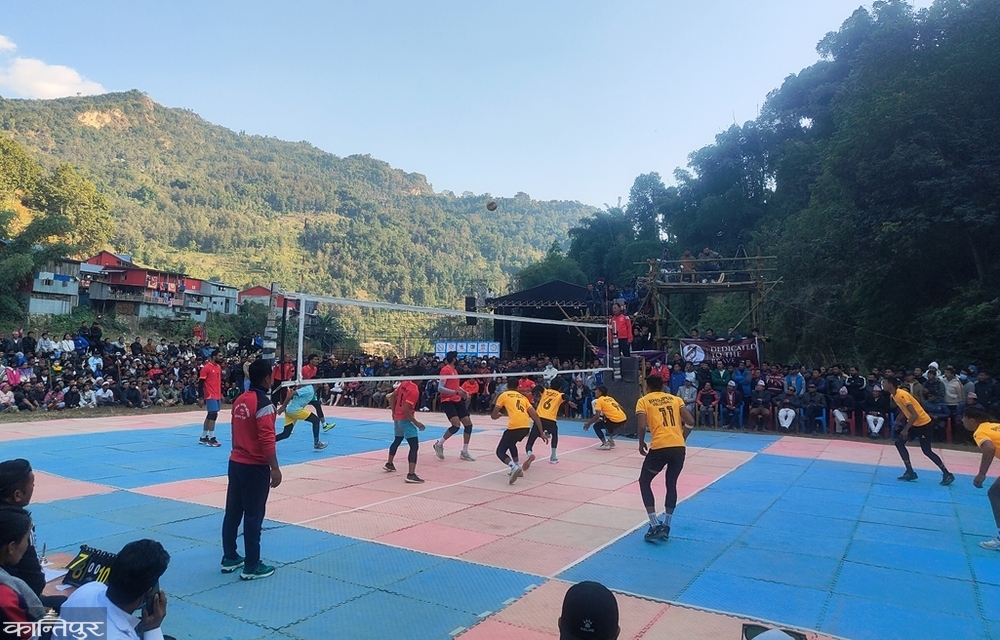
After the monsoon, when the water level in the Mewa Khola recedes, some part of it becomes empty. In recent years, volleyball competitions have also been held on the occasion of the Puse Mela held in the empty area.
We use Google Cloud Translation Services. Google requires we provide the following disclaimer relating to use of this service:
This service may contain translations powered by Google. Google disclaims all warranties related to the translations, expressed or implied, including any warranties of accuracy, reliability, and any implied warranties of merchantability, fitness for a particular purpose, and noninfringement.
The Mewakhola River, which flows through the border of Meringden and Athrai Tribeni rural municipalities, changes course every year near Dobhan Bazaar. Sometimes it erodes the part towards Meringden and sometimes towards Athrai.
After the rainy season, when the water level in the river decreases, some part becomes empty. A fair is organized in the empty bagar. In recent years, volleyball competitions have also been organized on the occasion of the fair. After the beginning of Mangsir, the youth of Dobhan Bazaar use dozers to level the bagar left by the river and organize a competition. People flock from villages to watch the volleyball.
Dolma Sherpa of Mikwakhola Rural Municipality-5, Papung, reached Dobhan Bazaar with 12 friends on Poush 5 after paying Rs 600 for rent. Her group, who had eaten at home in the morning and left for the market, watched the final of the volleyball tournament between Bhojpur and Sankhuwasabha districts in the afternoon. In the evening, they returned home the next day after watching a concert in the presence of Samiksha Adhikari and Prakash Saput.
They spent at least two thousand rupees each while participating in volleyball and concerts. They paid 100 rupees for volleyball and 200 rupees for the concert, making a total of 300 rupees for tickets to the organizers. Since the district shares a border with their municipality, they also encouraged Sankhuwasabha to win from outside.
Baburam Palungwa Limbu and Rajendra Nepal of Phungling Municipality-8, Dokhu Bejambu, spent at least 12 liters of petrol while traveling 42 kilometers of dirt roads on motorcycles to observe the competition from Poush 2 to 5. They spent more than 10 thousand on tickets and lunch. Their interest was only in volleyball.
The residents of Meringden-2, Khamlung Dobhan Bazaar, organize a Puse Mela every year at the beginning of Poush. The Mewa River, which flows through the border of Meringden and Athrai Tribeni rural municipalities, experiences floods every rainy season. Floods also plague the residents of Dobhan Bazaar. In Mangsir, when the river becomes small, the fair and volleyball competition held in the Bagar, which is built by the locals, attracts spectators from neighboring districts.
According to Pratap Prakash Hangam of Meringden-4 Lingtep, who has been the Minister of Industry, Agriculture and Cooperatives of Koshi Province, this fair has been going on for 52 years. He is also a witness to the fair that started in Dhule Odar. At that time, it was not for sports like volleyball and football, but as a place for villagers to gather and meet friends to sell doka, dala, namla, and thunse. He said that the fair started as per the agreement to hold the fair from 1st to 3rd of Poush every year and to name it Puse Mela. This fair, which was originally organized for three days, lasted for seven days.
The fair, which is dominated by the Limbu community, developed into a place for rice dancing and arranged marriages. ‘People used to save money to go to the Puse fair from the beginning. After reaching Poush 1, they would return home only after the money in their pockets and the goods in the fair were gone,’ recalled Hangam. ‘Many rice dancing boys would seduce girls. There was no sport like there is now. Oranges and almonds produced in the village were sold in large quantities.’
According to Hangam, the three-day fair lasted for five days and in some years even for seven days when people stopped coming. People would start coming only after the goods for sale were gone and the traders got up. Hangam says that the fair also became a major place for political activists and friends to meet. ‘With the development of communication, the number of people coming here has decreased. Some years it was only in name only . After starting to organize volleyball tournaments in recent years, its craze has attracted people from remote villages in the mountains,' he said . After seeing the presence and enthusiasm of the audience, the organizers have started charging admission for the past three years .
National volleyball umpire Krishna Chongbang Parfit also says that there has been a steady participation . He claimed that not only at the Puse fair but also at the municipal-level mayor volleyball tournament held in the district headquarters, Phungling, and even in games held in the villages, there is a crowd .
Another National Umpire Day Chongbang says that the craze for volleyball has also been seen among the younger generation in recent years . 'A large field is not required for volleyball,' he said, 'After harvesting rice and millet, you can also make a field and play in the village fields . They play in it and come to watch in large numbers.' He said that this is the only competition in Taplejung where tickets are purchased.'
International level competitions are held here by inviting teams of players from India. Indian teams also come to the competition, which has a prize money of 3 lakhs for the winner and 1 lakh 75 thousand for the runner-up. 'This year too, it was said that a team would come from Kolkata, India,' said Ganesh Karki Doli, secretary of the organizing committee of the Puse Mela. 'Although the team did not come because they had to return from the road, three good players from India did come.'

