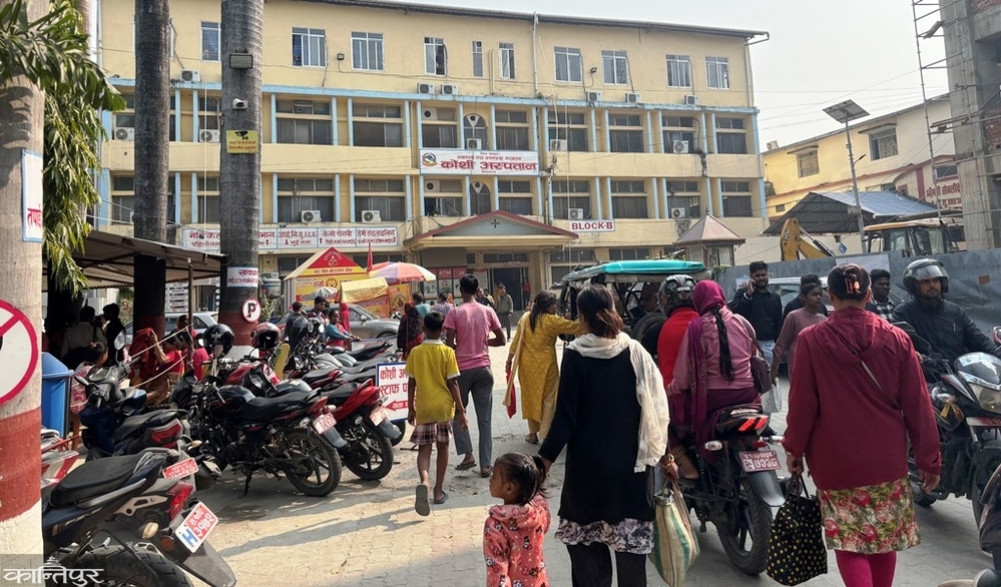
Services at Koshi Hospital have become disorganized due to excessive patient pressure, lack of manpower, cramped structure, and weak and disorganized services.
We use Google Cloud Translation Services. Google requires we provide the following disclaimer relating to use of this service:
This service may contain translations powered by Google. Google disclaims all warranties related to the translations, expressed or implied, including any warranties of accuracy, reliability, and any implied warranties of merchantability, fitness for a particular purpose, and noninfringement.
There are dozens of private hospital signboards in Biratnagar metropolis. There are crowds of patients inside and outside, and the prices of services are just as expensive as the services themselves.
However, the Koshi Provincial Hospital, which is considered one of the few government hospitals that is considered reliable, is in disarray. The service at Koshi Hospital has become disarray due to excessive patient pressure, lack of manpower, cramped structure, and weak and disorganized service.
Another important reason for the increase in crowding at this hospital is the treatment services provided by health insurance. The pressure of patients who come with referrals from the municipal hospital comes to Koshi Hospital. ‘The ratio of patients treated by insurance and others is about half and half,’ said Govinda Katuwal, the hospital’s medical statistics officer, ‘that is why the crowding at the hospital has increased.’
According to him, the hospital’s service also seems to be in disarray due to delays in the insurance software. According to him, the hospital, which receives 1,500 to 2,000 service recipients daily, gets even more crowded on Sundays.
Rani Hospital and Baijnathpur Hospital, owned by Biratnagar Metropolitan City, have been upgraded in recent years, but have become more of a place to issue insurance referral papers than a treatment center. These city-level hospitals often look deserted due to the overcrowding in provincial hospitals. ‘The crowd that appears is only coming to get referral papers,’ said Ahab Baijnath Sharma of Rani Hospital, ‘90 percent more come for referrals and 10 percent for treatment.’
Rani Hospital in Ward 15 was previously a primary health center. It has now become a 15-bed city hospital. The health post in Baijnathpur has also become a 5-bed hospital. Despite the increase in physical infrastructure, the treatment service remains the same.
Even though the city has upgraded, the federal government considers Rani Hospital as a primary health center. As a result, there is only one medical officer here. He is more busy signing referral papers than providing treatment. Even though specialist doctors are called from private hospitals four days a week, the service is not continuous and adequate. Specialists from dentistry to obstetrics and orthopedics come, but there is not much crowd of service recipients coming for treatment.
Baijnathpur Hospital in Ward 19 has a health responsibility of about 8,000 people. But due to lack of manpower, the service runs only from 10 am to 4 pm daily. There is a day and night service for obstetric patients, but the hospital officer Bhola Timsina says that the 24-hour service has not been started due to the lack of radiologists, pharmacists and other necessary staff.
Since the service is not available at the city level, the entire burden of patients from general patients to obstetrics, emergencies, and serious problems is ultimately borne by Koshi Hospital.