As the cold weather continues to worsen, human activity in the mountainous settlements of Phaktanglung and Mikwakhola has decreased as local residents have begun to descend into the valleys.
We use Google Cloud Translation Services. Google requires we provide the following disclaimer relating to use of this service:
This service may contain translations powered by Google. Google disclaims all warranties related to the translations, expressed or implied, including any warranties of accuracy, reliability, and any implied warranties of merchantability, fitness for a particular purpose, and noninfringement.
The sun only starts to appear at 10:30 in the morning on the premises of Ghunsa Basic School in Lelep Ghunsa, Faktanglung Rural Municipality-6.
The first place to see the sun in the settlement surrounded by mountains is the school area. Since it gets cold in the morning and evening in this settlement, which is 3,100 meters above sea level, children prefer to sit in the field after reaching school and finishing their prayer meeting. When the sun is shining, the teachers have also made similar arrangements.
Since the cold has set in, eight students studying here have already returned home. The school has now given a holiday to students studying in the lower levels, including child development classes, and students outside the settlements of Ghunsa and Phelek, so that they can come back when the weather starts to warm up.
Preparations for the half-yearly exams for upper-class students have been underway since the first week of Mangsir. The school has given a holiday because children get sick a lot after the cold starts, they need special care, and their parents are far away. 24 students from two settlements of Ghunsa and Phelek, which are at the same altitude, are still studying.
Human activity in this area, which is located in the Kanchenjunga base camp, has also decreased. Tourists who came to visit the northern and southern base camps of the Kanchenjunga mountain have returned, except for a few. As the cold increases, local residents have also gradually started leaving the settlements and moving down to the valley.
Singh Bahadur Yadav, the principal of Ghunsa Basic School in Bhardaha, Saptari, says that their daily lives depend on the pace of the cold. ‘When the sun sets late in the settlements, it becomes difficult to bear the cold,’ he said. ‘After that, people start leaving the settlements, dismissing schools and offices, and taking their livestock to pastures in the villages.’
According to Dandu Sherpa of Ghunsa, as the cold increases, local residents lock their houses and start moving towards the villages. Most of them have been using this time to meet relatives. Some have also gone to Taplejung, Kathmandu, and Darjeeling in India.
All households in Yangma, Phaktanglung Rural Municipality-7, where 11 families live, leave their settlements during the cold season. Residents of Khambachen, Ghunsa, Phale in Lelep, Phaktanglung-6, and Tokpegola in Mikwakhola Rural Municipality-5, Papung, also walk from their settlements to escape the cold. Even though they do not leave their settlements, the population in Olangchungola, Phaktanglung-7 also thins out in winter.
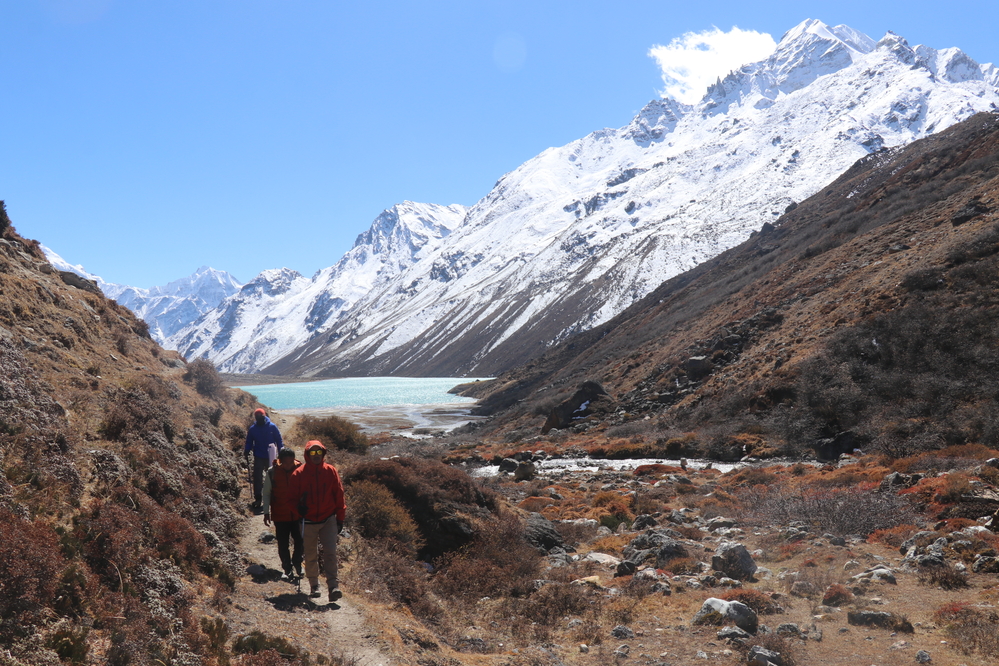
Until a decade ago, locals used to make a schedule to leave and return to their settlements in winter. Locals say that due to the change in the climate, decisions have been made immediately based on the situation recently. ‘Until a decade ago, there was a fixed date for how long to stay in the settlement, how long to go out and return,’ said Dandu of Ghunsa. ‘Now, due to climate change, there is a difference between cold and hot, and when it snows and when it doesn’t, the exact time to leave the settlement and return is not the same.’ According to
Dandu, up until a decade ago, people used to be outside the settlement from Mangsir to Magh. Snow would start falling after Mangsir. Now, since the time of snowfall is not certain, sometimes people stay in the settlement until the end of Mangsir. But since the cold does not subside and the snowfall pattern changes, they return to the settlement only towards the end of Falgun. ‘Our regular school holidays are from the last week of Mangsir to Magh,’ said Principal Singh, ‘If the children and villagers cannot bear the cold, we will open the school earlier and if it is moderately cold, we will open the school by the end of Mangsir.’
There are settlements in Taplejung at an altitude of up to 4200 meters. Yangma and Khambachen districts are the highest settlements. These settlements have community schools, health posts, police posts, Armed Police Base Camps, and offices of the Kanchenjunga Conservation Area.
Even though the school holidays are over, other government offices have to arrange firewood for heating, warm clothes for the body and bedding for staying in the settlements. Locals say that the winter season is also very expensive for living here.

