We use Google Cloud Translation Services. Google requires we provide the following disclaimer relating to use of this service:
This service may contain translations powered by Google. Google disclaims all warranties related to the translations, expressed or implied, including any warranties of accuracy, reliability, and any implied warranties of merchantability, fitness for a particular purpose, and noninfringement.
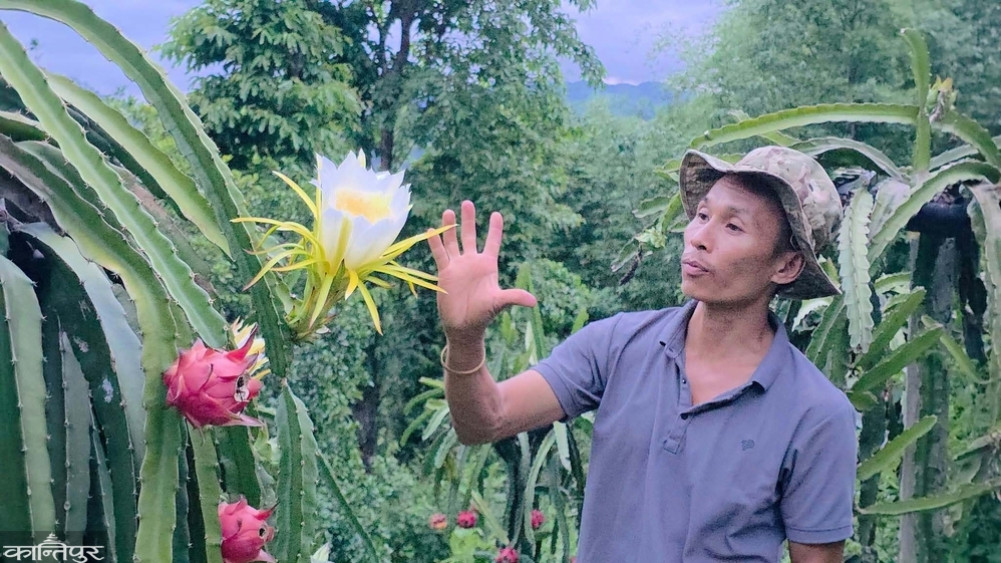
Saroj Rai of Rawabesi Rural Municipality-6 Houchur has started earning a lot of income from dragon fruit farming. The dragon fruit planted in about 18 plantations has started giving income since last year.
Last year, he said, he earned 8 lakhs by selling 2,000 kg at 400 rupees per kg. This year, Rai said, more than 3,000 kg of fruit will be sold. "So far, 1,500 kilos have been sold," he said, "and there will be another 2,000 kilos."
Rai started commercial dragon fruit cultivation in 2079. After working in Dubai for three years and returning, Rai said, he became aware of doing agricultural business in the village. After that, he registered 'Himalayan Agro Farm' in Domestic and Small Industries Office Khotang and started commercial farming.
He says that he started this farming after the goat and goat rearing business did not find a market. 'I went to Hyderabad in India and took training on the techniques of dragon fruit cultivation. From there, we brought 250 dragon fruit plants and started farming," Rai said. "Now 2,700 dragon fruit plants have started to grow."
He said that about 25 kg of fruit is produced per plant. Fruits can be picked up to eight times a year from one plant. There is no problem with the market as customers come to the house looking for dragon fruit.
Rai said that about 18 lakhs were spent on dragon fruit cultivation. Out of this, last year, Rawabesi Rural Municipality provided 200,000 subsidy for pillar construction and purchase of tires. Eco Himal Nepal also provided 400 plants last year and 1000 plants this year.
Rai has planted dragon fruit on 18 acres of land, while mangoes, macadamia nuts, lemons and other fruits have been cultivated on 22 acres.