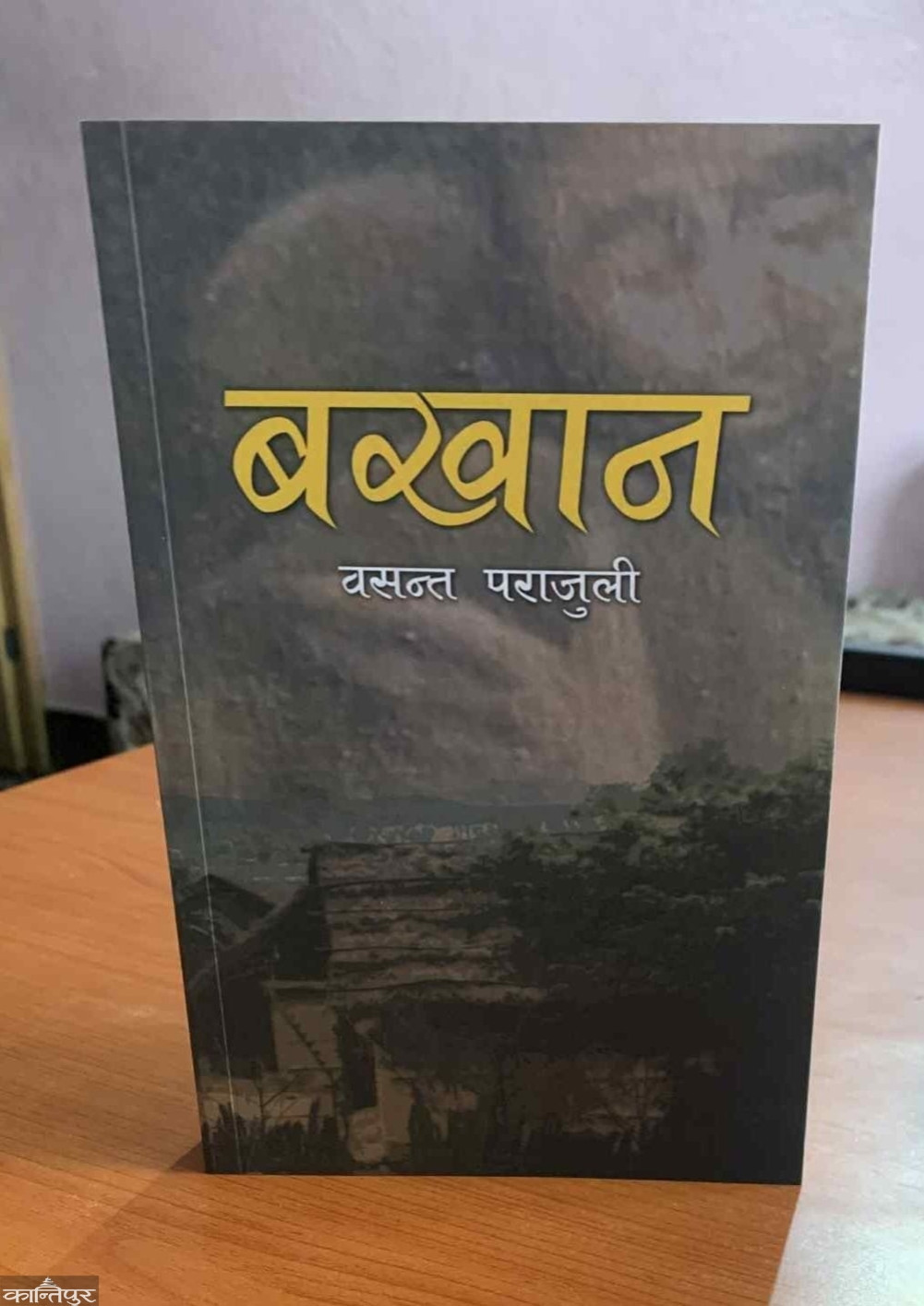
The novel 'Bakhan' has provided literary context to the collective memory of a region by presenting the geography, history, culture, politics, and social changes of Chitwan in an integrated manner.
We use Google Cloud Translation Services. Google requires we provide the following disclaimer relating to use of this service:
This service may contain translations powered by Google. Google disclaims all warranties related to the translations, expressed or implied, including any warranties of accuracy, reliability, and any implied warranties of merchantability, fitness for a particular purpose, and noninfringement.
Although the tradition of historical and biographical novels in Nepali literature is old, most of them seem to focus on central figures in national politics or court history. Novels that combine local geography, regional history, social structure, cultural memory, and political transformation are comparatively few.
Basant Parajuli's novel 'Bakhan' can be considered as a strong attempt to address such a deficiency. This novel presents the geography, history, culture, politics, and social change of Chitwan in an integrated manner, providing a literary context to the collective memory of a region.
The novel 'Bakhan', written with Bakhan Singh Gurung, a character who has been gradually forgotten by history, is not just a biography of an individual; it is also a socio-cultural autobiography of Chitwan. The novel has intertwined personal life and collective history in such a way that the reader can experience the history of Chitwan in parallel with Bakhan Singh's life.
Basant Parajuli is basically a storyteller. Parajuli, who is active in journalism and literary writing while living in Chitwan, is known for his simple, descriptive and factual language style. Journalism practice has given him a perspective on collecting facts, sensitivity towards sources and an objective understanding of events. This perspective is also evident in his literary writing. Parajuli, who has established himself as a storyteller through story collections such as Kumata and Momcho, has presented his investigative skills, historical awareness and ideological maturity more strongly through the novel Bakhan.
The structural feature of the novel is its beginning. The story of the novel begins with the death of Bakhan Singh Gurung and the funeral rites performed according to the traditions of the Gurung community. This beginning immediately places the reader on a cultural and emotional plane. This narrative style, starting from death and returning to life, connects the novel with deep human feelings. Bakhan Singh is not just a person here, he is established as a symbolic character carrying the history of Chitwan.
Bakhan Singh Gurung is one of the pioneers of modern settlement in Chitwan. Not only that, he is also the founder of Nepal's first cooperative—Bakhan Loan Cooperative Society. The novel extensively explores the background of the establishment of cooperatives, its social significance, and its relationship with economic self-reliance. In this sense, Bakhan is also a history of development, economy, and community consciousness.
Bakhan Singh, a warrior of the 2007 People's Revolution, resigns from his position as a captain in the Royal Army and joins the anti-Rana movement. This decision is not just an example of political courage; it is also depicted as a determination to face personal risk, family separation, and an uncertain future. The difficult years of underground life, the risky commute between Chitwan-Madi-Narkatiaganj, the death of two sons during the revolution—all these contexts make Bakhan Singh's life extraordinary and extremely tragic.
The novel does not confine Bakhan Singh's life to the confines of mere biography. Rather, it presents his life journey in parallel with Nepali political history from 2007 to 2040. Events such as the 2007 revolution, the political changes of 2017, the rebellion within the Nepali Congress, the 2036 student movement, the 2037 referendum, and the participation of some Congress leaders in the Panchayat system are artistically covered in the novel. In this way, Bakhan is not a textbook of political history, but has become a literary medium that transforms history into a living experience.
The depiction of the geography, history, and cultural structure of Chitwan is another notable aspect of the novel. Chitrasen Baba's temple, Someshwor Gadhi, Upardang Gadhi, the ancient religious importance of Devghat, the establishment of the Chitwan National Park, and the brutality of the hunting culture of the royal family and foreigners—all these contexts are presented in a research-based and lively manner. These details make the novel not just a narrative work but a cultural-historical map of Chitwan.
The depiction of the customs, traditions, and lifestyle of the Tharu community is another strong aspect of the novel. The interesting details about the reproduction of elephants and rhinos, the relationship between the forest and humans, and the culmination of the cooperative movement have made the novel multifaceted. In this way, Bakhan is not just a novel; it is also a detailed document of the socio-cultural life of Chitwan. The novel has deeply affected the extremely poignant aspects of human emotion. The death of a young son, the loneliness of a young daughter-in-law, the premature death of a grandson from malaria—these events fill the novel with a sense of compassion. As important as Bakhan Singh's political struggle and social contribution are, the pain, deprivation, and silent struggle he faced in his personal life are equally important. The author has presented these aspects in a restrained and sensitive manner without making them overly dramatic, which leaves a deep impression on the reader. The presence of historical real characters in the novel is also notable. The arrival of characters like Mallu Chaudhary, Rampreet Yadav, Karna Shakya, Muktilal Chuke, Raja Mahendra, BP Koirala, Suvarna Shamsher, and Ganeshman Singh gives the novel historical credibility. These characters are not limited to names alone; their roles reinforce the political and social environment of the time.
However, the novel is not completely flawless. Some factual errors and missing contexts are visible. The failure to include the meeting with Mohan Shamsher in Bangalore, the statements made by Mohan Shamsher, and the context of Bakhan Singh Mohan Shamsher being under his umbrella is a minor weakness in terms of historical completeness. Similarly, linguistic simplicity has become both the strength and limitation of the novel. The simple and descriptive language makes the novel easy and readable, but the reader seeking literary depth and symbolism may feel that the description is too much in some places.
But the main achievement of the novel is much greater than these minor weaknesses. Bakhan has established itself as a document that provides a comprehensive introduction to Chitwan by putting history, politics, culture, development, and human sensitivity on a single canvas. Restoring characters like Bakhan Singh Gurung, whom history has begun to forget, through literary means is the author's deep dedication to his homeland.
Overall, Bakhan is a readable, studyable and collectible novel. It not only reveals the history of Chitwan, but also the political transformation of Nepali society, cultural diversity and human suffering. Basant Parajuli has given literary form to the collective memory of a region by combining history, geography, culture and human sensitivity.
This novel does not just teach the reader history; it makes the reader feel history. Bakhan Singh's life is not just the story of an individual, but the story of an era. Chitwan's forests, settlements, cooperatives, politics, culture and struggle—all of these are vividly present in Bakhan.
In this sense, Bakhan is an important achievement in the Nepali historical novel tradition. Heartiest congratulations to Basant Parajuli for this beautiful and serious work. May her energetic and responsible writing journey be even more powerful and long-lasting.