One day after the construction of Singha Darbar, Chandrashamsher accompanied his younger daughter, Badamaharani Balkumari Devi, to the Kausi of the palace. Baghdarbar was seen from there, Chandrashamsher said 'O Baghdbar' and pointed with his hand and showed Balkumari Devi. Balkumari said 'Maharaj! If it is a tiger palace, why not name this palace as a lion palace? she said Chandrashamsher found his proposal appropriate and the newly built palace was named 'Singh Darbar'.
We use Google Cloud Translation Services. Google requires we provide the following disclaimer relating to use of this service:
This service may contain translations powered by Google. Google disclaims all warranties related to the translations, expressed or implied, including any warranties of accuracy, reliability, and any implied warranties of merchantability, fitness for a particular purpose, and noninfringement.
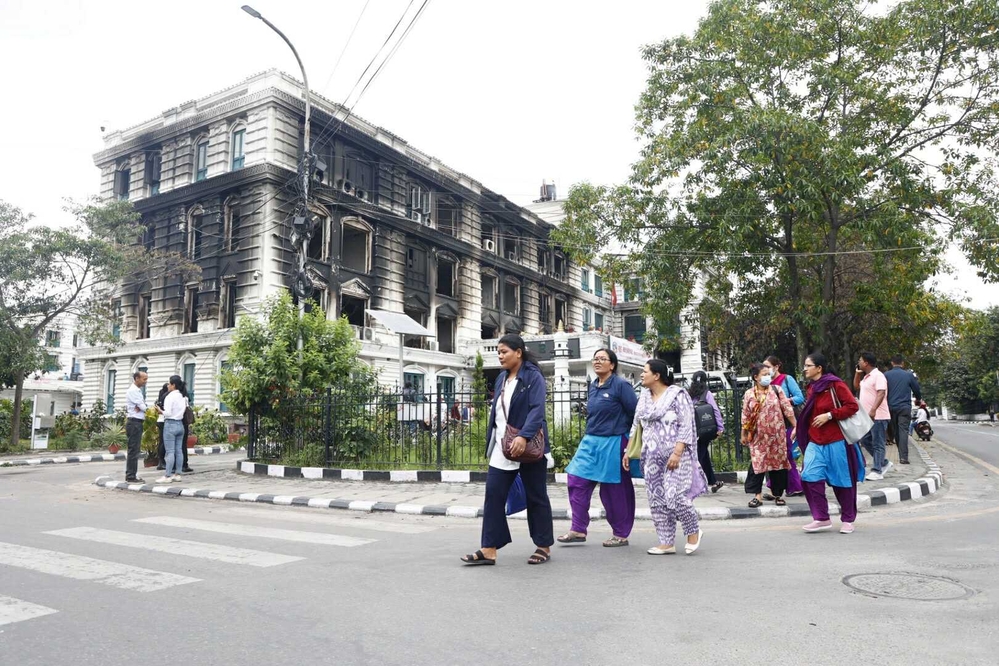
The Gen-Ji movement threw out the old power like a tumor. However, when the Jain-Jitra protestors who got into the agitation set fire to the magnificent buildings, the city turned into a nightmarish nightmare of moribund bungalows. And, the national life surrounded by anomalies became a feature—dhoovaidhoovaan.
People are suffocated in the terrible crisis of existence by seeing the burning parliament building auditorium, Sheetal Niwas, Supreme Court and lion palace.
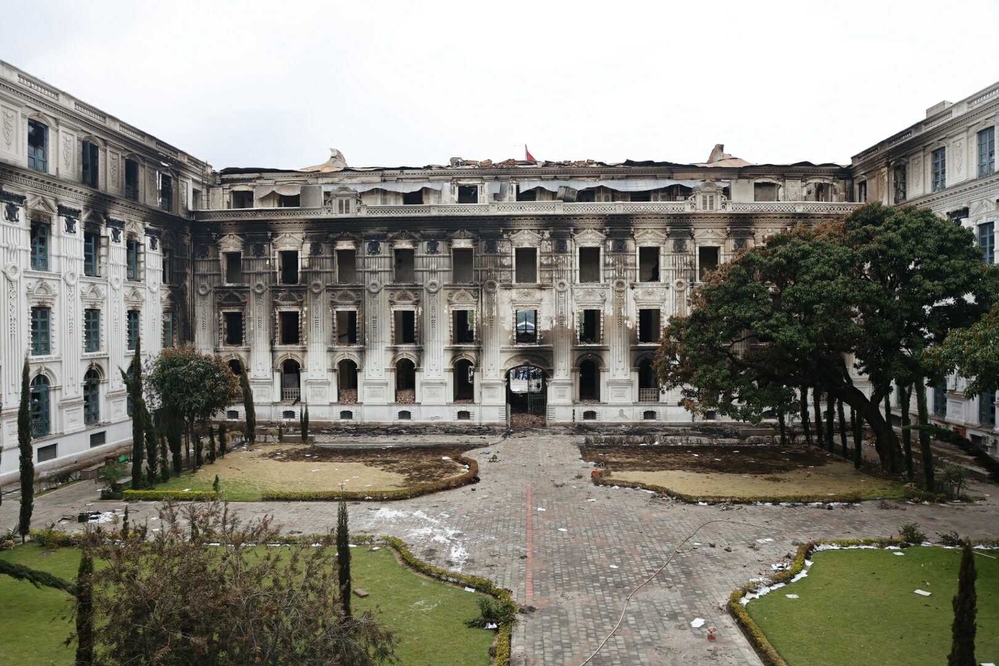
The lion palace, which was standing as a strong fortress of power and strength until yesterday, today is sleeping in the black veil of innocence, its color is as sad as the clouds before the rain. The fire not only destroyed the magnificent building, thousands of stories and beliefs ended in its brutal flames. The craftsmanship and magnificence of the vast palaces have today turned into heaps of ashes.
The fire of Singha Darbar plunged the sky of the capital into darkness. Its roof was still being washed away for weeks after the fire broke out. The cement walls, bastions and wooden pillars of this grand palace have been burnt and turned into ruins. The memory of history and symbols of power have been destroyed by lapka.
This fire is reciting the pre-story of the historical palace, in whose sanctum and prestige the political power of the nation used to reside, here it stands today, in the hour of crisis. This was the fire — Nepal's story of joy and sorrow, struggle and defeat. People are suffocating with the realization that the future of a country surrounded by a high wall of prohibition will be more depressing, deranged and strange.
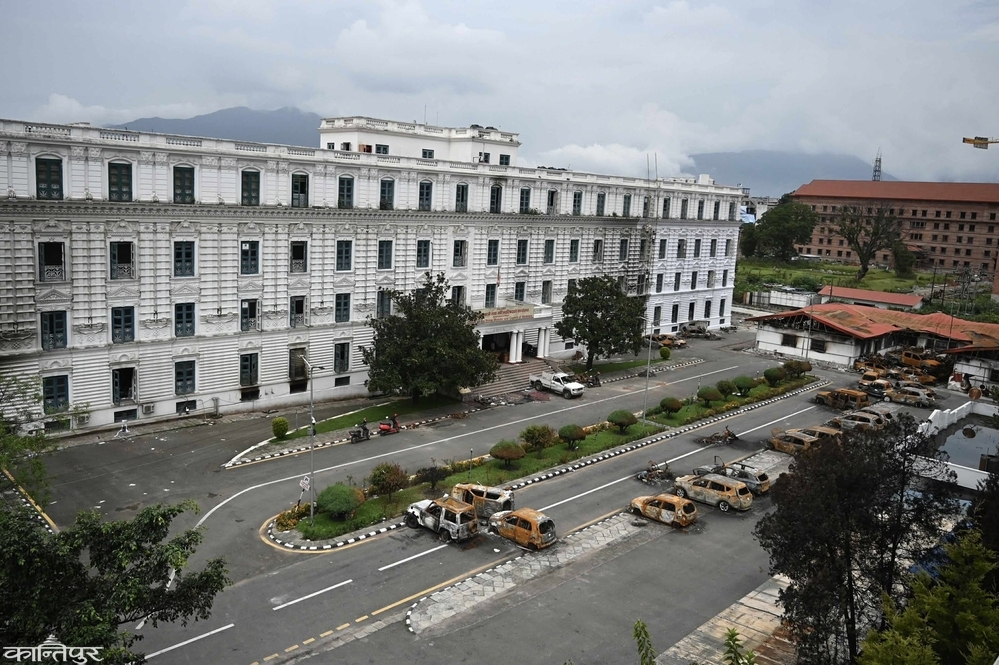
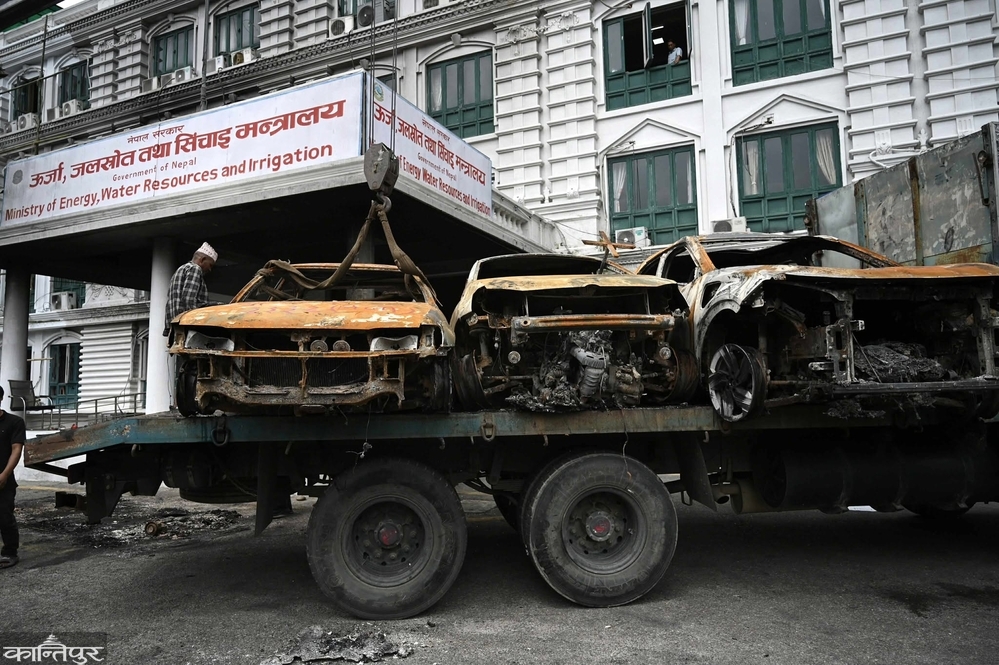
The lion palace, which was standing as a strong fortress of power and strength until yesterday, is now sleeping under the black blanket of innocence, the fire not only destroyed the magnificent building, but thousands of stories and beliefs also ended in its brutal flames. It is enough to say that the Singha Durbar turned into ashes, now the country has fallen into the abyss of horror. As the temperature of the movement gradually rose, the Singha Durbar was burnt. And all the ministries within this yard - Ministry of Home Affairs, Ministry of Education, Ministry of Finance... Scattered everywhere in the Singha Durbar courtyard are all the skeletons of rusted motors and vehicles.
But, it survived the fire - Nepal's data center. If this was also burned, we would probably be zero-zero in the data and the dream of digital Nepal would remain incomplete.
then?
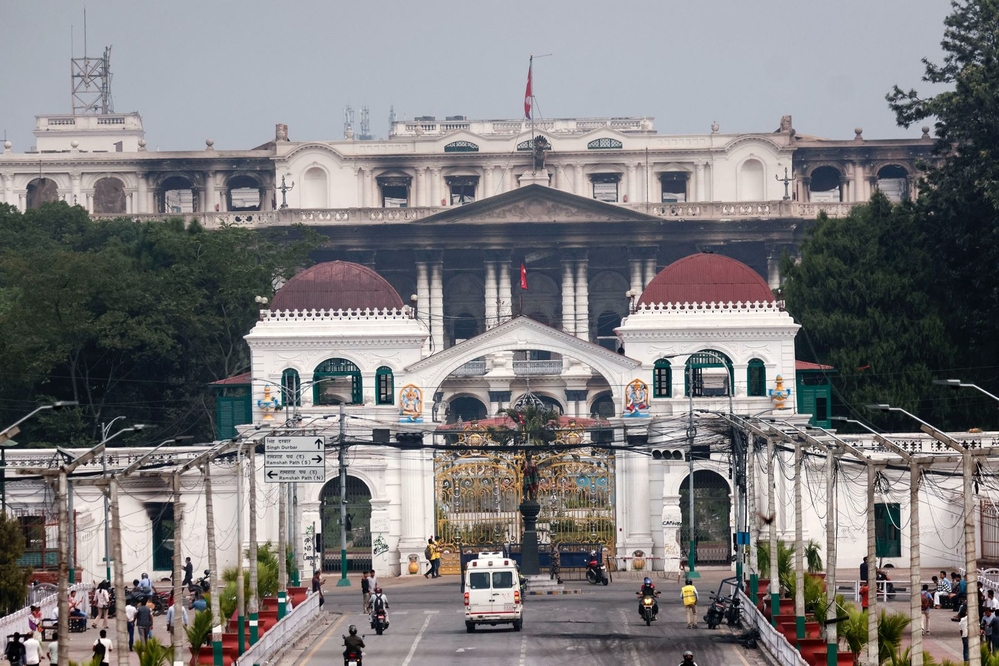
After many days, people in the narrow alleys and streets of Kathmandu are starting to look back to the slums they left behind. "Hey, where did you come from?" They began to sigh. Buried in the dust of the past — the city. The old casket of memory, the golden and noble history, is now on fire. Still floating in the city—the smell of fire.
The Singha Darbar, sitting majestically in the heart of Kathmandu, was not just a unique building, nor was it just an administrative structure, it was a story of Nepali history and politics. Its grand architecture itself was a declaration of power and authority.
This was not the first fire incident in Singha Durbar, history says - on Monday, 25 June 2030, at 10 o'clock in the night, the fire broke out due to an electrical short. The fire burnt the turrets, kausi and roofs of all the houses in the Singha Durbar. That fire destroyed the precious documents of the Singha Darbar. Burns again after 52 years - Singha Durbar. And, once again, the historical documents in its womb have become ashes. The political-constitutional history of Nepal has also become gray along with Singha Darbar. Those documents with charcoal were valuable cultural heritage of the nation.
A typical 19th century architectural model, this palace. It is written in history - Chandrashamsher built this grand palace in 1960 at a personal cost of 25 lakh rupees. There were 1700 rooms and various squares. It took a year to build the palace.
This palace was a perfect combination of nobility and artistic consciousness of Nepalese queens. Writer Balakrishna Sam has written memoirs and memoirs on the architecture of the Singha Durbar.
After the burning of the Singha Darbar, Sam discussed the architecture of the Singha Darbar in the essay "Mero Araj Seto Darbar and Mero Sahaj Singha Darbar" in "Gorkhapatra" dated 20th July 2030. Sam writes, Salutations to the pillars that have burned and fallen, Salutations to the pillars that are still alive. Obeisance to the never-ending Sahodar crores of rejuvenating instincts.' According to
Sam, the main wealth in the Singha Darbar was—mostly government documents and historical books. He writes, "Even though most of the important papers were taken down, it is natural that many papers were burnt in such a fire." In the same way, many decorations were burnt.'
narrator, essayist Dhach Gotame has written a memoir on that fire for thirty years - in 'Samjhanaka Galchedaharu'. While the fire was raging in the Singha Darbar, a deputy secretary appeared from the corner towards the Ministry of Foreign Affairs. He was barefoot and had pulled the hem of his turban down to his knees. He had a large framed picture of the queen in both hands.
He approached the Prime Minister without hesitation and said - Sir! I did not care about the fire and saved both the pictures of the governments....The room like the Foreign Ministry, which houses the country's priceless historical heritage, was half consumed by the fire. Vice-Secretary Vishwa Pradhan thought it preferable to carry two photographs instead of dragging a large pile of ink and letters from ancient historical records. Later, he became the foreign secretary and also became the ambassador of the most important places.' That was an example of morality. In that fire five decades ago, the eastern part of the palace was destroyed. Although efforts were made to save Bhagirath from the fire, that effort was not successful. The rear part was destroyed by cannon damage and the front part was saved, the rest of the Singha Darbar was burnt to ashes.'(Major Historical Palaces of the Rana Period, Purushottamshamsher Jabara).
The current western mohad of the Singha Darbar is a structure built at the time of construction and the parts inside the No. 1 Chowk inside the Singha Darbar were built later. The Nepalese army saved the facade of the Singha Darbar from being destroyed. Many government offices were eventually moved after that fire.
Chandrashamsher, who came to power on 10 June 1958, felt the need for a palace for himself, and bought 350 ropani of land for Singhdarbar at the rate of 90 rupees per plant. Although Chandrashamsher wanted to build a palace where he could live, a magnificent palace was prepared as he built it. All the wood used in the Singha Darbar was brought from the 'Chhariya' forest near Kathmandu," says historian Maheshraj Pant. "The Singha Darbar is said to have been built as a personal building by Chandrashamsher, who later sold it to the nation. All the Prime Ministers after him stayed there, but Padmasamsher didn't, because he thought it would cost more to come to Singha Durbar. Padmasamsher was careful about money and simple, ruled from Vishalnagar palace. Fifth Rana Prime Minister Chandrashamsher only started living in Singha Durbar. Chandrashamsher, his successor Bhimshamsher ruled from there. That was also the abode of Shri 3 Maharaj. The reign of Mohanshamsher also ended there.
There is a book by Pandit Ambika Prasad Upadhyay - 'History of Nepal and History of Ramnagar', in which he has written about the decoration and decoration of the Singha Durbar, 'Maharaj Chandrashamsher, after he became the Prime Minister, spent a lot of money and built a huge palace that is second to none in India. The Singh Darbar was made a government palace by the name of 'Prime Minister's Palace' as it was said that henceforth the Prime Minister would stay in this palace. The priceless furnitures that are decorated in the places of this palace were also made to stay with the palace, that is, E Maharaj did not leave this palace only, but all the belongings suitable for the Prime Minister were also made official with the palace.'
But, now there is a dull silence in this magnificent lion palace. The dreamy historicity of Singha Darbar is no less than a talismanic story. The planners of Singha Darbar, whose construction began in 1960, were Nepalese engineer Colonel Kumar Narasimha and Indian engineer Jogendrababu. It has been written in history that most of the workers who built the Singha Darbar were Nepali national soldiers and prisoners who had been sentenced to a long time in prison. Because Nepali national soldiers and prisoners were used, the construction of the vast palace was completed within 11 months.
Jagannath and Baijnath Sedhai's book 'Chandramayukh and Bhuchandra-Chandrika' describes Sinha Darbar - Sinha Darbar is based on neoclassical architecture, an architecture that reflects Greco-Roman art! Maheshraj Pant says, “The outer structure of the palace was of western style, where cement was not used. The mud of the palace was made using sandalwood, knives and mas dal. Darshan stone, Simar was also used.'
were in Singha Durbar - 5 courtyards, 1700 large rooms and 17 courtyards. Surrounding the palace were magnificent gardens, where seasonal flowers bloomed. Among them, the butterfly garden is becoming famous. The story of that garden has been written by Sardar Bhim Bahadur Pandey in 'Tysabakhatko Nepal', 'A small cracked wooden house built in a butterfly garden inside the lion palace.
There, the Prime Minister was lying on a comfortable mech, in front of him was a big basket full of various sweet spices, a silver paanbatta, an artistic hookah made of silver, a rubber tube tied with gold at the end and a mech. Talukwals had to sit on mechs and other worldly rulers on carpets. The Prime Minister used to listen to the talk for hours while smoking spices and tobacco. When did that garden get destroyed? No account. And now there is no garden but a long pond in front of the palace.
In 'Indu' (monthly magazine 2041, June) historian Rajesh Gautam has written an essay on Singha Darbar - 'Singh Darabar' a historical study. He writes, "The pool and fountains of the Singha Darbar were built in the Italian style, while the road was built on both sides of the palace, which separated from the main gate and surrounded the palace, and connected to the main gate." Most of the palaces in Rana period Nepal are built in European style. The gate of the Singha Durbar is also large and of a kind befitting a palace, and has two iron pillars, made in the French style, flanked by single wavy houses flanked by wings. In the various rooms of which the Prime Minister's body was protected by lightning. The living rooms of the palace were decorated with British, Italian and French furniture. After returning from his trip to Britain, Chandrashamsher did some additional work in the palace. As he made a 'British meeting'.
The walls of that meeting were covered with mirrors and large pans were hung, which were brought from Britain and France,' says Rajesh Gautam, who met Bhimsengola's own residence on Wednesday morning, but Chandrashamsher, who built such a large lion palace, did not even make a brick in the palace.
He, his entire family and the Rana Prime Ministers living there used to work from copra with the help of slaves and servants for toilet work. The lower-level servants who worked in the palace used to go to the fields, forests and washrooms far away from the palace to do toilet work. 5-6 charpis were first built in 2006 in Singha Darbar, but modern charpis were not there. When foreigners come to a meeting, they would immediately go back to the embassy if there was a problem. And, in 2017, the parliamentary government built a modern chapel for the first time in Long, where the Ministry of Foreign Affairs sits.
Why is this palace named Singha Darbar? Gautam has written, "The Prime Ministers of Nepal during the Rana period were like 'lions' in a way... Chandrashamsher was a very angry, warlike person who never laughed." That is why it was said that Chandrashamsher laughed or died. People at that time started calling the name of the palace as 'Singh Darbar' as a symbolic form of the 'Singh' placed on the roof in front of the palace because there was a person like a 'Singh' sitting in that palace. Chandrashamsher himself did not name the palace 'Singh Darbar'.'
Historian Purushottam Shamsher Jabara has a different opinion on the name of Singha Darbar. In 'Major historical palaces of the Rana period' he writes, 'One day after the construction of the Singha Darbar, Chandrashamsher accompanied his younger daughter Badamaharani Balkumari Devi to the Kausi of the palace. Baghdarbar was seen from there, Chandrashamsher pointed to Balkumari Devi by saying 'O Baghdarbar'. Balkumari Devi said 'Maharaj! If it is a tiger palace, why not name this palace as a lion palace? she said His proposal was reasonable to Chandrashamsher and the newly built palace was named 'Singh Darbar'.
Why did Chandrashamsher build this huge palace full of art? He had a big family. He built the palace with the view that his sons would be able to participate. However, later his sons expressed their desire to build separate palaces so that they would not live in the same palace. And Chandrashamsher sold it to the nation to make it the residence of the prime minister," says Rajesh Gautam.
According to Purushottamshamsher Jabara, Chandrashamsher sold Singha Darbar to Nepal government and took two crore rupees from the national treasury. But, irony! In a poor country like Nepal, Singha Darbar was not sold just once. Elders say that after the 2007 revolution, the palace was once again sold to the nation within a period of 2026. When and who sold it is the subject of investigation," writes Gautam.
In the history books, it is mentioned that there is a magnificent garden of various plants in Singha Durbar. Author Saurabh writes in the article titled "Singh Durbar" in the book "Disahamati", "The sweetest mango tree in Nepal was considered to be the one in the first square of this square."
However, it does not seem to be certain yet which species it is.... Camphor nuggets were also made by evaporation from the camphor trees inside the lion palace.... Kip flowers planted inside the lion palace were used to make perfume. Every morning, ice was poured into the vessel wrapped with leaves through the Helambu-Sundrijal, every morning water was poured from the milk pond of Machhegaon just to wash the mouth.
was actually the Lion Palace — a symbol of British colonial times, which had long been a symbol of power, struggle and conspiracy. It is a witness to innumerable historical events from the downfall of the Ranas, the rise of democracy, the soil-friendly Panchayats and republics, an integral part of political history, a witness to our modes of governance. Singha Darbar, which stood at the courthouse of the era, is abandoned today. And, its splendor has become a past-memory.
According to historian Rajesh Gautam, the presence of 'Singh Darbar' before Narayanhiti Darbar was a sign of dual rule. "The Narayanhiti Palace remained meaningless in front of the Singha Darbar, so that the Nepalese people followed the 'Nepalese political culture' of following powerful people and the Singha Darbar remained the focal point of the Nepali people for half a century," he says. According to him, King Tribhuvan told the then Prime Minister Chandrashamsher when he was very young, 'You come and stay here (at Narayanhiti Palace), I will go and stay there (Singh Darbar). People come there a lot, it is easy to meet me.'
After Chandrashamsher sold the 'Singh Darbar' to the nation of Nepal, it became the residence of the Prime Ministers of Nepal. 28 years of Chandrashamsher's 29-year tenure were spent in Singha Durbar, on 30th of December 1986, he passed away in Singha Durbar.
The next Prime Minister Bhimshamsher ruled for 3 years, he also died in Singha Durbar. After Bhima, Juddhashamsher became the prime minister for 14 years. After February 7, 2007, the Singha Darbar came under the ownership of the government of the then King, and Mohanshamsher was ordered to leave the Singha Darbar as soon as possible. Mohanshamsher then went back to his own Lakshmi Nivas at Maharajganj, since then the Singha Darbar became the Secretariat of His Majesty's Government.'(Major Historical Palaces of the Rana Period).
Thus always remained the center of governance—Singh Durbar. And after 2007, uninterrupted rule continued from here as the Prime Minister's Office.
'Chandrashamsher announced the abolition of sati and slavery, the decision to classify the Rana family, the decision to force Madhavraj Joshi and other social reformers like Krishna Prasad Koirala to flee the country, and the decision to support the Yonghus band Midan regardless of the treaty between Nepal and Tibet,' says Gautam. During the war of Shamsher, many decisions were made here, incidents happened. An important incident was the expulsion of the 'C' category Rana from the valley, the torture and punishment given to the Nepal Praja Parishad. This incident was the seed of the 'against Rana' revolution. And, Padmashamsher announced the creation of the first constitution in 'Nepal' from here.' However, this story of fire has perhaps given a new perspective and a new lesson to the politics of Nepal. Singh Durbar, which was shaken by the earthquake of 2072, was put into operation in 2077 after being reconstructed to withstand an earthquake of 8 magnitude. The earthquake did not shake, but the lion palace was reduced to ashes by this fire .
is the storyteller of Sinha Durbar. From the Rana period to the Republic period, the characters and trends, the witness of the movement and the celebration is a long narrative of emotions – Singha Darbar, which has deeply communicated with thousands of people who have grown up in its sanctum sanctorum.
The rhythm of this city, which was terrorized by Jane-Jieter protestors, has not been drawn again, the muddy cloak of silence has not been removed. In the seemingly war-torn city, the smoke empire has cleared, but the deep marks and scars of the fire are everywhere in the city's streets, alleys and elegant buildings.