In American literature-the blues is the Mississippi, in Russian labor-art the Volga, in Chinese history-music the Huang-Ho, and in Hindu myth the Ganges beats.
We use Google Cloud Translation Services. Google requires we provide the following disclaimer relating to use of this service:
This service may contain translations powered by Google. Google disclaims all warranties related to the translations, expressed or implied, including any warranties of accuracy, reliability, and any implied warranties of merchantability, fitness for a particular purpose, and noninfringement.
Congo'Aa yi o ko, ye gu de, aa yi o ko, ye gu de. The stream flows quietly, the water murmurs, the river flows in a sweet rhythm. The labor is not tiring, the burden is light, the behavior is with a friend. For all of us, all of us together... . Ye Gu De... Dream meeting, Ye Gu De... Let's all together, let's enjoy the lake, along with the river...'
These quotes are from Paul Robson's song 'Sanders of the River'. In particular, this folk song of his has made the main theme of the collective spirit of the tribal people around the Congo River, their harsh lifestyle and interesting voyages.
This song has a direct connection with something, it is with the Congo River, it is with the collective labor of sailors . On the one hand, the interlude "Aa yi o ko, ye gu de" represents the local African vernacular, while on the other hand, when rowing a boat, it inspires the sailors to row even harder. Words like 'for all of us, all of us together', 'rejoicing along the river' represent workers' unity and collectiveness .
The Congo River, one of Africa's most famous rivers, has long been a symbol of life, struggle and community in African culture. In Robson's songs, the river is not just a geographical feature, but a living force, the daily life, labor and dreams of the people living along the river. Robson transforms traditional African tunes into a mellow, lyrical phrase . The song connects the river and the rhythm of human life . The special theme of this song is the flow of water, waves and the close relationship between sailors. This song emphasizes the maneuvers, mutual assistance and patience to cross the river in a canoe.
Robson has another song about the Congo by Sirze, like a baby lullaby. The meaning of this Congo lullaby is as follows:
Oh, my little black dove, my little black dove, rolling in the love-nest, protected by the moon, sleeping in my arms . The stars twinkle, watching you all night, the river of sleep flows, full of quiet deep love . Nida Nani Nida, wake up when the darkness is gone, Nida Nani Nida, wake up only when the sun rises .
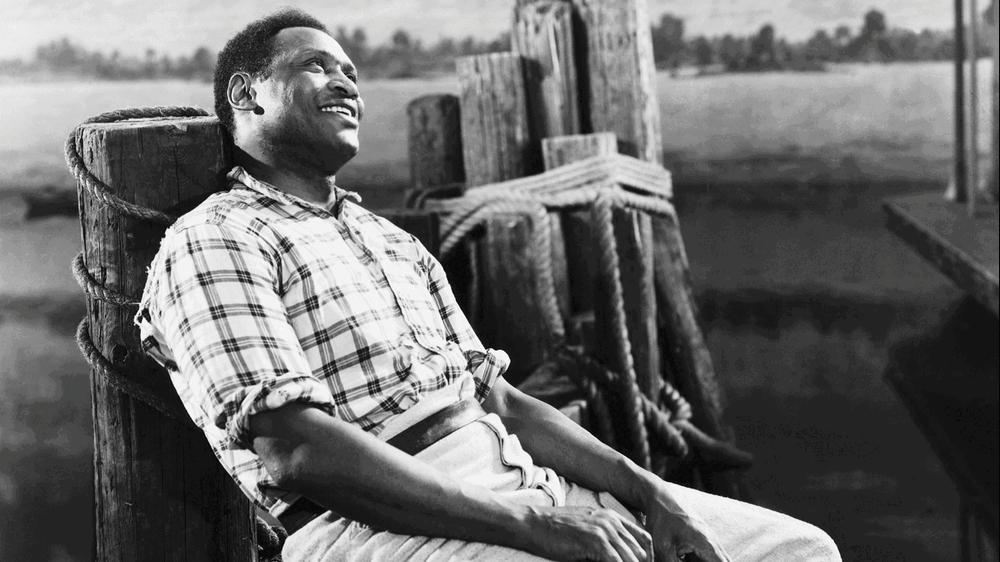
Through his deep and deep voice, Paul Robeson, who constantly raises his voice against discrimination and injustice and for social justice, has a special place in the musical world of the 20th century . Afro-American, Robson's creations are inspired by the Congo River and African life. These songs fall under his Nauka Vaka .
Robson's approach isn't just aesthetic when making a song over the Congo River. Instead, he made these songs a means of respect for African culture and poetic rebellion against Western colonialism. The Congo lullaby actually became a dynamic cultural identity for Robeson.
Mississippi
One of the most influential songs about the river itself is Paul Robeson's "Ol Man River" on the Mississippi. This song depicts the daily life of black workers in Mississippi, labor exploitation, pain and oppression. The song says, 'Though the world is troubled, though the land is not free, Flows with no purpose - the Mississippi . It neither plants potatoes, nor grows cotton . But it flows quietly.' For the first time, calling the Mississippi 'an old man', Oscar Hamstein wrote the song 'Ol Man River' for the musical play 'So Boat' in 1927. Later, Paul Robson sang this song with some modifications in his 1936 movie titled 'So Boat'.
Robson says - 'Mississippi has seen the suffering, pain, suffering and exploitation of the common workers. ... It certainly knows something, but does not say a word... We drink alcohol to relieve fatigue, and we are imprisoned . ... But, ignoring all this, the old man mississippi flows - just silently flows. The hero of the
song is a laborer from Mississippi. He wants to be free from the Mississippi and the white master . This song is an image of discrimination, exploitation and oppression experienced by African-Americans. There is a great irony in Hamstein's words . That is, he himself wants to be that frivolous, non-serious, frivolous old man like Mississippi, but Robson doesn't want to be that frivolous old man at all .
The role of the Mississippi River in American "prosperity" is great . From cotton to corn and wheat farming to cattle ranching, the area around the Mississippi was . With the advent of canoes, ships, and even the steam engine, the Mississippi River became the fastest mode of transportation. However, Mississippi was completely different for blacks and whites. There was a platform for whites to exploit blacks – Mississippi. Production is needed for profit, that too at low cost . For this, slave workers were needed, black slaves were needed . Therefore, Mississippi was also a center of the black slave trade. Walter Johnson wrote in 'River of Dark Dreams: Slavery and Empire in the Cotton', 'Mississippi not only traded cotton, it also spread capitalism and the slave trade.'
Mississippi itself was a structure of racial segregation, oppression of blacks, slave trade and labor exploitation. The most complex attack on this structure is - 'Ol Man River'.
Volga
Paul Robeson has sung another timeless song - Volga Boatman , even connecting the workers' relationship with the river Volga in Russia. And this creation of his is an English translation version of the folk song 'O Khayam' created during the hard labor of the laborers dragging the boats and ships on the Volga River to move them to the opposite direction of the water .
The specific creators of this song are pure shipwrights . They used to say this while addressing the Volga so that the ship would be able to move. These workers were called "burlaki" or "burlaks" in Russia. And on the Volga river, the city of Rybinsk was like a center of "burlaki". Laborers used to come here from far away hoping for work in dragging ships. Rybinsk on the banks of the Volga was the standard of transportation and economic activity. Ships 30 to 35 meters wide could easily be carried from top to bottom by sailors . However, when the ship had to be moved from the bottom up, i.e. in the opposite direction of the water, there was no choice but to drag the ship along the shore by a group of dozens of workers tied with leather ropes. And the workers who survived this hard labor anyway were the 'burlaki'.
This labor was a harsh compulsion . People were forced to do this work only when there was no alternative of livelihood or when money was very tight. Dayless women also used to join it . However, the 'burlaki' were not slaves, they were wage laborers. But his work was not only extremely difficult, there was also extreme exploitation of labor.
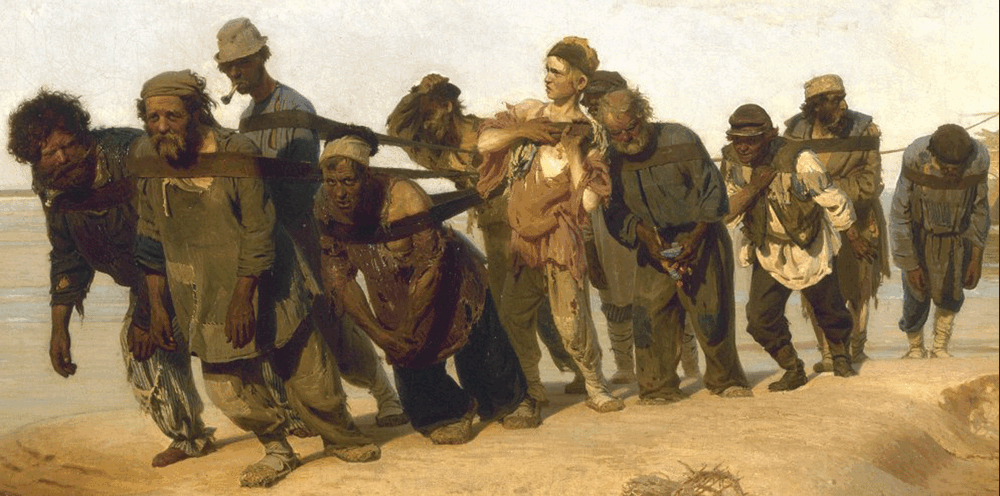
The Volga Boatman sung by Robson represents the hard life and labor of those 'burlaki'. They fill each other with energy by saying 'Tan-Patak Tan, Jor Lagae Tan' and together they express respect and respect to the Volga by saying 'Oh you Volga, mother of rivers, deep and wide' .
So, these three rivers are not the only ones in the world, on which the song is created. And Robson is not the only creator of creating a link between labor and identity on the river. The Mississippi beats in American literature and blues, the Volga in Russian labor and art, the Huang-Ho in Chinese history and music, the Ganges in Hindu myth.
Finally, rivers are not only sources of human culture and creation, but they are active participants in the political, cultural and knowledge structures, which are constantly reshaping our thinking and systems . Rivers are co-creators of ecosystem, culture, socio-political consciousness . To look at the river only from an anthropocentric point of view is to ignore its existence . Perhaps understanding the river requires a broader approach, such as neomaterialism, which sees it as an active agent rather than an object.

