Nisha used to say to Usha, ``Didi, if our father had died, he would have come to meet us at school. Usha used to talk about something and try to clear Nisha's curiosity. But sometimes his answer to such questions was nothing but tears.
We use Google Cloud Translation Services. Google requires we provide the following disclaimer relating to use of this service:
This service may contain translations powered by Google. Google disclaims all warranties related to the translations, expressed or implied, including any warranties of accuracy, reliability, and any implied warranties of merchantability, fitness for a particular purpose, and noninfringement.
When Madan Bhandari, a popular leader of the Nepali Communist Movement, died at a young age, his daughters were very young. The elder Ushakiran was barely 9 years old, the younger Nishakusum was only 6 years old. Usha and Nisha have only vague memories of Madan. The Madan of the image is more deeply engraved in their hearts than the Madan of the real one.
In general, children are more closely related to their parents. Usha and Nisha did not get that closeness and foundation. Few memories of her father are fresh in Usha's heart. Before 2046, Usha and Nisha's meetings with Madan were rare. They spent their childhood with their mother Vidya Bhandari. It was only after they started living in Chardhunge, Naxal, Kathmandu that they were able to spend time with their father, after the establishment of the multi-party system. That too very little time.
Usha still remembers sitting with her father and watching the Saturday afternoon movie on Nepal Television together. The last memory is when Madan left for a visit to China. Vidya along with her two daughters Usha and Nisha went to the special compartment of Tribhuvan International Airport to bid farewell to Madan.
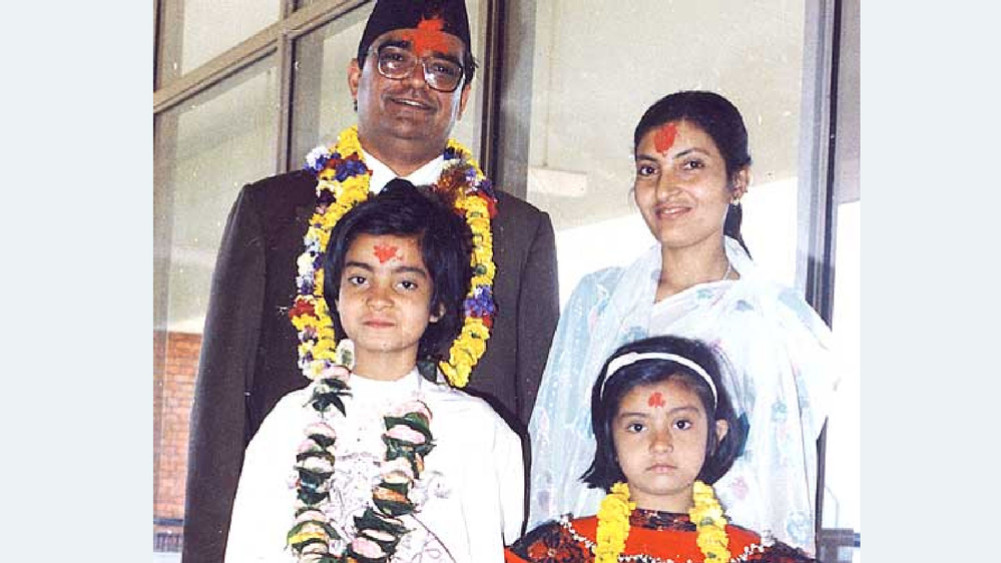
This was the last moment of Usha's meeting with her father that she would remember again and again. The reason for this was a family photo taken by Madan before leaving for China. This turned out to be Madan's last family photo. When Madan returned from China, he brought his daughters a 'teddy bear' shaped chocolate, which will never be forgotten by his daughters.
3 May 2050. The bar was Sunday. Madan Bhandari died mysteriously at Dasdhunga in Chitwan. The pain of their father's mysterious death will never fade from Usha and Nisha's memory. That day will be remembered as a terrible day throughout life. At first I didn't remember much when I was busy and focused on studying. Both Usha and Nisha studied in the hostel of Budhanilkanth School. Usha remembers, "During the school hostel stay, I didn't know when the day to see my father's face would be and when would be the day to see my mother's face."
When they started to understand the importance and place of their father, the importance of seeing father's face also increased. “As the cycle of time progresses, this day connects our lives more with our father, reminds us of his face and evokes a deep touch of his love in our souls,” says Usha, “but for me and my sister Nisha, it is not just a day of remembrance, but also a day of irreparable emptiness. Because we lost our father at a very young age. Our childhood, which should have been colored by father's love, was suddenly covered by a black shadow.'
Panchayat born in difficult times
Usha was born as the eldest daughter of Madan Bhandari and Vidya Bhandari on 22nd July 2041 at Koshi Zonal Hospital Biratnagar. The youngest daughter Nisha was born in the same hospital on 15 June 2044. When Nisha was born, Vidya Morang was a primary level teacher in a school in Naxalbari, a village north of Belbari.
Usha and Nisha's early childhood years were spent there. In the memory of former President Vidya Bhandari, when both daughters were born, Madan was devoted to the campaign of spreading CPN (Malay) nationwide with strict discipline in underground life. When both daughters were born, Madan was not present at the hospital in his true identity. For this reason, the name of the mother was written as Vidya Pandey in the register book of the hospital, but the name of the father was written as 'Jeevan Sharma'. In other words, a revolutionary leader put the child's birth certificate on the paper
was unable to write his real name. Vidya says, "Daughters' father was in the movement of changing the country through underground politics, we were not in a situation where we could be openly happy about the birth of our daughters." This was not just an incident of an ordinary family, it was a witness to the struggling underground life of a leader - where even personal life had to be bound under the shadow of political secrecy.
Madan's death: Daughters' feelings
On 3rd June 2050, both Usha and Nisha had a tragic and extremely painful moment. On that day, a big accident happened that was beyond the comprehension of a childish mind. Usha was only 9 years old and Nisha was only 6 years old. Usha had just finished 3rd standard and went to 4th standard while Nisha had just started going to school with her sister. Both studied at Mahendra Bhavan School in Dnyaneshwar, Kathmandu. Usha does not remember Madan going to his school.
Bhandari family's residence was Naxal Chardhunga. After receiving information about the incident, Usha and Nisha were immediately taken to Phupu's house in Maligaon. They were kept at home because it was school holidays. On June 8, the day of Madan's last cremation, Usha and Nisha were taken to the Deraghar in Naxal Chardhunge, where Vidya was in a state of agony.
Usha recalls that day, 'When I reached home, people were crying. One of Phupoo's daughters was also seen crying. My tears didn't stop either. Look at a magazine at home. There was news of father's accident in the newspaper. I thought it was just an accident. At once we were taken somewhere to be taken to the hospital. But we were taken to Dasharath Stadium where thousands of people were crying and shouting. Preparations were being made to take the father's body to Pashupati Aryaghat.'
Usha adds, 'I remember, my mother's face was in unimaginable pain. When I saw mother's vermilion hair wiped off and the bangles worn on her hands broken, I felt that we would never get father back, never get to talk to him. Make up your mind. And, I decided not to cause more pain to my mother.'
Nisha used to say, 'Why is father sleeping?' What time will you wake up?' Nisha was not aware that her father would never wake up. Looking, Usha and Nisha saw their father's body turned into ashes and flying towards the sky as smoke. After seeing all these events step by step, what did Usha think, 'Father's death is also an integral part of life.'
After Madan's death, everyone who came to meet Vidya and her daughters said the same thing, 'Madan's death is an irreparable loss not only to your family, but to the entire party and the country.' was.'
Childhood emptiness
Usha and Nisha had a difficult childhood without a father. Seeing other children playing with their fathers, having fun, bringing them to school was heartbreaking. But Vidya used to remind, 'I also experienced the pain of losing my father at the age of 10, I have to make up my mind, I have to follow my destiny and duty.'
In time, Usha and Nisha got an opportunity to study in the same school, Budhanilkanth School. Both of them completed their school level studies from there. Nisha always used to say, 'Didi, if our father had died, he would have come to meet us at school. Usha used to talk about something and try to clear Nisha's curiosity. But my heart was heavy with the memories of my father. Sometimes my answer to such questions was nothing but tears. But I had no other option to be taken care of,' she says.
Usha becomes emotional again while narrating this poignant story. And holding back the tears, she said, 'I can't talk about my father...'
Vidya always made sure that Usha and Nisha did not lack anything. Mother did not allow us to have any shortcoming in our studies. He used to encourage and say - you have to move forward in life, because this is what your father taught you,' says Usha, 'in general, mother gave her whole life to fulfill father's unfulfilled dream.'
Usha, who has a master's degree in international relations and diplomacy, has gone ahead with the dream of changing the face of the Nepali people, which Madan has put forward despite the unlimited possibilities. Because the political change has been completed in Nepal, but the goal of multi-party democracy of the people has not been fulfilled. That is why I have moved forward with determination to fulfill the dream that my father left unfinished," she says. Usha is currently the president of the Madan Bhandari Foundation established in memory of her father Madan.
Madan's legacy
Madan Bhandari was not just a father to Usha and Nisha, he was a source of inspiration for all of Nepal. The 'people's multi-party democracy' that he brought to Nepali political life is equally relevant today. It has become a fundamental guiding principle for the country. Therefore, Usha sees the need for further explanation and analysis. And, she also emphasizes on correct implementation.
"Remembering our father brings tears to us personally, but those tears also give us strength," Usha says, "We are proud - our father was a great leader not only for us but for the entire nation."
It is not just a religious or ritual work, it is our spiritual dialogue. We say to him - Father, wherever you are, we miss you very much. Our life is incomplete without you, but we are constantly struggling to fulfill your incomplete dream. On this day, mother's tears also fall with us, but those tears remind us - we have to be stronger,' she says. On this year's father's day, Usha has promised, "We will protect the name, ideals and dreams of the father. You are a support not only for us but also for the proletariat all over the country. You will always live on in our hearts.'