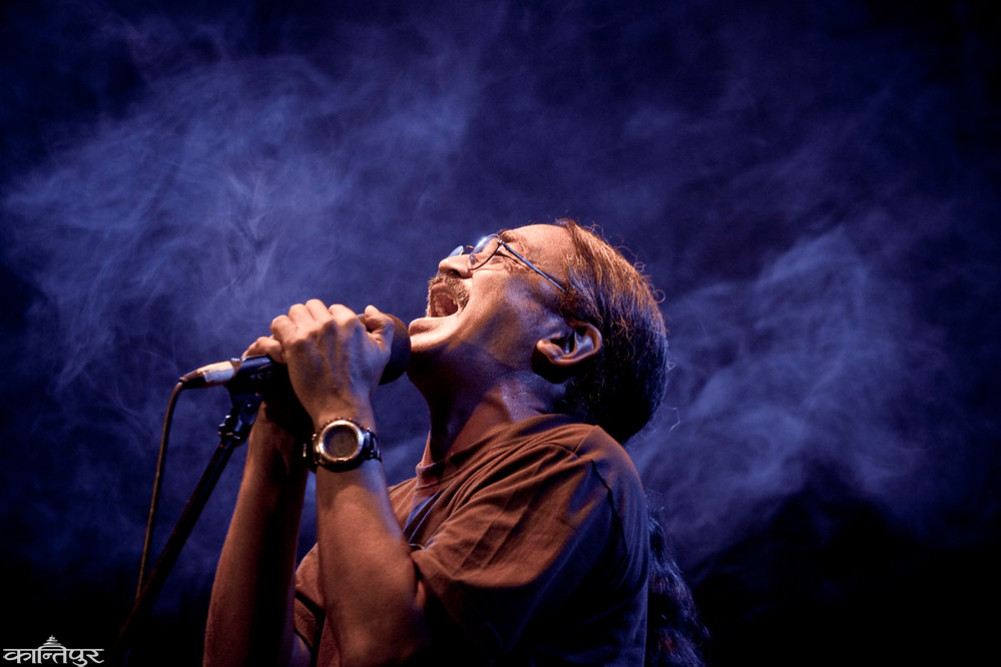
'Nepathya'-singer Amrit Gurung goes to the rivers, measures the hills, plunges into the depths of the forest, laughs with the mountains, gets entangled in the sound of the birds, smells the scent of the soil, climbs the mountains looking for songs, gets lost looking at the plains of the plains, cries somewhere - laughs somewhere. Finally, Amrit comes and pours in concerts.
We use Google Cloud Translation Services. Google requires we provide the following disclaimer relating to use of this service:
This service may contain translations powered by Google. Google disclaims all warranties related to the translations, expressed or implied, including any warranties of accuracy, reliability, and any implied warranties of merchantability, fitness for a particular purpose, and noninfringement.
Kathmandu Valley is covered with dust and smoke No matter where you go, you are never left with a pile of garbageNo need to sit in the window and throw garbageYes, no littering
Nepathya band's famous song 'Chhekyo Chhekyo Deurali Danda Hussu and Kuhirole' was sung by us in Tarapunj School in Tahachal, Kathmandu in association with dirt. When I was going to school in Tahachal from Kalimati, people used to throw garbage from the window in the street. Kathmandu has been ruined for a long time. Now, all the cities of the country are competing to see how to become worse like Kathmandu. The
song was sung at the end of the last decade of the previous century, i.e. in 1998. At that time there was neither radio nor television in my camp. At the beginning of the 21st century, i.e. in 2001, when returning from the Arabian Gulf, mother brought a Panasonic radio tape recorder with two speakers.
That was the most expensive and precious item of my life. It was not only possible to listen to songs, but also to record them. In fact, it was the tape recorder that made me a radio talker. He was a friend, a parent. I listened to most of Nepathya's songs on that tape recorder, and also recorded them.
Even after 30 years in this pit, I never met its singer Amrit Gurung to talk to him. Initially, the song 'Chhekyo Chhekyo' was sung by Nepathya's Ravin Shrestha, but later Amrit became synonymous with Nepathya. One day last December I was walking aimlessly.

Sometimes I walk all day in this city, aimlessly or walking with a purpose. I find journeys with no destination more fun. It is not arbitrary, it is arbitrary. If you don't get anywhere, you shouldn't be sad, where you get to is the destination. He ate burnt corn somewhere, sat down and sat down for tea! He smelled the smell of the river bank, car fumes in the air. Made a phone call to someone, drank tea together, said 'I'll see you later', moved on.
I walked from Jawalakhel in Lalitpur to Dillibazar in Kathmandu. Nepalaya, which manages Nepathya Band, has its office at Thumko in Dillibazar. I called Bimal Acharya, book editor of Fatt Nepalaya, for tea. As I entered the building, Bimal told me 'I will meet Amrit dai first' and entered a room. He said to Amrit who was sitting looking at the desktop computer, "Brother, Ramesh Bhusal." But Amrit did not recognize him.
 Nepathya-concert at "House of Blues" in Los Angeles, Anaheim, USA (June 12, 2082)
'Chalbato Dai', added Vimal. Oh brother, I have walked that Karnali road many times and also done rafting. While reading the book, it felt like a journey,' said Amrit to Bimal after reading my book 'Chalbato : Kailash to Ganga' the previous day. The reason why Bimal met me was revealed later. I would be more than happy with my beloved singer.
You never meet a person, but you always feel like you meet them, there is no dialogue, but it feels like a special person who is always talking. Amrit is such a person for me. I didn't sit in the radio studio sweating profusely and shut the door to listen to his songs by myself. In that meeting, I remembered many songs he sang and we started to talk about nature and music even after standing for a while.

One evening after an unexpected meeting with him, I went to Nepal to watch the Palenti Sangeet in Nepal. I was confused for a while and bought the book 'Nepathya' written by Girish Giri, got Amrit correct and returned home. The book sat there for a few days. I was thinking of starting to read. For some reason, I wanted to read that book while playing songs on an old tape recorder, just like I used to read Physics, Chemistry, Biology, Geology and Ecology coursebooks, with that Panasonic humming.
The other day I found old cassettes. I found two cassettes of Nepathya. V.No. 2058's 'Silk' and 2060's 'Like Sheep's Wool...'. Both the cassettes are priced at Rs. 65 is I cleaned the dust from the tape recorder on the ground floor. I arranged to feed it with electricity. I inserted 'Resham' into the cassette tape, but the song did not play.
After Meenakshi said 'change the side, the reel might be over', I suddenly remembered - the cassette has 'Side A' and 'Side B'. My wife is also from my generation. I showed my 8-year-old daughter how we used to listen to songs like this, but she said, “You're serious!” I'm just now at the age of “40 kts ramaunla,” but my daughter is amazed by the cassette! Ah, the times did not change with the fuel called 'technology', it only sped up, in the last two decades.
song played :
The habit of loving, the opposite is the loss
doesn't go away, no matter what you do, the habit
Sometimes I turn on the tape recorder, listen to music, read a book. I am turning the pages like this, slowly. While reading the book, I felt like this - Geet in the beginning goes around looking for his parents, fetches pirti, Geet sits in the womb, he is born with great sorrow and is saved.
How many songs die prematurely and how many sadly survive. Like people, songs are happy and sad. Some songs get sick and some live for hundreds of years. A song has a specific target audience. The parents of the songs that make it meet are its singers, composers and songwriters.

In the month of January, I have just plucked the belauti tree standing in front of the room. Playing with words, my eyes keep going to the same place every now and then. I have fertilized the soil of the standing ground so that it can get nutritious food and flower itself quickly. Belauti is preparing to grow again from the cut place. House sparrows are chirping at the top.
Sometimes Jureli also comes. Some time ago, the Phapre bird also came. The song is playing but the sparrows are not interested. Does he not know the Amrit of Nepathya who sings 'chari maryo sisaiko golile'? I wonder. And again I say to myself, only people on this earth listen to songs, sing songs, sell cassettes, listen to YouTube. Other species have neither writers nor songwriters. Neither a singer nor a musician. No band, no guitarist.
Birds make different sounds and so do other species. But, that's all, they can't make things like a human, they don't record in the studio, they don't learn surtal, they don't fill music, they don't perform concerts on stage. Neither the host nor the audience. No other species has the same vocal diversity as humans. All the cuckoos of the same species have the same voice, but even if humans are the same species, billions of billions of humans have the same voice. Man has really got a lot of things, but even after getting the most, eating a lot, he is the most sad, why? I ask again. "Side A" is finished on the 
cassette, I press the button of the tape recorder to listen to the song of "Side B". I've been hearing two wheels alternating from time to time. You also have old cassettes and if you have a cassette-player that plays, take them out and catch them! If not, remember the old days. If you are a little later than me Gen-G or Gen-Alpha generation, sorry for not being able to experience this! You don't have to worry about returning the cassette, now you can have fun with the video by putting the song on the playlist. Lucky you!
song played :
Sa Jouka Bari, Gounka Phula Company
Sa Phool Bandi Jaya Bainai Company
Jhalkaideu Jhalkaideu Galaiko Mala Company
...
In the last half of February, I am going to Pokhara, where he was born, putting the book 'Nepathya' in my bag. In the morning, when I arrived at the airport in Xismise, after talking to me for seven hours, he told me that the ship would not fly, and Buddha went to meditate. I left the boarding pass of the ship in Goji and reached Pokhara in the middle of the night by car. Wearing the pillow of the boarding pass, I limped the body shaken by the turbulence of the turbulent road to the lakeside of Pokhara, hoping to see the mountains in the morning.
Hundreds of people by the lake are gossiping about literature or something like that. People are drifting in boats on the lake, taking pictures. Trees are standing, birds are chirping. The Machhapuchhre, Dhaulagiri and Annapurna glaciers are covered with snow as the bones are covered with flesh. It seems that Fishtail is wearing a snowy t-shirt while others around him are wearing jackets.

It takes one and a half hours to reach the lovely hut where Amrit practices Sadhana from this lake, but I don't want to go, I just want to remember. He's been touring Australian cities in concert so why not go to his barn? Maybe the barn cats were waiting, but I didn't want to see that waiting.
I am around the mountains played by Amrit, the lake where he swam! He said in the book "Nepathya" - In his time, the young people in the village used to say, either shop or Japan! I'm laughing at the memory. What is Amrit doing now if he went to Japan? If you had opened a shop, how would Amrit, who is now selling goods in a grocery or clothing shop, look like? Amrut is fine now, at least I can hear the song, I smile.
After drifting in a boat for a while in Fewatal, I have reached the lake. I am looking at the mountains beyond. The sun is melting the asphalt snow and turning it into steam. The same mountain, where that cloud fell as snow and stayed there for a while, is flying and tearing it. It is not a matter of time. The rain that fell as snow yesterday flew away in the morning and became clouds, and later it will become snow and fall again like a man. Someone came yesterday, someone is there today and someone will come again tomorrow. All will speed up for a while and return to soil as manure for someone else. Everything on earth is moving and even life is moving - through birth, transition and death.
In the shade of the surrounding trees, in the water of the lake, in the standing white mountains, in the flying clouds - it is reflected in Nepathya's heart and songs. After all, man lives on the same water, soil, air, clouds, trees, plants, but he thinks that he is alive by breathing through his lungs. A man is delusional, but if he says so, he gets angry.
Underestimate the modern man? He flinches. A person who sails a ship, sets off a bomb, drives a car, or launches a rocket is oppressed by the weight of his ego, yet he says - only humans must live on this earth, and our government must run.
The water of the lake will be mined by fish
Will it go with Pirims or not!
A wild bird dancing on a branch is a hawk in the sky
Jugaun goto Pirim Vako Bala met today
In the song of 'Nepathya' many dimensions of nature did not come just like that, Amrit brings them searchingly. He listens to the song sung by man and also listens to the sound of nature that gives birth to that song. He told me in the first meeting, while walking up to the mountain, a man who was walking with a song on the speaker asked him to take a photo.
While taking photos, Amrit said, "Birds are singing such beautiful songs, trees are swaying, why are you walking around singing loud songs?" Here you can even hear birds and trees.' He added, 'I walk with both ears and eyes open. Be it the roar of the city or the roar of the river. Be it the chirping of a bird or the needle of a tree.'

They go to the arrows of the Amrit river to find a child in the form of a song, they measure the heights of the mountains. They sink into the depths of the forest, laugh with the mountains. They get caught up in the sound of birds, they smell the scent of the soil. He communicates with those who are enjoying life and waiting for death.
Sometimes Thinle of Dolpa meets and sometimes Dille of Sankhuwasabha. They climb the mountains looking for songs, they wander over the plains. Sometimes they cry, sometimes they laugh. In this way, the nectar that has progressed comes to the concerts and pours out. He has great respect for three things – music, literature and nature. I am now thinking about music, listening to literature and enjoying nature, in the village of Amrit.
I don't have a tape recorder across Fewatal, otherwise I would have caught it to change the side of the cassette. However, there is a song in my memory, which I am humming while looking at Dhaulashiri Himal –
Shiraphool Shiraima, Vanfool Vanaima
Snow Flower Dhaulashirima
...
The ship flew up challenging the white mountain. The mountains passed through Hocha. The river deepened. The Seti River, which has flowed down from the mountains after melting them, is flowing towards Nagbeli and heading south. The hills, washed by the previous day's rain, look lush and clean. I am remembering or singing the same song of 'Nepathya' -
When you look at it, it keeps on flickering The river fell from the mountain. I didn't see what love is. To meet the concrete jungle before the ship, where my body lives, where is my mind! While looking at the mountains from the ship, I am reminded of the mountain trek that I walked amidst tension after the terrible meeting with Amrit's beloved singer Arun Thapa.

Arun, trapped in drugs, is spending the last time of his life. One day Amrit reaches the hotel where Arun is staying in Baghbazar. Arun trying to stick a needle in his hand is not able to. “Bhai help me”, requests Arun. Amrit takes pity and goes to help. However, Arun's hand shakes and the needle is buried in Amrit's hand, blood comes out. HIV infected, Arun.
Amrit knew that, but his compassion probably did not think about the virus. Amrit is shocked when his hand bleeds and panics as he thinks it is a virus. Arun says 'okay brother' while shouting 'what have you done?' But what does that mean! The needle has gone, the blood has come! Amrit returns to Fanak and goes to Teku Hospital for an HIV test, but the report is said to take 42 days.
He is newly married and goes to the mountains for a few weeks, the same mountains that I am looking at. Fear of death does not diminish his respect for Arun. On the way, he hears the news of Arun's death on the radio and gets sad. A few weeks later he returns to Kathmandu. His report comes 'Negative'. Amrit takes a long breath in this city where Arun has stopped breathing.
The effect of Arun's singing ability is deeply rooted in Amrit, but the way Arun perfects himself, Amrit's mind is restless. Amrit says, 'Arun dai was sad, but when he sat on the stage, the stage would shine brightly. Especially Arun was the spring of singing like the spring of the seasons, his life was as hard as dew.'
...
The last week of March! The leaves on the roof of the house are definitely falling, happy in the heart. Nepathya has returned from Australia and is preparing to settle in Gokarneshwar, north of Kathmandu, on the banks of the Bagmati. I am planning to see Nepathya's concert for the first time. Full moon evening. The sun set, June rose. The clock on the stage showed the time, 6 o'clock.
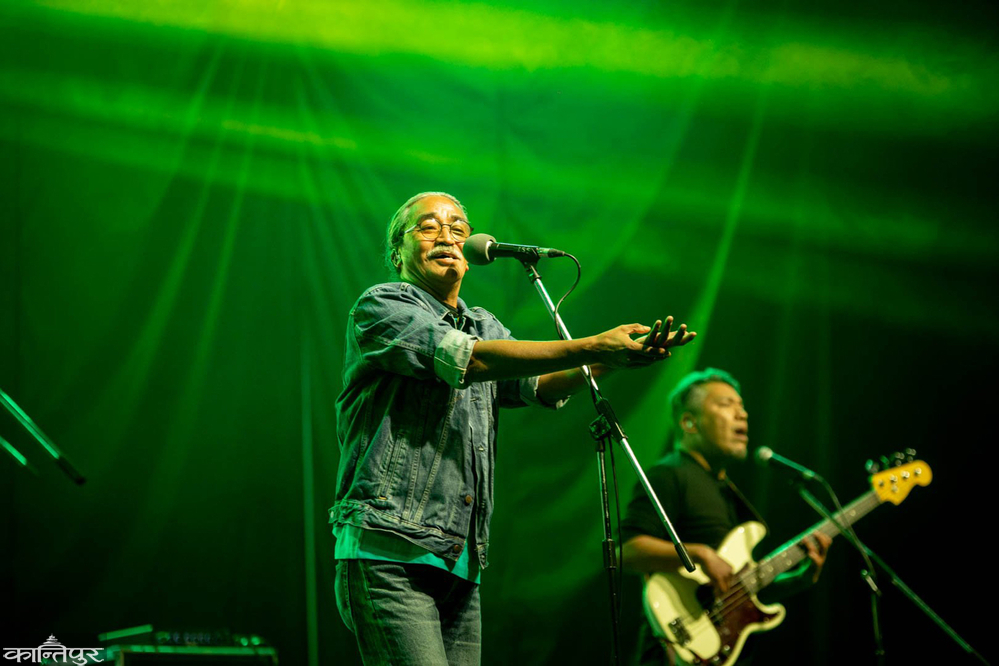
Seven thousand people have gathered. As the evening slowly deepened, Amrit sang a song. Looking at the audience's thousands of mobile phones and above, it seemed that every person has a mobile phone, just like there is a phone on earth. People are shooting 'Nepathya' with mobile June, swaying to the song, making the June above pale. Looking at Purne's June, Amrit said, 'May the coming new year be good to everyone. Let's go see this beautiful country anyway. Let's protect the nose given by nature. Keep speaking this Nepali language. Let's stay together as long as this red moon-sun remains.'
I am remembering watching this magnificent concert - the context of the 'Nepathya' concert in Bhairahawa, where the organizer ran away after the program was over. Chasing those organizers, the Amrits run on the streets shouting obscenities, saying 'Samat Samat' and finally return to Kathmandu empty-handed. The same 'Nepathya' is singing confidently in organized and grand concerts today, among thousands. The clock struck eight, the concert was over, and the audience went wild. However, the organizer did not run away.
...
In 2013 Nepathya became the first Nepali band to sing at Wembley Stadium in London. When this article was started, it was 'Nepathya' towards Australia, and it is going to America when the article is printed. I can't help but say whether the complaint that 'Nepathya' brought less new songs after running so much in the concert is from his well-wishers or mine. Again, I did not miss to say that it is not bad for Nepali bands to spread all over the world like this.
You can also call me Dodhare or Dahichiure. Artists can surely create if they have enough money to live on. Many capable members of "Nepathya" fled abroad because of that - some Hong Kong, some Japan! At some point Amrit was also thinking of quitting music. "That's why the concert is going on like that, but new songs are also coming. Hey Amrit Dai!"
A book should have been written about a band like this. Though the book is written by Girish Giri, Amrit is co-writer. Somewhere the boat is struggling to cross the waves of Nepathya river, somewhere it is swimming calmly. There are a series of disagreements, fights and breakups between the band members. Somewhere it is buried in the rock, somewhere it is calm - Nepathya. However, he did not stop flowing.
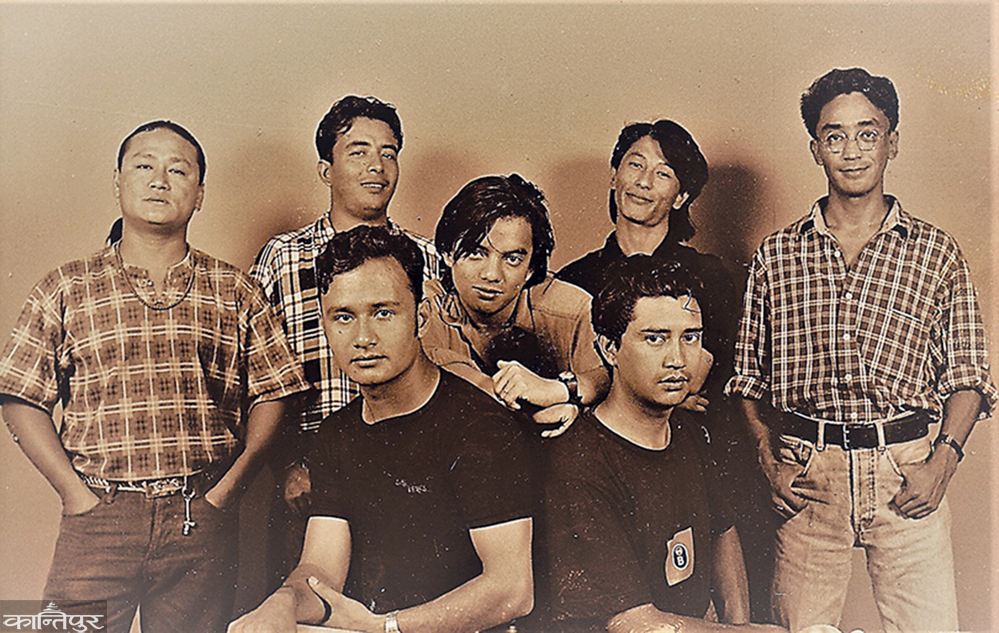
There is Deepakjung Rana who takes cover when the boat falls into the waves but he is not in the band. Bhima Pun, who founded 'Nepathya', is not there either. Opening singer Ravin Shrestha also joined at the end. 'Nepathya' breaks up again and again, like the Communist Party of Nepal, but 'Nepathya' does not die because it grows again by watering it with nectar and fertiliser.
...
In the last week of Baisakh, a few days before the team of 'Nepathya' left for America, while watching the video of a new song in 'Nepalay', I met Amrit again briefly. He calls me 'Chalbato'. His new song is also from Karnali - 'Karnalika Chaila' means 'shadow'. After watching that video, I am again sitting on the same balcony listening to the song on cassette to write this article. The leaves of Belauti are definitely gone. Just bloomed, will bloom in a while. "Nepathya" is also broken several times and joined again and again.
has been cut and respawned several times. It has fallen down many times and risen again, just as a cut down birch tree turns green again and blooms with white flowers. Belauti was fertilized by me and 'Nepathya' by his loving audience.
As a new experiment, 'Nepathya' has made the video of the song available for some time by paying money. I couldn't wait a week or two to watch it for free, so I paid Rs 20 and bought the video and watched it over and over again. I mixed the shade of 'Nepathya' on my body which was wet with the waves of Karnali. On one hand, a song is playing on a cassette player, on the other hand, a video is playing on a laptop and a 'Nepathya' book is in hand. I wanted to shout, 'Nepathyale geet gairhos haeeeeee amrit dai,' the way he would sing at concerts. Other things may be in the barn, for now, "Karnali's skin is haiiiiii"!
Jiu Kati Jiunarai Layan, still not believing
Pirti broke without speaking, still not believing
Karnali's skin, Karnali's skin is skin